
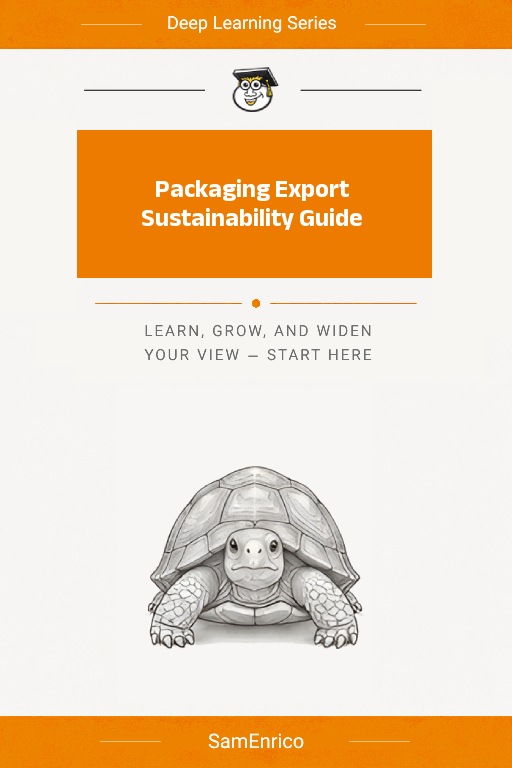
Non-FictionBusiness BriefPackaging Compliance
Packaging Export Sustainability Guide eBook
Covers FSC, recyclability claims, compostable cert
by Britton Lyda
Covers FSC, recyclability claims, compostable certification, and How2Recycle labeling for exported packaging materials.
Formats
Free sample
Chapter 1: The $400,000 Mistake--–- The集装箱 sat in Hamburg port for seventeen days. Inside, 20,000 bags of single-origin Colombian coffee, each bag bearing an FSC-certified label and a cheerful green "compostable" logo. The exporter had spent $40,000 on sustainable packaging – FSC-certified paper, plant-based inks, compostable bioplastic liners. They had done everything right. Or so they believed.The German customs officer who detained the shipment was polite but firm.
"Your packaging claims 'compostable' but does not specify the certification standard. Under German packaging law, without TÜV OK Compost or Seedling logo verification, this is considered misleading. Additionally, your FSC Chain of Custody documentation is incomplete – the transaction verification numbers do not match the batch codes." The exporter's representative protested: "But we have FSC certification! Our supplier gave us the certificate!" The officer shook his head. "The certificate is expired.
And even if it weren't, you cannot prove this specific shipment's fiber originated in certified forests. The Chain of Custody is broken."The financial damage: 400,000inseizedgoods,400,000 in seized goods, 400,000inseizedgoods,85,000 in storage fees, 120,000incontractpenaltiesfromthe Germanbuyerwhoneededthatcoffeefortheirprivate−labelholidayblend.Totalloss:over120,000 in contract penalties from the German buyer who needed that coffee for their private-label holiday blend. Total loss: over 120,000incontractpenaltiesfromthe Germanbuyerwhoneededthatcoffeefortheirprivate−labelholidayblend.Totalloss:over600,000. All because of packaging labels.This is not an isolated incident. In 2024 alone, EU customs authorities detained over 3,200 shipments valued at more than €450 million due to non-compliant packaging claims.
France's DGCCRF (Directorate General for Competition, Consumer Affairs and Fraud Control) issued €78 million in fines for greenwashing violations. The UK's Environment Agency opened 1,400 investigations into false recyclability claims. And the US FTC, while less aggressive in enforcement, has signaled that 2025 will bring a wave of new actions under its updated Green Guides.The era of casual sustainability claims is over.The New Reality: Sustainability as a Technical Barrier to Trade For most of packaging history, environmental claims were marketing niceties – feel-good additions to a box that consumers might appreciate but rarely scrutinized. An exporter could slap a chasing arrows symbol on a corrugated carton, call it "recyclable," and never face consequences. Customs officials cared about tariffs, phytosanitary certificates, and country-of-origin labels.
They did not care about your FSC certification or your compostability claims.That world has ended.Today, sustainability credentials function as Technical Barriers to Trade (TBTs) – legally enforceable requirements that can stop shipments at borders, trigger fines, and destroy customer relationships. The World Trade Organization recognizes TBTs as legitimate non-tariff barriers when they protect environmental objectives. And major economies have enthusiastically embraced this authority.Consider the mechanics: When an exporter ships packaged goods to Germany, that packaging must comply with Verpack G (Packaging Act). Verpack G requires registration in the LUCID database, payment of license fees based on material weight, and accurate labeling of recyclability. Fail any of these requirements, and German customs can reject the entire shipment – not just the packaging, but the products inside.When an exporter ships to France, the AGEC law (Anti-Waste for a Circular Economy) imposes additional requirements: compostable packaging must display specific French-language warnings ("Ne pas jeter sur la voie publique"), recyclability claims must be accompanied by sorting instructions, and EPR (Extended Producer Responsibility) registration must be renewed annually.When an exporter ships to the United Kingdom, the Plastic Packaging Tax imposes a £210 per tonne penalty on plastic packaging with less than 30% recycled content.
Certification of recycled content must be provided through recognized schemes like EN 15343 or equivalent. Without proper documentation, HMRC will assume the packaging is non-compliant and issue a tax bill – plus penalties.These are not suggestions. They are legal requirements backed by detention authority, fines, and in extreme cases, criminal prosecution.The Three Pillars of Export Compliance Through analysis of over 200 packaging-related shipment detentions and regulatory enforcement actions, this book has identified three critical domains where exporters most frequently fail. Master these three pillars, and you eliminate 90% of compliance risk.Pillar One: Forest Stewardship Council (FSC) Certification for Fiber-Based Packaging Paper and cardboard account for approximately 40% of all packaging materials exported globally. For these materials, FSC certification has become the de facto standard for demonstrating sustainable sourcing.
However, FSC is not a single label – it is a family of certifications with different meanings, requirements, and legal implications.The three FSC labels – FSC 100%, FSC Mix, and FSC Recycled – each carry distinct Chain of Custody requirements. Exporters who fail to understand these distinctions risk precisely the situation that befell our Colombian coffee exporter: an expired certificate, a broken chain, and a seized shipment.Chapter 4 of this book provides the complete deep dive into FSC certification. But the essential principle is this: FSC certification is not a one-time achievement. It is a continuous process of documentation, verification, and renewal. Your supplier's certificate does not certify your packaging.
You must maintain your own Chain of Custody, track transaction verification numbers, and ensure every invoice and packing list carries the correct claim code.Pillar Two: Compostable Certifications for Biowaste Systems The word "compostable" has become one of the most dangerous claims in international trade. Why dangerous? Because most consumers – and many exporters – do not understand the distinction between industrial composting, home composting, and simply biodegrading in a landfill. These are entirely different processes with entirely different certification requirements.In the EU, industrial composting requires temperatures of 58°C and controlled humidity – conditions found only in specialized facilities. Packaging certified to EN 13432 (the Seedling logo) is designed for these facilities.
But send that same packaging to a country without industrial composting infrastructure – most of Southeast Asia, Africa, and South America – and it will behave exactly like conventional plastic. It will persist in the environment for years, potentially decades.The EU has banned the term "biodegradable" on most packaging unless accompanied by specific, verified timeframes and environmental conditions. Oxo-degradable plastics – materials containing additives designed to fragment into microplastics – are prohibited entirely in the EU and under consideration for bans in Canada, Kenya, and other nations.Exporters who wish to make compostability claims must navigate a maze of certifications: TÜV OK Compost (recognized across the EU), BPI (valid primarily in North America), Seedling (EU-wide), and Green Pla (Japan). Each certification carries different testing requirements, different labeling rules, and different legal standing in different markets.Chapter 6 and Chapter 7 of this book provide the complete guide to compostability claims. But the essential principle is this: never claim "compostable" without specifying the certification standard and the environment (industrial compost, home compost, or neither).Pillar Three: How2Recycle and Recyclability Claims for Circular Economy The chasing arrows symbol – three arrows forming a triangle – is one of the most recognized symbols in the world.
It is also one of the most frequently misused. In the United States, the FTC Green Guides explicitly state that using the chasing arrows symbol without qualification implies that the packaging is recyclable in most communities. If it is not, the claim is deceptive.How2Recycle was created to solve this problem by providing standardized, specific labels that tell consumers exactly what to do: "Store Drop-off" for plastic films, "Widely Recycled" for materials accepted by 60% or more of US recyclers, and "Check Locally" for ambiguous cases.But How2Recycle was designed for the North American market. Its labels have no legal standing in the EU, where the Green Dot and Tidyman symbols serve different purposes.…
This is the end of the free sample. Get the eBook to keep going. Buy now
About this book
Details
- Author
- Britton Lyda
- Publisher
- SamEnrico
- Language
- English
- Genre
- Non-Fiction, Business Brief, Packaging Compliance
- Released
- 2026-06-01
- Pages (approx.)
- 150
- Available as
- eBook, Audiobook

Read better in the ZLOADR app
Your eBooks on your phone or tablet. Sign in with your SamEnrico account and start reading.
More by Britton Lyda
 Bipolar Treatment Resistance GuideBritton Lyda$11.99
 Adolescent Alcohol DetoxBritton Lyda$11.99
 OT/ICS Security Year ReviewBritton Lyda$11.99
 Networking Imposter SyndromeBritton Lyda$11.99
 The Binge Eating Triggers LogBritton Lyda$11.99
 The Great Pacific Puzzle: How a Schoolgirl Mapped the Ocean FloorBritton Lyda$11.99
 Understanding Primary AgammaglobulinemiaBritton Lyda$17.99
 Cone and Barricade Placement (Mutcd)Britton Lyda$11.99
 GA4 Roll Up Property GuideBritton Lyda$12.99
 How to Become a Compositor ApprenticeBritton Lyda$11.99
You may also like
 Hong Kong Handover 1997Dunn Johnnie$11.99
 Zumba For Postnatal Recovery CourseNeal Christian$11.99
 Zumba for BeginnersLadner Nikia$11.99
 YouTube Comment Mining GuideHumes Pandora$12.99
 Worry Box MeditationCarlin Rudy$11.99
 Workplace Stress MeditationNguyen Lynn$11.99
 Workplace Stress and Sleep RepairHawley Ivory$11.99
 Workplace Perfectionism CureDelaney Jeffry$11.99
 Workplace Injustice Anger GuideWallen Isabelle$11.99
 Work Addiction and Burnout LinkGreenwood Ester$11.99
 Women in Yoga and WellnessBeattie Galina$11.99
 Women in Stand Up ComedyChun Evangeline$11.99