
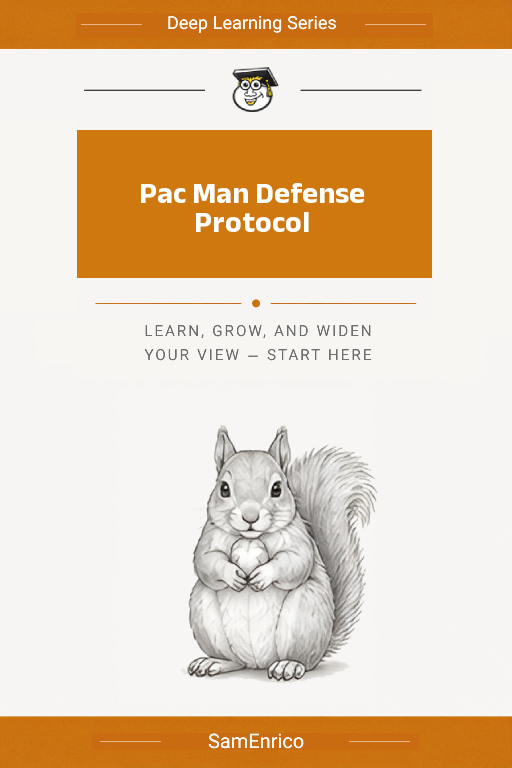
Pac Man Defense Protocol eBook
Turn tables and attempt hostile takeover of the ac
Turn tables and attempt hostile takeover of the acquirer, forcing them to defend.
Formats
Free sample
Chapter 1: The Power Pellet...--The overnight Fed Ex envelope sat on the mahogany conference table like a grenade with the pin already pulled. Seven board members, three lawyers, and two investment bankers stared at it. No one touched it. The CEO, a sixty-two-year-old veteran of three recessions and two hostile bids that never materialized, finally reached out with a steady hand. He sliced the seal with his index finger.
Inside was a single sheet of paper—no cover letter, no pleasantries, no offer to "explore a mutually beneficial combination." Just a paragraph announcing that Acquisitions Corp. had filed a Schedule 13D with the SEC disclosing 7.2 percent ownership and stating its intention to "seek control through a tender offer at $52 per share."The room went silent. The company's stock closed at $38 the day before. The premium was 37 percent. By any conventional metric, it was a generous offer.
By any conventional board, it would have triggered a polite negotiation, a special committee, and eventually a sale. But this board had read the history books. They knew that "generous" offers were often opening salvos, not final bids. They knew that accepting the first offer was the fastest way to leave money on the table. And they knew something else—something that separated them from the ninety-nine percent of targets that simply rolled over.They had a plan.
Not a plan to defend. A plan to eat.The Power Pellet Moment is the instant a target board decides to stop running and start hunting. It is the psychological switch from victim to predator, from object to agent, from the company being acquired to the company doing the acquiring. This chapter is about that moment—what triggers it, why most boards miss it, and how to recognize it when it arrives. The rest of this book is about what comes after.
But without the Power Pellet Moment, the rest is irrelevant.The Hunter and the Hunted: A Video Game Lesson in Corporate Strategy In 1980, a Japanese arcade game manufacturer named Namco released a maze-chase game called Puck-Man. When it was licensed to Bally/Midway for North American distribution, they changed the name to Pac-Man—fearing that vandals would scratch out the "P" to make an obscenity. The game was simple. The player controlled a yellow circle with a mouth. Four ghosts—Blinky, Pinky, Inky, and Clyde—chased Pac-Man through a blue maze.
If a ghost touched Pac-Man, the player lost a life. The only strategy was to run and avoid.But there was a twist. Scattered throughout the maze were four large dots called power pellets. When Pac-Man ate a power pellet, the ghosts turned blue. The music changed.
For a few precious seconds, the hunter became the hunted. Pac-Man could eat the ghosts, sending them back to the center of the maze in a twitching pile of eyeballs. The tables had turned.This is the exact psychology of the Pac-Man Defense. The target company—Pac-Man—is being chased by a predator—the ghosts. Conventional defenses are just running faster, hiding in corners, or hoping the ghosts get bored.
The Pac-Man Defense is the power pellet. It transforms the dynamic entirely. The target stops running and launches a reverse tender offer for the predator's stock. Suddenly, the predator's shareholders are looking at their own board and asking: "Why are you letting our company be eaten?"The metaphor is not just colorful. It is operationally precise.
Just as Pac-Man has only a few seconds to eat the ghosts before they turn dangerous again, a target has a narrow window to launch its counter-bid before the predator consolidates its position. Just as Pac-Man cannot eat the ghosts without the power pellet, a target cannot launch a Pac-Man defense without a war chest. Just as the ghosts respawn in the center of the maze, a defeated predator may return with a higher bid. The game mechanics of an arcade game from 1980 map almost perfectly onto the mechanics of corporate takeover warfare forty years later.Bruce Wasserstein, the legendary investment banker who advised Martin Marietta during its 1982 battle with Bendix, was the first to articulate this analogy in a strategy memo. Wasserstein, who would later be called the "father of modern M&A," wrote: "We need to stop thinking like prey.
We need to eat them before they eat us." The memo circulated on Wall Street. The term "Pac-Man Defense" stuck. By the end of the decade, it was standard vocabulary in every boardroom that had ever faced a hostile bid.But here is the irony that Wasserstein himself would come to appreciate: the term was coined by an advisor to a target, but it was soon used by predators to describe their worst nightmare. The Pac-Man Defense is not a tactic for the weak. It is a tactic for the bold.
And it requires a board that understands the difference between fighting to survive and fighting to win.Why Your Board Is Programmed to Lose The human brain is not wired for hostile takeovers. It is wired for a savanna where threats were predators with teeth and the correct response was either flight or freeze. Fight was reserved for situations where escape was impossible. This evolutionary legacy explains why most boards, when confronted with a hostile bid, default to three predictable responses: find a white knight (flight), activate a poison pill (freeze), or negotiate a sale (surrender). Each of these responses is rational in isolation.
Each is catastrophically wrong in the context of a Pac-Man opportunity.Consider the white knight. A white knight is a friendly acquirer invited to outbid the predator. On paper, this is appealing. The target finds a buyer who will pay a higher price and preserve management jobs. But white knights are not philanthropists.
They are opportunists. They know the target is under duress. They know the predator has already done the valuation work. They know the board is desperate. A white knight's first bid is rarely its best bid.
And because the target has signaled weakness by seeking a savior, the white knight has every incentive to lowball. The historical data is damning: white knight acquisitions close at an average premium of only 12 percent above the predator's initial offer, compared to 28 percent when the target fights back first.Then there is the poison pill. The shareholder rights plan, invented by lawyer Martin Lipton in 1982, is the most common defensive tactic in corporate America. It works by issuing rights to existing shareholders that become exercisable when any single shareholder crosses a threshold (typically 15-20 percent). The rights allow shareholders to buy additional shares at a discount, diluting the predator's stake.
A poison pill makes a hostile takeover expensive. But it does not make it impossible. A determined predator with deep pockets can simply wait. Or litigate. Or launch a proxy fight to redeem the pill.
The poison pill buys time. It does not buy victory. And time is the one thing a target under siege does not have.Staggered boards—where only one-third of directors stand for election each year—are similarly delaying tactics. A staggered board can force a predator to wait two years to gain control of the board. But two years is not a…
This is the end of the free sample. Get the eBook to keep going. Buy now
About this book
Details
- Author
- Mcclellan Kermit
- Publisher
- SamEnrico
- Language
- English
- Genre
- Non-Fiction, Crisis Management
- Released
- 2026-06-01
- Pages (approx.)
- 136
- Available as
- eBook, Audiobook

Read better in the ZLOADR app
Your eBooks on your phone or tablet. Sign in with your SamEnrico account and start reading.
More by Mcclellan Kermit
 Fiverr Buyer Persona GuideMcclellan Kermit$11.99
 Hawking Zero Gravity FlightMcclellan Kermit$11.99
 Twelve Step for Compulsive ExerciseMcclellan Kermit$11.99
 Anticipatory Grief and LegacyMcclellan Kermit$11.99
 Remote HR Communication GuideMcclellan Kermit$11.99
 The Navy Sailor OverdoseMcclellan Kermit$11.99
 Impossible Standards ChildhoodMcclellan Kermit$11.99
 Hearst Good HousekeepingMcclellan Kermit$11.99
 Dancer Flexibility Maintenance GuideMcclellan Kermit$11.99
 The Forgotten Ecologists of Angkor: Decoding the Khmer Empire's Environmental WisdomMcclellan Kermit$11.99
 The Last Mile: Lance Armstrong's Fall from GraceMcclellan Kermit$11.99
 Steel Behemoths: The Pacific Carrier Duel That Shaped Modern Naval WarfareMcclellan Kermit$11.99
You may also like
 Hong Kong Handover 1997Dunn Johnnie$11.99
 Zumba For Postnatal Recovery CourseNeal Christian$11.99
 Zumba for BeginnersLadner Nikia$11.99
 YouTube Comment Mining GuideHumes Pandora$12.99
 Worry Box MeditationCarlin Rudy$11.99
 Workplace Stress MeditationNguyen Lynn$11.99
 Workplace Stress and Sleep RepairHawley Ivory$11.99
 Workplace Perfectionism CureDelaney Jeffry$11.99
 Workplace Injustice Anger GuideWallen Isabelle$11.99
 Work Addiction and Burnout LinkGreenwood Ester$11.99
 Women in Yoga and WellnessBeattie Galina$11.99
 Women in Stand Up ComedyChun Evangeline$11.99