
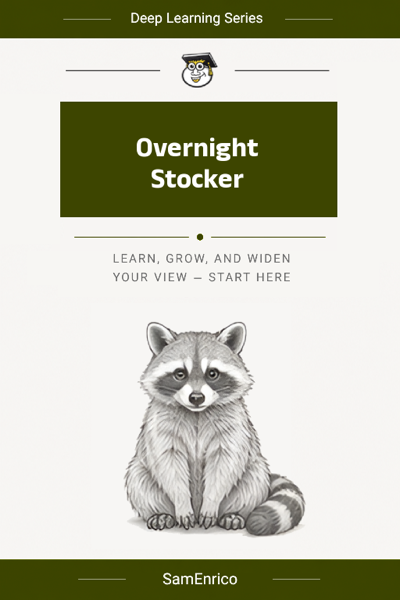
Overnight Stocker eBook
A Coursebook on Overnight Stocker
by Ladd Drema
A Coursebook on Overnight Stocker
Formats
Free sample
Chapter 1: The Invisible Kingdom--– The first thing you notice, standing in the receiving bay at 9:47 PM, is how loud the silence becomes once the last day-shift worker’s car has pulled out of the parking lot. The fluorescent lights hum a frequency you never heard at noon. The empty aisles stretch before you like a deserted highway. And somewhere in the back of your mind, a quiet voice asks: What am I doing here?This chapter answers that question, but not in the way you might expect. It does not apologize for overnight work.
It does not frame it as a temporary humiliation you must endure until something “better” comes along. Instead, it reframes the entire premise of the night shift—transforming it from a graveyard sentence into a strategic advantage that day workers will never understand.Welcome to the invisible kingdom. You are about to become its newest citizen.The Three Tribes of Retail Before you can master the night, you must understand where you fit in the broader ecosystem of a store. Most people outside the industry—and many inside it—lump all “stocking” jobs together. This is a costly misunderstanding.
The overnight stocker occupies a distinct territory with its own rules, rewards, and challenges. To see the difference clearly, let us map the three tribes.The Day Stocker The day stocker works while the store is fully alive. Customers weave around their carts. Managers patrol every aisle. The phone rings constantly with questions about price checks and backroom locations.
A day stocker might spend four hours on a single pallet not because they are slow, but because they are interrupted every seven minutes. Studies of retail productivity show that day stockers lose approximately 40% of their working time to customer interactions, manager check-ins, and the constant need to move equipment out of foot traffic.The day stocker’s greatest challenge is fragmentation. They cannot enter a flow state because the environment will not allow it. Every time they build momentum—every time their hands start moving with that beautiful, unconscious rhythm—a customer appears needing help finding gluten-free pasta or an employee asks about a spill in aisle four. The day stocker is a public servant first and a logistician second.The Receiver The receiver works in the backroom, often on a completely different schedule from the sales floor.
They are the guardians of the loading dock, the gatekeepers of inventory. When a truck arrives at 2:00 PM, the receiver checks the manifest, counts the pallets, signs the paperwork, and directs drivers to the correct bay. Receivers rarely touch the sales floor. Their world is concrete floors, pallet jacks, and the constant puzzle of where to store the overstock that will not fit on the shelves.The receiver’s greatest challenge is space. Every retail backroom is too small.
That is a universal truth. The receiver must become a master of three-dimensional chess, stacking pallets in the steel racking, squeezing rocket carts into corners, and somehow leaving a clear path to the baler and the break room. A good receiver is worth their weight in shrink reduction. A bad receiver creates chaos that the night crew will discover at 10:00 PM when they cannot find the pet food pallet.The Overnight Stocker And then there is you.The overnight stocker works during the hours when the store is either completely closed or reduced to a trickle of late-night customers. Your primary interaction is with product, not people.
Your primary metric is cases per hour, not smiles per customer. You are not a public servant during these hours—you are a logistics operator executing a precise plan developed by people who never see the store in darkness.The overnight stocker’s greatest challenge is biological. The work itself is straightforward. The human body’s resistance to working while the world sleeps is not. Your body will fight you for the first three weeks.
It will demand sleep at 2:00 PM, a time when day workers are in their afternoon slump. It will send hunger signals at odd hours. It will try to convince you that the 4:00 AM wall—that famous moment when exhaustion crashes over you like a wave—is a sign that you cannot do this job.You can. Millions of overnight workers have proven it. The trick is learning to work with your biology instead of against it, a topic we will cover extensively in Chapter 2.The Invisible Operator Here is a truth that no orientation video will tell you: when a customer walks into a store at 8:01 AM and sees fully stocked shelves, facing perfectly aligned, every product in its correct home, they do not think about who made that happen.
They do not marvel at the logistics. They do not thank the night crew. They simply reach for what they need and proceed to the register.This is not ingratitude. It is the highest compliment the system can pay you.Think about the infrastructure that supports your daily life. You turn on a faucet and water comes out.
You do not thank the pipefitters who laid the mains, the engineers who designed the pressure system, or the night crews who repair leaks at 3:00 AM when no one is using the water. You simply take the water for granted because the system works perfectly.You are the pipefitter of retail. Your success is measured by your absence from the customer’s awareness. When you do your job perfectly, no one notices. When you fail—when a shelf is empty, when a product is in the wrong spot, when cardboard litters the floor—everyone notices immediately.
This asymmetry can feel unfair until you recognize it for what it is: power.The invisible operator controls the customer’s experience without the customer ever knowing your name. That is not invisibility. That is influence without accountability, which is a kind of freedom that day shift workers will never possess.The Psychology of Solitude Most new overnight stockers list “loneliness” as their biggest fear before starting the job. They imagine eight hours of isolation, no one to talk to, no social connection, the clock crawling toward morning like a wounded animal. This fear is understandable but misinformed.
Solitude and loneliness are not the same thing.Loneliness is the pain of disconnection. Solitude is the pleasure of uninterrupted focus. Night shift offers solitude in abundance, but loneliness only arrives if you mistake the former for the latter.Consider the research on flow states. Psychologist Mihaly Csikszentmihalyi spent decades studying the conditions under which people become completely absorbed in their work. The key ingredients are clear goals, immediate feedback, and a challenge that matches your skill level.
Stocking shelves provides all three. The goal is an empty pallet. The feedback is visual—the shelf fills, the cart empties. The challenge is speed, accuracy, and efficiency.When you enter flow, time distorts. Two hours pass like twenty minutes.
Your hands move independently of your conscious thought. The chatter in your mind—the anxieties about money, relationships, the future—fades into background static. You are not lonely in this state. You are fully present in a way that day workers, constantly interrupted by customers and managers, rarely achieve.The night…
This is the end of the free sample. Get the eBook to keep going. Buy now
About this book
Details
- Author
- Ladd Drema
- Publisher
- SamEnrico
- Language
- English
- Genre
- Non-Fiction, Informative, Educational
- Released
- 2026-05-06
- Pages (approx.)
- 133
- Available as
- eBook, Audiobook

Read better in the ZLOADR app
Your eBooks on your phone or tablet. Sign in with your SamEnrico account and start reading.
More by Ladd Drema
 Divorce Loneliness Recovery GuideLadd Drema$11.99
 Cross Border LBO GuideLadd Drema$11.99
 Bariatric Surgery Fiber Supplementation GuideLadd Drema$11.99
 Screen Time Family Contract WorkbookLadd Drema$11.99
 Lactose Free Supplement GuideLadd Drema$11.99
 The Silent Revolution: How a Teenage Hacker Toppled a DictatorLadd Drema$11.99
 The Last Oracle of Delphi: A Voice Between WorldsLadd Drema$11.99
 How to Start a Poster Advertising Business (Beginners Guide)Ladd Drema$11.99
 Proposal Risk Assessment GuideLadd Drema$12.99
 AI Financial Data Literacy GuideLadd Drema$12.99AI Financial Data Literacy GuideLadd Drema$12.99
 Understanding Celiac Disease Epilepsy Occipital CalcificationsLadd Drema$17.99