
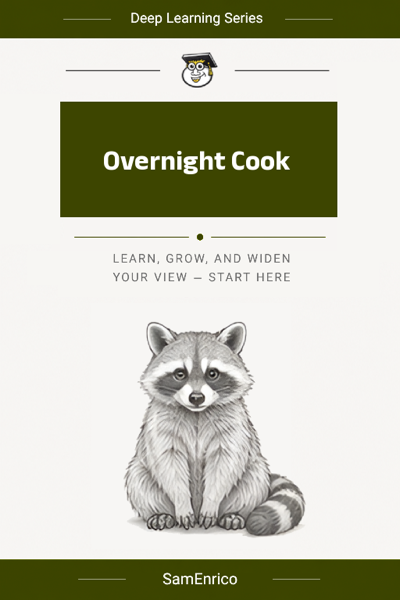
Non-FictionInformativeEducational
Overnight Cook eBook
A Coursebook on Overnight Cook
by Lara Caitlin
A Coursebook on Overnight Cook
Formats
Free sample
Chapter 1: While You Dreamed--The most expensive ingredient in your kitchen isn't saffron, vanilla beans, or dry-aged steak. It is attention. Every minute you spend standing over a bubbling pot, stirring, checking, adjusting, and waiting is a minute you cannot spend anywhere else. For years, the cooking industry has sold you the fantasy of the "thirty-minute meal" as liberation, but thirty minutes of frantic chopping, searing, and deglazing is still thirty minutes of your life—usually at 6 PM, when your patience is already frayed, your children are asking for homework help, and your email inbox has metastasized into something requiring professional intervention.This book is built on a different proposition. What if the most important cooking you do happens while you are horizontal, unconscious, and drooling slightly on your pillow?
What if the eight hours you spend sleeping could be transformed from dead time into the most active, productive cooking hours of your day? That is not a gimmick. It is a complete rethinking of when and how food transforms from raw ingredients into something memorable.Welcome to the philosophy of the overnight cook.The Myth of the Present Cook For the last century, home cooking has been dominated by what I call the "present cook" model. The assumption is that good food requires your physical presence: you must be there to flip, stir, taste, adjust, and plate. Cookbooks are written in the language of real-time intervention.
"Sauté until golden." "Reduce until syrupy." "Stir constantly to prevent scorching." These instructions assume you have nowhere else to be and nothing else to do.But here is the truth that the food industry does not want you to realize: most of what happens in cooking is time-dependent, not attention-dependent. A pot roast does not need you to watch it become tender. A pot of beans does not require your presence to soften. A cheesecake does not demand that you stare at it while it sets. These transformations are governed by heat, time, and chemistry.
Your attention is not the active ingredient.The overnight cook recognizes this distinction and exploits it ruthlessly. You do not need to be present for heat to do its work. You need only to set the conditions correctly—temperature, timing, layering—and then walk away. Not for thirty minutes. Not for an hour.
For the entire night.Sleep as Active Cooking Time Let me offer you a reframe that will change how you think about every meal you make from this point forward. Sleep is not a pause in your cooking. Sleep is cooking time. When you place ingredients into a slow cooker at 10 PM and set the temperature to low, the next eight hours are not downtime. They are the most productive cooking hours of your day, because they require nothing from you except the ability to remain unconscious.Consider the math.
A typical home cook spends sixty to ninety minutes per day on dinner, plus another twenty to thirty minutes on breakfast. Over the course of a year, that adds up to between three hundred and four hundred hours of active cooking time. That is the equivalent of ten full workweeks. Now consider what happens when you shift a significant portion of that cooking to overnight hours. Your active time drops to fifteen minutes of prep before bed and perhaps five minutes of finishing in the morning.
The remaining six to ten hours of cooking happen while you are doing something you would be doing anyway: sleeping.This is not efficiency hacking for its own sake. This is a reclamation of your life. The hours between 5 PM and 7 PM, when you are most tired and most needed by your family, are no longer hostage to the stove. The morning scramble, when you are rushing to get out the door, no longer includes a question mark about what you will eat. You wake to food that is already done.
That is the overnight promise.The Three Pillars of Overnight Cooking Every successful overnight dish rests on three foundational principles. Master these, and you will never produce a mushy, bland, or unsafe meal. Ignore any one of them, and you are gambling with your breakfast.Pillar One: Low-and-Slow Thermodynamics Heat transforms food in two fundamentally different ways. High heat is for searing, browning, and caramelization. It happens quickly, at temperatures above 300°F, and it creates the crust on a steak or the golden edge on a roasted vegetable.
Low heat is for breaking things down. It happens slowly, at temperatures between 170°F and 250°F, and it is responsible for turning a tough chuck roast into tender shreds, converting collagen into gelatin, and transforming raw starches into digestible, creamy carbohydrates.Overnight cooking exclusively uses low heat. This is not a limitation; it is a superpower. When you cook a pork shoulder at 190°F for ten hours, the connective tissue that makes it chewy at hour two melts into silky richness by hour eight. The same process happens with beans, grains, and even fruits.
Low heat also prevents the evaporation that plagues stovetop cooking. A pot of chili on the stove loses liquid steadily, requiring you to add more broth or water. A slow cooker loses almost nothing, because the lid traps moisture and the low temperature minimizes steam production.The critical insight is this: collagen converts to gelatin only within a specific temperature window. Below 160°F, nothing happens. Above 200°F, the meat fibers seize and dry out.
Overnight cooking keeps you in the sweet spot for hours, doing something that no stovetop method can replicate without constant supervision. You are not cooking faster. You are cooking better, using time as your primary tool.Pillar Two: Flavor Layering Without Stirring Here is a confession that most cookbook authors will not make: stirring is largely performative. Yes, you need to move food around to prevent burning on high heat. Yes, you need to incorporate ingredients when you add them.
But the idea that you must stand at the stove and stir a pot of stew for hours to develop flavor is a myth perpetuated by people who want you to feel virtuous about your time in the kitchen.Flavor develops through diffusion and heat, not agitation. When you place whole spices, aromatic vegetables, and umami-rich liquids into a slow cooker and close the lid, the heat creates convection currents that circulate flavor compounds throughout the pot. No stirring required. The compounds responsible for savory depth—glutamates in tomatoes, mushrooms, and fish sauce; sulfur compounds in garlic and onions; aromatic oils in cumin and cinnamon—migrate through the liquid over time. By morning, they have permeated every ingredient.This is why the overnight cook can use whole spices that would be harsh if added late, dried chiles that need hours to rehydrate, and tough aromatics like ginger and lemongrass that release their oils slowly.
You are not missing anything by not stirring. You are gaining everything by waiting.Pillar Three: Strategic Timing The third pillar is the one that most home cooks neglect, and it is the reason overnight cooking fails in their kitchens. Timing is not just about how many hours you set the cooker for. It is about when you add each…
This is the end of the free sample. Get the eBook to keep going. Buy now
About this book
Details
- Author
- Lara Caitlin
- Publisher
- SamEnrico
- Language
- English
- Genre
- Non-Fiction, Informative, Educational
- Released
- 2026-05-06
- Pages (approx.)
- 139
- Available as
- eBook, Audiobook

Read better in the ZLOADR app
Your eBooks on your phone or tablet. Sign in with your SamEnrico account and start reading.
More by Lara Caitlin
 The Fulfilled Overachiever GuideLara Caitlin$11.99
 FOMO Buying GuideLara Caitlin$11.99
 Tenant Resentment GuideLara Caitlin$11.99
 Caregiver Burnout for Heart Disease CareLara Caitlin$11.99
 The Quantum Alchemists: Black Pioneers Who Rewrote the Laws of MatterLara Caitlin$11.99
 How to Become a Lumber StraightenerLara Caitlin$11.99
 How to Produce Baby and Toddler Diaper CoversLara Caitlin$11.99
 UN Spouse Employment GuideLara Caitlin$12.99
You may also like
 Hong Kong Handover 1997Dunn Johnnie$11.99
 Zumba For Postnatal Recovery CourseNeal Christian$11.99
 Zumba for BeginnersLadner Nikia$11.99
 YouTube Comment Mining GuideHumes Pandora$12.99
 Worry Box MeditationCarlin Rudy$11.99
 Workplace Stress MeditationNguyen Lynn$11.99
 Workplace Stress and Sleep RepairHawley Ivory$11.99
 Workplace Perfectionism CureDelaney Jeffry$11.99
 Workplace Injustice Anger GuideWallen Isabelle$11.99
 Work Addiction and Burnout LinkGreenwood Ester$11.99
 Women in Yoga and WellnessBeattie Galina$11.99
 Women in Stand Up ComedyChun Evangeline$11.99