
Non-FictionBiographyIntelligence History
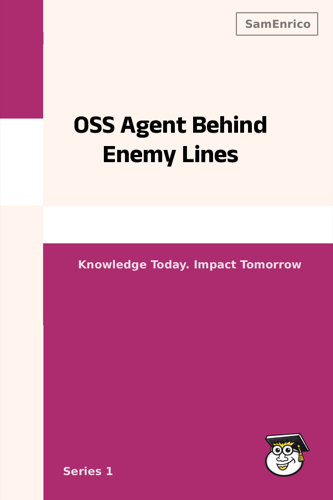
OSS Agent Behind Enemy Lines eBook
Tells the story of an American spy coordinating pa
by Orellana Ty
Tells the story of an American spy coordinating partisans in occupied France.
Formats
Free sample
Chapter 1: The Unseen Thread...--The boy learned to count on a loom.Not with wooden blocks or picture cards, but with the clatter of wooden shuttles and the whisper of silk threads passing through steel reeds. His mother’s hands—scarred from forty years of pulling tension—would guide his small fingers across the warp, teaching him the rhythm of the Jacquard mechanism. “Every thread has its place,” she would say in the soft, musical French of Lyon’s Croix-Rousse district. “Pull the wrong one, and the whole pattern falls apart.”That lesson would save his life fifteen years later, though he did not know it yet.The workshop stood on the slope of the hill that overlooked the Saône River, one of hundreds of canuts—silk weavers—who had made Lyon the textile capital of Europe. The building was ancient, its wooden beams blackened by centuries of candle smoke and coal dust.
The looms dominated every room, their iron frames like the skeletons of prehistoric beasts. In the summer, the heat was suffocating; in the winter, the cold crept through the stone floors and settled in the bones. But the Beaumont family had worked these looms for four generations, and they would not stop now.Daniel Beaumont was born in 1920, the third child of Philippe Beaumont (a silk merchant with a talent for mathematics) and Marguerite Beaumont (née Fournier), whose family had woven silk for the Empress Eugénie. The Beaumonts were not rich—no weaver in Lyon was rich after the Great War—but they were respected. Philippe had served as a captain in the French Army, surviving Verdun with a limp and a collection of nightmares he never discussed.
Marguerite ran the workshop with the iron discipline of a woman who had buried one child (a daughter, lost to influenza in 1918) and would not lose another.The Americans came into Daniel’s life through his father’s war connections. Philippe had been liaison officer to the American Expeditionary Forces in 1917-1918, and he had made friends—real friends, not just wartime acquaintances—among the officers from Pennsylvania and Ohio. After the war, these men visited Lyon on their grand European tours, bringing with them stories of a country that seemed impossibly vast and optimistic. They called it “The States.” They spoke of skyscrapers and automobiles and a kind of freedom that the French, still nursing their wounds from four years of trench warfare, could barely imagine.When Daniel was twelve, his father sent him to live with an American family in Pittsburgh for six months. “You will need English,” Philippe said.
“The world is changing. France cannot hide behind her borders forever.” Daniel hated Pittsburgh at first—the smoke, the steel mills, the incomprehensible accents—but he learned. He learned to speak English without the heavy French accent that plagued his father. He learned to eat hamburgers and drink root beer and throw a baseball with something approaching competence. He learned that Americans were loud, generous, infuriating, and endlessly optimistic in a way that seemed almost childish to his European sensibility.But when he returned to Lyon, he was French again.
The silk workshop welcomed him back. The loom taught him patience. The threads taught him precision. And his mother taught him the one thing that would matter most: how to see what others missed.“Look at the thread,” Marguerite would say, holding up a strand of raw silk against the light. “Is it straight?
Is it true? A single flaw at the beginning ruins the entire bolt.” She would run her fingers along the length, feeling for imperfections invisible to the untrained eye. “The Germans who come to buy our silk—they do not know how to look. They see the surface. You must see beneath it.”The Fall On May 10, 1940, Daniel was twenty years old, working as a junior engineer for a telecommunications company in Paris.
He had graduated from the École Centrale Paris the previous year, one of the youngest in his class, and had been recruited by Compagnie Générale de Télégraphie Sans Fil—the company that built France’s radio networks. It was good work. Honest work. The kind of work that allowed him to send money home to Lyon, where the silk trade was dying under the weight of German trade restrictions and the lingering depression of the 1930s.He was in his office on the Rue de la Boétie when the news came: the Germans had invaded the Low Countries. The office fell silent.
Men who had served in the Great War stared at their desks, their faces gray. The younger ones—Daniel among them—did not yet understand what was coming. They had heard the speeches. They believed in the Maginot Line. They trusted that the French Army, the greatest in Europe, would hold.It did not hold.The next six weeks were a waking nightmare.
Daniel listened to the radio in his small apartment as city after city fell: Rotterdam, Brussels, Sedan, Amiens. The British Expeditionary Force was trapped at Dunkirk, then miraculously evacuated, leaving the French to fight alone. The government fled Paris on June 10, declaring it an open city to spare it from destruction. Daniel watched from his office window as columns of refugees—women with babies in prams, old men pushing wheelbarrows, children crying—flowed south, away from the gray-green tide of German panzers.On June 14, the Germans entered Paris.Daniel stood on the sidewalk as the first columns marched down the Champs-Élysées. The sound was like nothing he had ever heard: the synchronized stomp of boots, the rumble of armored cars, the throaty roar of motorcycle engines.
The Parisians watched in silence. Some wept. Others—the ones who would later be called collaborators—saluted. Daniel felt a cold, quiet fury settle into his chest, a heatless anger that would not leave him for five years.He could not fight. He was not a soldier.
The French Army had been decimated, and the armistice signed on June 22 created a new reality: the north and west of France under direct German occupation, the south under the collaborationist Vichy regime. Daniel’s Lyon was in the so-called “Free Zone,” but everyone knew it was free in name only. The Germans could cross the demarcation line whenever they pleased.For a year, Daniel stayed in Paris, working under German supervision. The telecommunications company was now required to cooperate with the occupiers, providing radio relays and telephone infrastructure for the Wehrmacht. Daniel did his job without enthusiasm, but without sabotage.
He was not a resistor. He was not a hero. He was a young man trying to survive.But he watched. He listened. He remembered his mother’s lesson: look beneath the surface.He saw the way the German officers treated French civilians—with a cold, bureaucratic cruelty that was somehow worse than outright violence.
He saw the yellow stars appear on the coats of Jewish neighbors who had lived in Paris for decades. He saw the black Citroëns of the Gestapo pull up outside apartment buildings, and the sounds that followed: screams, boots on stairs, doors slamming. He saw the…
This is the end of the free sample. Get the eBook to keep going. Buy now
About this book
Details
- Author
- Orellana Ty
- Publisher
- SamEnrico
- Language
- English
- Genre
- Non-Fiction, Biography, Intelligence History
- Released
- 2026-06-07
- Pages (approx.)
- 139
- Available as
- eBook, Audiobook

Read better in the ZLOADR app
Your eBooks on your phone or tablet. Sign in with your SamEnrico account and start reading.
More by Orellana Ty
 Sam Sheppard Career After PrisonOrellana Ty$11.99
 Meal Prep for Holiday FeastsOrellana Ty$11.99
 Gates Product LicensingOrellana Ty$11.99
 Relationship Induced ApathyOrellana Ty$11.99
 Intestinal PermeabilityOrellana Ty$11.99
 Perfectionism vs Healthy StrivingOrellana Ty$11.99
 Cryptojacking TrendsOrellana Ty$11.99
 The Devil's Tunnel: The Escape That Shook the CartelOrellana Ty$11.99
 The Blood of the Steppe: The Magyar Horde's Last StandOrellana Ty$11.99
 How to Start a Propane Business (Beginners Guide)Orellana Ty$11.99
 How to Produce Filler PuttyOrellana Ty$11.99
 Madrid Language RequirementsOrellana Ty$12.99
You may also like
 Hong Kong Handover 1997Dunn Johnnie$11.99
 Zumba For Postnatal Recovery CourseNeal Christian$11.99
 Zumba for BeginnersLadner Nikia$11.99
 YouTube Comment Mining GuideHumes Pandora$12.99
 Worry Box MeditationCarlin Rudy$11.99
 Workplace Stress MeditationNguyen Lynn$11.99
 Workplace Stress and Sleep RepairHawley Ivory$11.99
 Workplace Perfectionism CureDelaney Jeffry$11.99
 Workplace Injustice Anger GuideWallen Isabelle$11.99
 Work Addiction and Burnout LinkGreenwood Ester$11.99
 Women in Yoga and WellnessBeattie Galina$11.99
 Women in Stand Up ComedyChun Evangeline$11.99