
Organic Vegetable Export Guide Audiobook
Get organic certification for vegetable exports. E
Get organic certification for vegetable exports. European and North American market requirements.
Formats
Free sample
Chapter 1: The Two Giants--The first time a container of organic vegetables is rejected at the port of Rotterdam, the exporter typically makes the same statement: “But I followed the rules.” The second time, if there is a second time, the statement changes to something closer to the truth: “I did not realize there were two different sets of rules.” This is the fundamental trap that destroys more organic vegetable export businesses than pests, weather, or logistics combined. There is no single “organic standard” for international trade. There are two dominant, diverging, and often contradictory regulatory systems: the United States Department of Agriculture National Organic Program (USDA NOP) and the European Union Organic Regulation 2018/848. Treating them as interchangeable is not a minor paperwork error. It is a strategic mistake that can result in seized containers, destroyed product, and blacklisting by importers on both sides of the Atlantic.This chapter dissects these two giants.
It is not a simple comparison chart. It is a deep exploration of the philosophical, legal, and practical differences that shape every decision you will make as an organic vegetable exporter. By the end of this chapter, you will understand why the US approach focuses on your process while the EU approach focuses on your outcomes. You will learn why a system that works perfectly for a certified organic farm in California can trigger a RASFF alert in Germany. Most importantly, you will gain the ability to look at any organic regulation, any buyer requirement, or any inspection finding and immediately know which side of the Atlantic it comes from.The Two Philosophies: Process Versus Outcome The USDA National Organic Program, which took full effect in 2002, was built on a fundamentally American regulatory philosophy.
It is a process-based system. This means that if you follow the prescribed steps—if you create an Organic System Plan, maintain buffer zones, use only allowed substances from the National List, keep meticulous records, and submit to annual inspections—your product is organic. The USDA does not routinely test the final product for pesticide residues. The assumption is that a compliant process produces a compliant outcome. This approach has significant advantages for exporters.
It is predictable. It is auditable. It allows for economies of scale because the same process documentation works for every crop on every farm.The European Union’s Organic Regulation 2018/848, which replaced the previous 834/2007 regulation in 2021, operates on a…
This is the end of the free sample. Get the Audiobook to keep going. Buy now
About this book
Details
- Author
- Riddick Latasha
- Publisher
- SamEnrico
- Language
- English
- Genre
- Non-Fiction, Business Brief, Eco-Compliance
- Released
- 2026-05-29
- Pages (approx.)
- 143
- Available as
- eBook, Audiobook

Listen in the VoxFlicks app
Audiobooks and audio dramas wherever you go. Sign in with your SamEnrico account and press play.
More by Riddick Latasha
 The Complicated Grief and HealthRiddick Latasha$11.99
 Watchman Nee TestimonyRiddick Latasha$11.99
 Pet Loss For Foster ChildrenRiddick Latasha$11.99
 Mindful Vacuuming CourseRiddick Latasha$11.99
 The Structural Engineer CreativityRiddick Latasha$11.99
 The Iron Kings of Caledonia: Rome’s Celtic Foes and the Birth of British ResistanceRiddick Latasha$11.99
 How to Start a Camel Hair Spinning on The Woollen System Business (Beginners Guide)Riddick Latasha$11.99
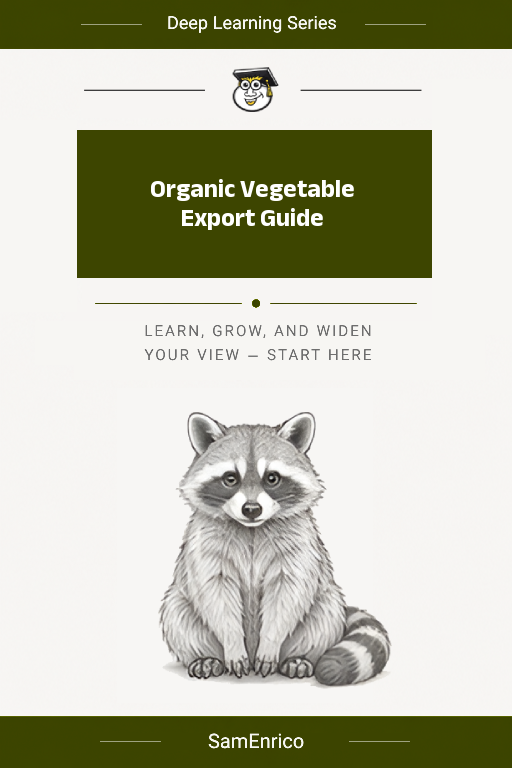 Organic Vegetable Export GuideRiddick Latasha$12.99Organic Vegetable Export GuideRiddick Latasha$12.99Organic Vegetable Export GuideRiddick Latasha$12.99Organic Vegetable Export GuideRiddick Latasha$12.99Organic Vegetable Export GuideRiddick Latasha$12.99
You may also like
 RSPO Certification ExportBeaty Hien$12.99
 Zero Deforestation ExportPeachey Alona$12.99
 WRAP Certification ExportBeaudoin Magen$12.99
 Water Neutral Export GuideEchols Seema$12.99
 UTZ Coffee Export GuideTimmons Tama$12.99
 Sprouts Certification ExportArroyo Denese$12.99
 SMETA Audit Export GuideHeath Elana$12.99
 SBTi Certification ExportMaclean Linnea$12.99
 Rainforest Alliance ExportHardin Madelyn$12.99
 Rainforest Alliance CoffeeWiseman Erasmo$12.99
 Plastic Neutral Export GuideHazel Lissa$12.99Organic Vegetable Export GuideRiddick Latasha$12.99