
Non-FictionHealth & WellnessSleep Environment
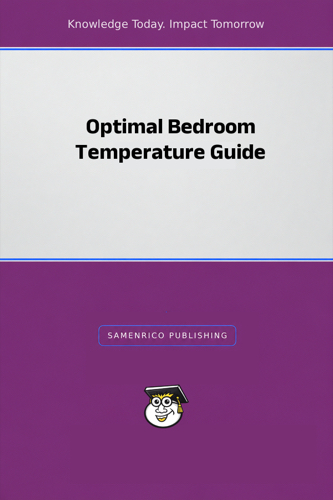
Optimal Bedroom Temperature Guide eBook
Set your thermostat between 60 and 67 degrees Fahr
by Wilburn Rina
Set your thermostat between 60 and 67 degrees Fahrenheit for deeper sleep cycles.
Formats
Free sample
Chapter 1: The $45 Billion Mistake--–- On a cold January night in 2019, a 47-year-old software engineer named David did something that would have seemed insane to him just six months earlier. He set his bedroom thermostat to 62 degrees Fahrenheit, removed the heavy down comforter his wife loved, and slept under a single cotton sheet. His friends called him crazy. His mother asked if he was trying to catch pneumonia. His wife slept in the guest room for three nights.
But on the fourth morning, David woke up at 6:15 a.m. without an alarm, felt clear-headed for the first time in years, and realized he had not woken up once during the night. After fifteen years of chronic insomnia, three failed prescriptions, two CPAP machines, a $5,000 mattress, and countless supplements that did nothing, the solution was not a pill or a gadget. It was a number on a dial.David’s story is not unique. It is replicated thousands of times every day, in bedrooms across the world, by people who have been told that their sleep problems are psychological, genetic, or simply incurable.
They are told to try meditation, lavender oil, white noise machines, weighted blankets, blue light blocking glasses, and a hundred other products that together form a $45 billion industry built on a single lie: that sleep is complicated, expensive, and requires constant intervention. The truth is far simpler, far cheaper, and hiding in plain sight. You are sleeping in a room that is too warm, and your body has been trying to tell you this every single night of your adult life.This book is about that number. It is about the narrow band of temperatures—between 60 and 67 degrees Fahrenheit—that unlocks the deepest, most restorative sleep your body is capable of producing. It is about the neuroscience of thermoregulation, the circadian biology of heat loss, and the clinical evidence showing that temperature manipulation outperforms many prescription sleep aids.
But more than that, this book is about why you have been misled. The sleep industry does not want you to know that the most effective intervention is free. Mattress companies cannot patent 65 degrees. Pill manufacturers cannot charge $200 a month for a thermostat setting. And the wellness industry certainly cannot sell you a $300 diffuser that mimics what your grandmother already knew: cool rooms produce better sleep.The Core Temperature Connection Let us start with a fundamental biological fact that most adults do not learn until they are deep into a sleep disorder diagnosis.
Sleep onset is not primarily triggered by darkness, fatigue, or even melatonin production. It is triggered by a drop in your core body temperature. Every single night, approximately two hours before your habitual bedtime, your brain instructs blood vessels near the surface of your skin to dilate. This process, called vasodilation, allows warm blood to flow away from your internal organs toward your hands, feet, and skin surface. Your core temperature begins to fall.
Your extremities become warm. And this cooling signal is what tells your brain that it is time to sleep.The required drop is not large—only one to two degrees Fahrenheit—but it is absolutely necessary. Without it, your brain cannot transition from wakefulness to non-REM sleep. Your neurons continue firing at daytime rates. Your heart rate remains elevated.
Your body stays in a state of low-level arousal, even as you lie perfectly still in a dark room. This is why so many people report lying in bed for hours, feeling tired but unable to cross the threshold into sleep. Their core temperature has not dropped enough, and their brain is still waiting for the signal that never comes.The relationship between room temperature and core temperature is not one-to-one. This is a critical point that even many sleep specialists get wrong. A change in room temperature of approximately four to five degrees Fahrenheit produces a change in core temperature of roughly one degree.
This conversion rule will appear throughout this book because it explains why your thermostat setting matters so much. If your bedroom is 70 degrees, your core will struggle to drop the necessary one to two degrees. If your bedroom is 74 degrees, it is biologically impossible for most people. Your body is trying to radiate heat into a room that is already warmer than your skin, and the laws of thermodynamics are not on your side.The $45 Billion Lie Let us pause here to examine the scale of the deception. The global sleep aids market was valued at approximately $45 billion in 2023 and is projected to grow to over $60 billion by 2030.
This includes prescription medications (Ambien, Lunesta, Sonata), over-the-counter supplements (melatonin, magnesium, valerian root), sleep trackers (Oura Ring, Fitbit, Apple Watch), specialized mattresses (Purple, Casper, Tempur-Pedic), pillows, weighted blankets, white noise machines, blackout curtains, aromatherapy diffusers, and an endless parade of gadgets promising to hack your way to better rest. Most of these products work, at best, modestly. Some work no better than placebo. A few are actively harmful.What is missing from this $45 billion market? The humble thermostat.
You cannot buy a $45 billion thermostat. You cannot advertise a thermostat setting on Instagram. You cannot create a subscription service for turning down the heat. The sleep industry has a structural incentive to ignore, downplay, or complicate the single most effective intervention available. This is not a conspiracy.
It is simple capitalism. Companies make money by selling things, not by telling you to adjust a dial you already own.The research, however, is unambiguous. A 2012 study from the National Institutes of Health found that insomniacs had significantly higher core body temperatures in the hours before sleep compared to healthy sleepers. A 2017 study from the University of South Australia showed that a cooling mattress pad reduced sleep latency (the time it takes to fall asleep) by an average of 13 minutes, comparable to low-dose benzodiazepines but without any side effects. A 2019 meta-analysis published in the Journal of Applied Physiology concluded that “manipulation of body temperature is among the most robust and reliable methods for improving sleep quality across all age groups.” Not one of these studies was funded by a thermostat company because thermostat companies do not exist in the sleep space.
The research is clean. The results are replicable. And nobody is trying to sell you anything.Why Modern Bedrooms Are Disasters for Sleep If the science is so clear, why do most people sleep in rooms that are far too warm? The answer involves a convergence of architectural, cultural, and economic factors that have slowly shifted our bedrooms away from biological optimization.First, the advent of central heating and air conditioning. Before the mid-20th century, most people slept in rooms that tracked closely with outdoor temperatures.
In winter, bedrooms were cold. People used hot water bottles, extra blankets, and bed warmers. In summer, they slept with windows open, using fans and cross-breezes. The body adapted to these natural variations. Central heating changed everything.
Suddenly, every room in the house could be maintained at a constant 70 to 72 degrees, year-round. This was marketed as comfort, but it was comfort for daytime activities—reading, cooking, watching television—not for sleep. The bedroom became just another climate-controlled room, and the biological need for nighttime cooling was…
This is the end of the free sample. Get the eBook to keep going. Buy now
About this book
Details
- Author
- Wilburn Rina
- Publisher
- SamEnrico
- Language
- English
- Genre
- Non-Fiction, Health & Wellness, Sleep Environment
- Released
- 2026-06-06
- Pages (approx.)
- 154
- Available as
- eBook, Audiobook

Read better in the ZLOADR app
Your eBooks on your phone or tablet. Sign in with your SamEnrico account and start reading.
More by Wilburn Rina
 Loving Kindness Meditation GuideWilburn Rina$11.99
 HGH and Microbiome AgingWilburn Rina$11.99
 Parenting Stress and MarriageWilburn Rina$11.99
 Payment Currency Choice for Export ContractsWilburn Rina$12.99
 EmbalmerWilburn Rina$11.99
 How to Produce Bubble Blowing ToysWilburn Rina$11.99
 How to Become a Heel DipperWilburn Rina$11.99
You may also like
 Hong Kong Handover 1997Dunn Johnnie$11.99
 Zumba For Postnatal Recovery CourseNeal Christian$11.99
 Zumba for BeginnersLadner Nikia$11.99
 YouTube Comment Mining GuideHumes Pandora$12.99
 Worry Box MeditationCarlin Rudy$11.99
 Workplace Stress MeditationNguyen Lynn$11.99
 Workplace Stress and Sleep RepairHawley Ivory$11.99
 Workplace Perfectionism CureDelaney Jeffry$11.99
 Workplace Injustice Anger GuideWallen Isabelle$11.99
 Work Addiction and Burnout LinkGreenwood Ester$11.99
 Women in Yoga and WellnessBeattie Galina$11.99
 Women in Stand Up ComedyChun Evangeline$11.99