
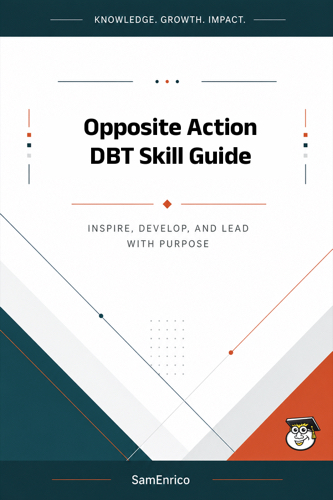
Non-FictionSelf-HelpBehavior Change
Opposite Action DBT Skill Guide eBook
Teaches acting opposite to emotional urges to chan
Teaches acting opposite to emotional urges to change feelings.
Formats
Free sample
Chapter 1: The Thinking Trap--Most people who pick up this book have spent years trying to think their way out of how they feel. They have replayed conversations in their heads, searching for the exact words that would have prevented the argument. They have analyzed their anxiety from every angle, hoping that if they could just understand it well enough, it would dissolve. They have told themselves to calm down, to be rational, to look on the bright side, to stop overreacting. And when none of that worked, they concluded something was wrong with them.There is nothing wrong with you.The problem is not your effort, your willpower, or your intelligence.
The problem is the strategy itself. You have been trying to solve an emotional problem with a thinking tool, and that approach is structurally incapable of working. This chapter will show you why thinking fails, what emotions actually are, and the radical alternative that changes everything.The Most Useless Phrase in the English Language Let us start with an experiment. Think back to the last time you were truly overwhelmed by an emotion. Perhaps it was fear before a job interview, anger after someone cut you off in traffic, or sadness that settled over you like a fog you could not escape.
Now imagine that in that moment, someone looked at you and said, with complete sincerity, "Just calm down."Did that phrase help you? Of course not. In fact, it probably made you feel worse. You might have felt a flash of anger at the person who said it, or a wave of shame that you could not do something that seemed so simple. But here is the question no one asks: Why does "just calm down" never work?The answer is not that you are bad at calming down.
The answer is that calm is not a light switch you can flip with logic. Calm is the end result of a physiological process. And when your body is in the middle of an emotional surge, telling it to calm down with words is like standing in a burning building and shouting at the fire to stop being so hot.This chapter dismantles the most common and useless piece of advice in the English language, not to make you feel bad about the times you have received it or given it to yourself, but to clear the ground for something that actually works.What Emotions Really Are (And What They Are Not)To understand why thinking fails, you must first understand what an emotion actually is. Most people believe emotions are feelings that happen to them, mysterious visitors that arrive without warning and leave without explanation. This is not accurate.Emotions are biological, hardwired action programs.
They evolved over millions of years to keep you alive. Every emotion you experience is designed to do one thing: motivate a specific behavior.Consider fear. When your brain detects a threat, it does not wait for you to think about it. Within milliseconds, your amygdala activates your sympathetic nervous system. Your heart rate increases.
Your breathing quickens. Blood rushes to your large muscle groups. Your pupils dilate. Your digestive system slows down. All of this happens automatically, without a single conscious thought.
And what is the purpose of this massive physiological shift? To prepare your body to flee or fight. Fear is not a feeling. Fear is a逃跑 program.Consider anger. When someone violates your boundaries or treats you unfairly, your body prepares to attack.
Your jaw clenches. Your fists curl. Your voice drops in pitch. Your face flushes with blood. You are being primed for combat.
Anger is not a moral failing. Anger is a program designed to help you defend yourself and assert your territory.Consider sadness. When you experience a loss, your body urges you to withdraw. You want to curl up, turn inward, conserve energy, and avoid social contact. This program evolved to keep you safe during a time of vulnerability.
When early humans experienced a loss, leaving the cave and going out to hunt was dangerous. Staying still and quiet was protective. Sadness is not weakness. Sadness is a hibernation program.Here is the critical insight: Emotions are not problems to be solved. They are programs to be run or overridden.The mistake most people make is treating their emotions as if they were logical arguments.
They try to debate their fear, reason with their anger, or argue their sadness out of existence. But you cannot debate a program any more than you can negotiate with a computer virus. You need a different approach.The War Between Two Minds Dialectical Behavior Therapy, the clinical foundation of this book, describes the human mind as having two distinct operating systems. Understanding these two systems is essential to understanding why you have been stuck.Emotional Mind is the system where feelings drive behavior. In Emotional Mind, facts are filtered through the lens of how you feel.
If you are afraid, everything looks threatening. If you are angry, every comment seems like an insult. If you are sad, the future appears hopeless. Emotional Mind is fast, automatic, and powerful. It evolved first.
It kept your ancestors alive. It is not bad or wrong. But it is not always accurate.Reasonable Mind is the system where logic drives behavior. In Reasonable Mind, you analyze data, weigh pros and cons, and make decisions based on facts. Reasonable Mind is slow, deliberate, and effortful.
It is the voice that says, "There is no real threat here" or "This anger is disproportionate to the situation." Reasonable Mind is essential for planning and problem-solving. But it is weak compared to Emotional Mind.Here is the problem that creates so much suffering: When Emotional Mind is activated, it floods your body with stress hormones, changes your heart rate and breathing, and prepares you for action. Reasonable Mind, meanwhile, is just sitting there thinking. It is like a bicycle trying to stop a freight train. It is not that Reasonable Mind is wrong.
It is that Reasonable Mind does not have access to the body's levers.You cannot think your way out of a feeling because the feeling is not located in your thoughts. It is located in your body. Your racing heart does not care about your logical argument. Your clenched jaw is not persuaded by your reasonable observation that the threat is not real. Your curled posture does not respond to your internal monologue about how you should be more optimistic.This is the fundamental error that keeps people trapped for years, decades, or entire lifetimes.
They keep trying to use Reasonable Mind to solve a problem that lives in Emotional Mind and the body. And when it does not work, they conclude that they are broken, weak, or crazy.You are none of those things. You have simply been using the wrong tool.A Brief Glimpse of Wise Mind Before we go further, it is worth noting that there is a third state. DBT calls it Wise Mind. Wise Mind is the integration of Emotional Mind and Reasonable Mind.
It is the place where you can feel your emotions without being controlled by them, and think clearly without suppressing…
This is the end of the free sample. Get the eBook to keep going. Buy now
About this book
Details
- Author
- Collazo Marcene
- Publisher
- SamEnrico
- Language
- English
- Genre
- Non-Fiction, Self-Help, Behavior Change
- Released
- 2026-06-06
- Pages (approx.)
- 146
- Available as
- eBook, Audiobook

Read better in the ZLOADR app
Your eBooks on your phone or tablet. Sign in with your SamEnrico account and start reading.
More by Collazo Marcene
 Affirmations For Success CourseCollazo Marcene$11.99
 Phobia Assessment GuideCollazo Marcene$11.99
 Bullying Trauma TriggersCollazo Marcene$11.99
 Hong Kong Consumer RecoveryCollazo Marcene$11.99
 The Phantom Limb Symphony: When the Brain Rewrites RealityCollazo Marcene$11.99
 Understanding Paget's Disease of The BreastCollazo Marcene$17.99
 Lisa Su GuideCollazo Marcene$12.99
 Ad Scheduling First GuideCollazo Marcene$12.99
 Cabinet MakerCollazo Marcene$11.99
 How to Become a Lead FormerCollazo Marcene$11.99
You may also like
 Hong Kong Handover 1997Dunn Johnnie$11.99
 Zumba For Postnatal Recovery CourseNeal Christian$11.99
 Zumba for BeginnersLadner Nikia$11.99
 YouTube Comment Mining GuideHumes Pandora$12.99
 Worry Box MeditationCarlin Rudy$11.99
 Workplace Stress MeditationNguyen Lynn$11.99
 Workplace Stress and Sleep RepairHawley Ivory$11.99
 Workplace Perfectionism CureDelaney Jeffry$11.99
 Workplace Injustice Anger GuideWallen Isabelle$11.99
 Work Addiction and Burnout LinkGreenwood Ester$11.99
 Women in Yoga and WellnessBeattie Galina$11.99
 Women in Stand Up ComedyChun Evangeline$11.99