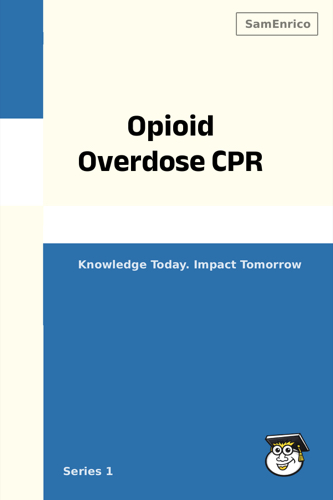
Opioid Overdose CPR
Combine rescue breathing with naloxone administrat
by Leal Nancey
Combine rescue breathing with naloxone administration for respiratory arrest.
Formats
About this book
Free sample
Chapter 1: The Silent Catastrophe...–- The first breath is automatic. So is the second. So are the fifteen thousand that follow it over the course of a typical day. You do not think about any of them. You inhale, you exhale, and somewhere deep in the architecture of your brainstem—a region so ancient that it predates the evolution of conscious thought—a cluster of neurons fires with the relentless precision of a pacemaker.
This is the medulla oblongata, and its only job is to keep you breathing until you die.But when an opioid enters the bloodstream, that pacemaker slows. Then it stutters. Then it stops.This chapter dismantles the most dangerous misconception in overdose education: that an opioid overdose looks like a heart attack. It does not. A heart attack is a plumbing problem—a blocked artery, a failing pump, a sudden halt in circulation.
An opioid overdose is a wiring problem. The heart is fine. The blood is fine. The oxygen is sitting in the lungs, waiting for a signal that never arrives. The brain has simply forgotten to breathe.Understanding this distinction is not academic.
It is the difference between watching someone die and knowing exactly what to do.The Heart Versus the Breath: Why Standard CPR Fails For decades, the public has been trained to recognize cardiac arrest as the prototypical medical emergency. Someone clutches their chest, collapses, turns blue, and the rescuer performs chest compressions to the beat of "Stayin' Alive." This is appropriate for heart attacks. It is actively harmful for opioid overdoses—not because it damages the person, but because it delays the one intervention that actually works.In cardiac arrest, the heart stops pumping. Blood stagnates. Chest compressions manually circulate that blood, pushing oxygen from the lungs to the brain.
The critical ratio is 30 compressions to 2 breaths, and the compressions are the priority. In an opioid overdose, the heart continues beating—sometimes for ten minutes, sometimes for twenty, sometimes until the moment of death. The problem is not circulation. The problem is ventilation. The lungs are full of air.
That air contains oxygen. But without the mechanical act of breathing, that oxygen never crosses the alveolar membrane, never binds…
This is the end of the free sample. Get the eBook to keep going. Buy now
Contents
- Chapter 1
- Chapter 2
- Chapter 3
- Chapter 4
- Chapter 5
- Chapter 6
- Chapter 7
- Chapter 8
- Chapter 9
- Chapter 10
- Chapter 11
- Chapter 12
Details
- Author
- Leal Nancey
- Publisher
- SamEnrico
- Language
- English
- Genre
- Non-Fiction, Health & Wellness, Opioid
- Released
- 2026-06-09
- Pages (approx.)
- 143
- Available as
- eBook, Audiobook

Read better in the ZLOADR app
Your eBooks on your phone or tablet. Sign in with your SamEnrico account and start reading.
More by Leal Nancey
 TikTok Star BiographyLeal Nancey$11.99
 The Blind CircumnavigatorLeal Nancey$11.99
 The Stress Safe Bedroom RuleLeal Nancey$11.99
 The Foster Brother TraffickerLeal Nancey$11.99
 Long COVID Breath RecoveryLeal Nancey$11.99
 Stephen Colbert TruthinessLeal Nancey$11.99
 Kemmons Wilson Holiday InnLeal Nancey$11.99
 The Silk and the Scandal: How a Chinese Embroiderer Exposed a Royal ConspiracyLeal Nancey$11.99
 The Golden Quill of Leopold Senghor: Africa's Poetic SovereignLeal Nancey$11.99
 Sky Pirates: The Untold Heist of the Boeing 747Leal Nancey$11.99
 Growing HypselaLeal Nancey$11.99
 How to Start a Mixed Beverages Containing Fruit Wines Business (Beginners Guide)Leal Nancey$11.99