
Non-FictionSelf-HelpEvening Routine
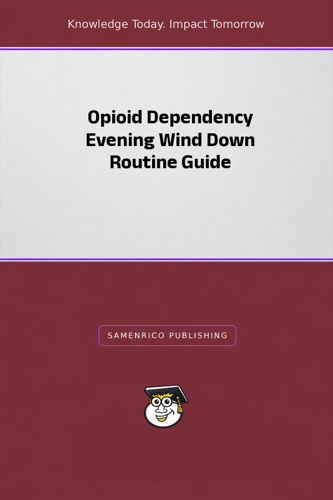
Opioid Dependency Evening Wind Down Routine Guide eBook
Creates a relaxing evening ritual to prevent opioi
by Dow Marleen
Creates a relaxing evening ritual to prevent opioid cravings at night.
Formats
Free sample
Chapter 1: The Stolen Stillness--–- The human brain is not designed to be still at night. For millions of years, darkness meant danger. The campfire needed feeding. The predator needed watching. The tribe needed guarding.
Only when the sun rose could the brain finally exhale. So when you lie awake at 3:00 AM, heart pounding, sheets soaked, your mind screaming for the very thing that nearly killed you—this is not a moral failure. This is not weakness. This is not a sign that you will never heal. This is your ancient survival brain, hijacked by opioids, mistaking the quiet for a threat.
And once you understand why this happens, you can stop fighting yourself and start rewiring the machine.The 3:00 AM Terror Is Not Your Fault Let us name what you already know but have never heard spoken out loud. The hour between 2:00 AM and 4:00 AM is the most dangerous hour of your recovery. Not because you are weak. Not because you lack willpower. But because three biological events converge at that hour like a perfect storm designed specifically to break you.First, your circadian rhythm—the internal clock that governs wakefulness and sleep—reaches its lowest point of cortisol production at approximately 3:00 AM.
Cortisol is the stress hormone that keeps you alert during the day. At 3:00 AM, it bottoms out. You are biologically primed to be asleep, vulnerable, and unaware. But withdrawal does not respect biology.Second, your brain has spent months or years adapting to opioids. Those substances artificially flooded your reward system with dopamine—sometimes ten to twenty times the natural baseline.
In response, your brain did what any intelligent system would do: it downregulated. It reduced its own natural dopamine production. It pulled back the number of dopamine receptors. It learned to expect the flood. And now, without that flood, your brain is starving for relief at the very hour when external distractions are absent.Third, the lack of external stimuli at night means your brain has nothing to divert its attention.
During the day, you have tasks, conversations, appointments, screens, noise—a thousand small distractions that keep the craving circuit from reaching full ignition. But at 3:00 AM, there is only you, the ceiling, the silence, and the void where the opioids used to be.The stillness of bedtime is not peace. It is a sensory deprivation chamber that amplifies withdrawal pain.This chapter will teach you why your brain betrays you at night, why the quiet feels like screaming, and—most importantly—why none of this means you are failing at recovery. By the end of this chapter, you will have a map of your own neurological terrain. And with that map, you will stop blaming yourself for the 3:00 AM terror.The Neuroscience of a Stolen Reward System To understand the nighttime craving, you must first understand how opioids stole your brain's natural reward system.
This is not abstract science. This is the story of why a cup of coffee no longer feels good, why music sounds flat, why human touch feels like pressure without warmth, and why the only thing your brain believes will help is the very thing destroying you.Dopamine is not the chemical of pleasure. This is the most common misunderstanding in all of addiction science. Dopamine is the chemical of wanting—of anticipation, motivation, drive, and craving. Pleasure itself comes from a different system involving endogenous opioids (your brain's natural painkillers) and endocannabinoids.
But dopamine is the gas pedal. It is the reason you get out of bed, the reason you reach for water when thirsty, the reason you seek connection when lonely. Without dopamine, you would be a motionless, desireless shell.When you take an opioid—whether prescription oxycodone, heroin, fentanyl, or any other—that molecule enters your brain and binds to mu-opioid receptors. These receptors are normally activated by your brain's own endorphins (endogenous morphine). But exogenous opioids are far more potent.
They cause a massive surge of dopamine in the nucleus accumbens, the brain's reward center. That surge feels like warmth, safety, relief, and love all compressed into a single molecule.But here is the betrayal. Your brain is designed to maintain balance—a state called homeostasis. When it detects an excessive dopamine surge, it adapts. It reduces the number of dopamine receptors.
It reduces the amount of dopamine it produces naturally. It strengthens the connections between the reward center and the stress center. Over time, your brain becomes a different organ. The same dose that once produced euphoria now only produces the absence of withdrawal. The same activities that once brought joy—eating, sex, socializing, hobbies—now produce nothing.
This is called anhedonia, and it is the most under-treated symptom of opioid withdrawal.Now apply this to the night.During the day, your brain's dopamine system is still suppressed, but you have external stimulation to compensate. The sound of traffic. The weight of a coffee mug. The glow of a screen. The voice of a coworker.
These provide small, intermittent dopamine spikes that keep you functional. At night, those external stimuli disappear. You are left alone with a dopamine-starved brain in a silent room. And that brain, desperate for relief, will do what it has been trained to do: it will generate a craving.The craving is not a desire for pleasure. It is a survival signal from a brain that believes it is dying.The REM Rebound: Why Your Dreams Are Trying to Kill You Opioids do something else to your sleep architecture that most people in recovery never learn.
They suppress REM sleep—the stage of sleep associated with vivid dreaming, emotional processing, and memory consolidation. During active use, you may have noticed that you rarely dreamed, or that your dreams were flat, vague, or absent. That was not a coincidence. Opioids act on the same brainstem circuits that regulate REM, effectively holding the door closed on your dream life.But when you stop using—whether through detox, medication-assisted treatment, or abstinence—your brain fights back. It enters a state called REM rebound.
The brain, having been denied its normal REM cycles for weeks or months, now attempts to catch up with a vengeance. You may find yourself dreaming more intensely than ever before. And those dreams are often about using.These are not ordinary dreams. They are vivid, sensory-rich, and emotionally devastating. You dream of finding pills in a bathroom cabinet.
You dream of cooking heroin on a spoon. You dream of crushing and snorting. You dream of the relief washing over you. And you wake up with a craving so intense that it feels indistinguishable from withdrawal. You may even wake up reaching for something that is not there.Here is what you must understand, and it is so important that it bears repeating: Using dreams are not moral failures.
They are not prophecies. They are not signs that you secretly want to relapse. They are neurological noise—the sound of your brain rebooting its sleep architecture after years of suppression.REM rebound typically peaks in the second to fourth week of abstinence or stabilization on MAT (medication-assisted treatment). It can last for several months, gradually decreasing in intensity. The dreams are worst between…
This is the end of the free sample. Get the eBook to keep going. Buy now
About this book
Details
- Author
- Dow Marleen
- Publisher
- SamEnrico
- Language
- English
- Genre
- Non-Fiction, Self-Help, Evening Routine
- Released
- 2026-06-10
- Pages (approx.)
- 151
- Available as
- eBook, Audiobook

Read better in the ZLOADR app
Your eBooks on your phone or tablet. Sign in with your SamEnrico account and start reading.
More by Dow Marleen
 Whey vs Casein GuideDow Marleen$11.99
 Loving Kindness for Community OrganizersDow Marleen$11.99
 Nobel Laureates in NeuroscienceDow Marleen$11.99
 Pushing Shopping CartDow Marleen$11.99
 Stress and Skin Picking DisorderDow Marleen$11.99
 Holiday Grief Without SpouseDow Marleen$11.99
 DoorDash Delivery Strategy GuideDow Marleen$11.99
 The Maori Athletes Who Fought for Equality: The 1867 New Zealand Native Football Team's Silent RevolutionDow Marleen$11.99
 The Billionaire's Obsession: How One Man Collected the World's Rarest BooksDow Marleen$11.99
 A Collector's Handbook to the Morris Cowley (1927-30)Dow Marleen$11.99
 How to Produce Wet Towel DispensersDow Marleen$11.99
 How to Produce a Manure SpreaderDow Marleen$11.99
You may also like
 Hong Kong Handover 1997Dunn Johnnie$11.99
 Zumba For Postnatal Recovery CourseNeal Christian$11.99
 Zumba for BeginnersLadner Nikia$11.99
 YouTube Comment Mining GuideHumes Pandora$12.99
 Worry Box MeditationCarlin Rudy$11.99
 Workplace Stress MeditationNguyen Lynn$11.99
 Workplace Stress and Sleep RepairHawley Ivory$11.99
 Workplace Perfectionism CureDelaney Jeffry$11.99
 Workplace Injustice Anger GuideWallen Isabelle$11.99
 Work Addiction and Burnout LinkGreenwood Ester$11.99
 Women in Yoga and WellnessBeattie Galina$11.99
 Women in Stand Up ComedyChun Evangeline$11.99