
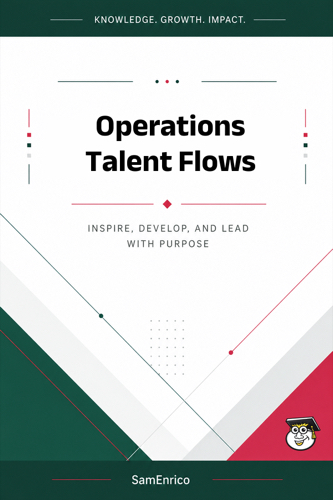
Non-FictionForecast & OutlookOperations Workforce
Operations Talent Flows eBook
Forecasts movement of supply chain and logistics e
by Leone Olevia
Forecasts movement of supply chain and logistics experts.
Formats
Free sample
Chapter 1: The Buffer Illusion--–- The phone call that changed how I think about talent came on a Tuesday, but the disaster it revealed had been building for seven years.I was consulting for a mid-sized logistics provider that had done everything right—or so they thought. They had lean operations. They had six-sigma processes. They had a leadership team trained in just-in-time principles. Their warehouses were models of efficiency.
Their inventory turns were the envy of the industry.Then their head of procurement resigned with two weeks' notice.Within thirty days, three more senior buyers followed. Within ninety days, the company had lost 40 percent of its procurement function. Supplier relationships that had taken a decade to build evaporated. Contracts were renegotiated from positions of weakness. Critical raw materials arrived late, or not at all.
The company missed earnings for three consecutive quarters. The CEO was fired.The board's post-mortem identified many causes: inadequate succession planning, underinvested training, a compensation structure that rewarded short-term cost cutting over long-term relationship building. But one finding stood above the others. The company had treated its talent supply chain exactly like its physical supply chain: optimized for efficiency, not resilience.They had assumed that people, like pallets of goods, could be replaced on demand. They had learned, at enormous cost, that this assumption was a lie.The Hidden Flaw in Operational Excellence Every supply chain professional knows the story of Toyota and just-in-time manufacturing.
In the 1970s and 1980s, Toyota revolutionized production by eliminating waste, reducing inventory, and synchronizing supply with demand. The results were extraordinary: lower costs, higher quality, faster throughput. JIT became the gold standard of operational excellence. Every supply chain manager wanted to be lean. Every consultant preached the gospel of waste reduction.But here is what the Toyota story leaves out.
Toyota's JIT system worked because Toyota had something else: a deeply resilient talent supply chain. They invested years in training each worker. They cross-trained relentlessly. They built a culture where every employee could stop the production line if they saw a problem. Their "lean" manufacturing was supported by a "buffered" talent system.Most companies copied the lean manufacturing without copying the talent resilience.
They cut inventory to the bone. They eliminated safety stock. They ran their warehouses at 98 percent utilization. And then they assumed they could do the same with people.You cannot.Physical inventory is passive. It sits on a shelf until needed.
It does not quit. It does not get recruited away. It does not retire. It does not demand work-life balance. It does not accept a better offer from Amazon.People do all of these things.
And when you have optimized your talent supply chain to the same razor-thin margins as your physical supply chain, you have created a system that will break at the first disruption.The pandemic proved this beyond any reasonable doubt. But the pandemic was not the cause of the problem. It was the reveal.The Parallel Collapse No One Saw Coming Let us compare two shortages that defined the pandemic era: the toilet paper shortage and the talent shortage.The toilet paper shortage was a failure of physical supply chain management. When demand spiked, manufacturers could not increase production quickly enough. Warehouses held minimal inventory.
Trucks were scheduled with no slack. The system had been optimized for steady demand and failed catastrophically when demand became spiky.The talent shortage that followed was a failure of human supply chain management. When the economy reopened, logistics companies needed to hire hundreds of thousands of workers. But years of lean hiring had left no bench strength. Recruiting pipelines were designed for steady-state attrition, not surge demand.
Training programs had been cut to save money. The system had been optimized for stable turnover and failed catastrophically when turnover spiked.The mathematical parallel is exact.In a physical supply chain, the reorder point formula is: safety stock plus (average demand times lead time). When demand increases or lead time extends, the reorder point must increase. If you have no safety stock, any variance leads to a stockout.In a talent supply chain, the equivalent formula is: bench strength plus (average attrition times replacement time). When attrition spikes or replacement time extends, you need more bench strength.
If you have no bench, any variance leads to a vacancy.Most companies run their talent supply chain with zero bench strength. They assume attrition will be predictable. They assume replacement lead times will be stable. They assume the labor market will always provide.These assumptions were always questionable. Now they are dangerous.The Cost of a Vacancy Let me put some numbers on this problem.The Society for Human Resource Management estimates that the cost of replacing a salaried employee ranges from six to nine months of their salary.
For a logistics manager making $80,000, that is $40,000 to $60,000 in direct replacement costs: recruiting fees, signing bonuses, training, lost productivity while the new hire ramps up.But direct replacement costs are only the beginning.The real cost of a vacancy is the operational impact. When a warehouse supervisor position goes unfilled for three months, what happens? Shift coverage deteriorates. Productivity drops. Safety incidents increase.
Turnover among hourly workers spikes because no one is leading them. Customer shipments are delayed. Penalties accrue.One of my clients calculated the total cost of a single unfilled logistics analyst position. The position was open for ninety days. In that time, the company’s forecast accuracy dropped by 8 percent.
That 8 percent led to $2.3 million in excess inventory, $1.1 million in expedited freight charges, and $700,000 in lost sales from stockouts.The analyst's salary was $75,000. The cost of the vacancy was more than fifty times that amount.Here is the question every supply chain leader should be asking: if a vacancy is so expensive, why do we treat talent like a cost to be minimized rather than an asset to be protected?The answer is a legacy of industrial-era thinking that has outlived its usefulness.From Labor as Cost to Talent as Asset The traditional view of labor comes from Frederick Winslow Taylor and the scientific management movement of the early twentieth century. Taylor saw workers as interchangeable units of production. His time-and-motion studies were designed to extract maximum output from minimum input. Labor was a variable cost to be minimized.
The less you spent on people, the more profit you kept.This view made sense in an industrial economy where most work was manual, most skills were simple, and most employees were interchangeable. If a factory worker quit, you could hire another one off the street and train them in a day.That world is gone.Today's supply chain professional manages complex systems, analyzes data, negotiates with global suppliers, and makes decisions that affect millions of dollars of inventory. Their skills are not interchangeable. Their knowledge is not easily replicated. Their relationships with suppliers and customers are assets that appreciate over time.When Maria, the supply chain executive from the opening of this chapter, lost four supervisors in two weeks, she did not lose four interchangeable bodies.
She lost four repositories of institutional knowledge. She lost four sets of supplier relationships. She lost four people who knew how…
This is the end of the free sample. Get the eBook to keep going. Buy now
About this book
Details
- Author
- Leone Olevia
- Publisher
- SamEnrico
- Language
- English
- Genre
- Non-Fiction, Forecast & Outlook, Operations Workforce
- Released
- 2026-06-07
- Pages (approx.)
- 136
- Available as
- eBook, Audiobook

Read better in the ZLOADR app
Your eBooks on your phone or tablet. Sign in with your SamEnrico account and start reading.
More by Leone Olevia
 ADHD Student Academic GuideLeone Olevia$11.99
 Teen Phobia TreatmentLeone Olevia$11.99
 Deep Sea Fisherman Stress GuideLeone Olevia$11.99
 Research Proposal Data Security PlanLeone Olevia$11.99
 Metta For Difficult PeopleLeone Olevia$11.99
 Exchange Rate Pass ThroughLeone Olevia$11.99
 Parent Respite Care GuideLeone Olevia$11.99
 Markiplier SpaceLeone Olevia$11.99
 The Mamas & The Papas: California Dreamin’ Made RealLeone Olevia$11.99
 The Hollow Echo of the Black SeptemberLeone Olevia$11.99
 The Calculus of Genius: Benjamin Banneker and the Birth of American SurveyingLeone Olevia$11.99
 The Mineral Guide to CeriteLeone Olevia$11.99
You may also like
 Hong Kong Handover 1997Dunn Johnnie$11.99
 Zumba For Postnatal Recovery CourseNeal Christian$11.99
 Zumba for BeginnersLadner Nikia$11.99
 YouTube Comment Mining GuideHumes Pandora$12.99
 Worry Box MeditationCarlin Rudy$11.99
 Workplace Stress MeditationNguyen Lynn$11.99
 Workplace Stress and Sleep RepairHawley Ivory$11.99
 Workplace Perfectionism CureDelaney Jeffry$11.99
 Workplace Injustice Anger GuideWallen Isabelle$11.99
 Work Addiction and Burnout LinkGreenwood Ester$11.99
 Women in Yoga and WellnessBeattie Galina$11.99
 Women in Stand Up ComedyChun Evangeline$11.99