
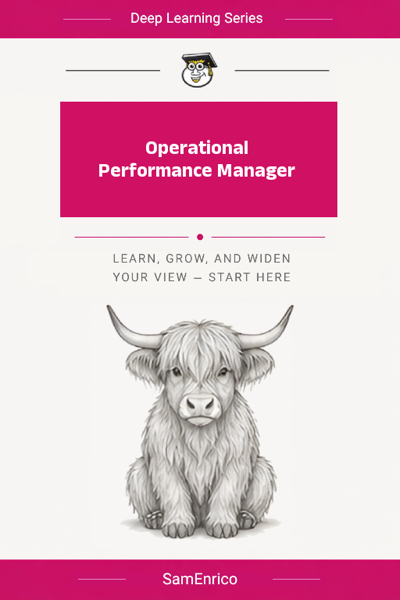
Operational Performance Manager eBook
A Coursebook on Operational Performance Manager
by Mayes Dede
A Coursebook on Operational Performance Manager
Formats
Free sample
Chapter 1: The Activity Trap--The meeting started at 8:00 AM. By 8:15, the first lie had already been told."I am swamped," said the head of customer support. "My team answered 4,700 calls last week. We are busier than ever."The head of sales nodded in sympathy. "We sent out 1,200 proposals.
Our pipeline is full."The production manager chimed in: "We shipped 45,000 units. The warehouse is running at 98% capacity."Everyone in the room felt a sense of accomplishment. The numbers were up. The activity was relentless. The team was exhausted but proud.Then the CEO asked a question that silenced the room: "If we are so busy, why did our revenue drop by 8% last quarter?"Nobody had an answer.
Because nobody had been measuring the right thing. They had been measuring activity. They had been measuring outputs. They had been measuring the wrong metrics for years, and they had built an entire culture around the comforting illusion that being busy is the same as being effective.This is the Activity Trap. And it is the single most destructive force in modern management.This chapter is about escaping that trap.
You will learn the critical difference between Outputs (what you produce) and Outcomes (the value you create). You will learn how Operational Performance Management (OPM) transforms chaotic busywork into disciplined execution. You will learn to spot the warning signs of the Activity Trap in your own organization. And you will leave with a diagnostic tool that forces you to confront the uncomfortable truth about whether your team is genuinely performing or merely exhausted.The Activity Trap has no mercy. It will consume your budget, burn out your best people, and leave you wondering why nothing ever gets better.
This chapter is your escape route.The Anatomy of the Activity Trap Let me describe a scene that plays out in thousands of organizations every single day.A marketing team celebrates sending 10,000 emails. They do not check how many were opened, how many led to clicks, or how many generated revenue. They celebrate the send.A customer service team celebrates answering 500 calls. They do not check how many problems were actually solved on the first call. They celebrate the answer.A software development team celebrates closing 200 tickets.
They do not check whether the fixes addressed the root cause of the bugs or simply patched the symptoms. They celebrate the close.A warehouse team celebrates shipping 10,000 boxes. They do not check how many were returned due to damage or incorrect items. They celebrate the ship.In every case, the team is measuring Outputs—the tangible units of activity. Outputs are seductive because they are easy to count.
You can put a number on a dashboard. You can trend it upward. You can reward people for increasing it. But outputs are dangerously misleading because they measure effort, not impact.The Activity Trap is the state of being addicted to output metrics while being blind to outcome metrics. It feels productive.
It looks professional. It is entirely hollow.The Warning Signs of the Activity Trap Ask yourself these questions about your team or organization:Do people brag about how many emails they sent, calls they made, or hours they worked?Do your dashboards show mostly green arrows pointing up, yet your financial results are flat or declining?Do employees describe themselves as "busy" or "swamped" more often than "effective" or "successful"?Do you have a culture where visible exhaustion is mistaken for dedication?Do your performance reviews reward effort ("worked 60 hours this week") over results ("closed three strategic accounts")?If you answered yes to two or more of these questions, you are in the Activity Trap. The good news is that you are not alone. The bad news is that the trap is self-reinforcing. The busier people feel, the less time they have to question whether their busyness is producing anything of value.
And the less they question, the deeper they sink.Defining Operational Performance Management (OPM)Let me give you a definition that will frame every chapter of this book.Operational Performance Management (OPM) is the discipline of aligning every resource, system, and behavior in an organization with its strategic goals, then measuring, managing, and improving the activities that directly drive those goals.Notice what this definition does not say. It does not say "measure everything." It does not say "create more reports." It does not say "install expensive software." OPM is not about measurement for the sake of measurement. It is about measurement for the sake of alignment.Think of OPM as a bridge. On one side of the bridge is the executive suite, where strategy is born. On the other side is the front line, where work is done.
Without a bridge, strategy is just words on a slide deck, and work is just random activity. The Operational Performance Manager is the architect, builder, and maintenance crew for that bridge.The Three Pillars of OPMThroughout this book, we will return to three foundational pillars that support all operational performance management:Alignment: Every action must trace back to a strategic goal. If you cannot draw a line from what someone is doing today to a specific outcome the organization needs, that action is waste.Measurement: You cannot manage what you do not measure. But you must measure the right things—not the easy things. Measurement without alignment is just accounting.Improvement: Once you know what matters and how you are performing against it, you must have a systematic method for getting better.
Continuous improvement is not a slogan; it is a discipline.These three pillars form a cycle. Alignment tells you what to measure. Measurement tells you where you are. Improvement tells you how to close the gap. Then you realign, remeasure, and improve again.
This is the heartbeat of operational performance management.Outputs vs. Outcomes: The Core Distinction I am going to spend significant time on this distinction because it is the single most important concept in this book. If you forget everything else, remember this: Outputs are what you produce. Outcomes are the value you create.Let me give you concrete examples across different functions.Customer Service Output: 500 calls answered Outcome: Customer problem resolved on first contact A team can answer 1,000 calls and resolve zero problems. That is activity without value.
The outcome—resolution—is what actually drives customer retention and reduces repeat calls.Sales Output: 1,200 proposals sent Outcome: Revenue generated A salesperson can send 1,000 proposals and close zero deals. The outcome—revenue—is what pays salaries. Proposals are just the cost of doing business.Manufacturing Output: 45,000 units shipped Outcome: Defect-free units that customers keep Shipping defective units is not value. It is waste. The customer pays for a working product, not a box of returns.Marketing Output: 10,000 emails sent Outcome: Qualified leads generated Spraying emails into the void is busywork.
Generating leads that convert to revenue is value.Software Development Output: 200 tickets closed Outcome: Root cause eliminated, preventing recurrence Closing tickets without fixing root causes is how technical debt grows. The outcome is a more stable system, not a shorter queue.The Output-Outcome Matrix Here is a simple 2x2 grid to help you audit your own metrics. Plot every metric your team tracks into one of…
This is the end of the free sample. Get the eBook to keep going. Buy now
About this book
Details
- Author
- Mayes Dede
- Publisher
- SamEnrico
- Language
- English
- Genre
- Non-Fiction, Informative, Educational
- Released
- 2026-05-04
- Pages (approx.)
- 126
- Available as
- eBook, Audiobook

Read better in the ZLOADR app
Your eBooks on your phone or tablet. Sign in with your SamEnrico account and start reading.
More by Mayes Dede
 Casino Environment RisksMayes Dede$11.99
 Workplace Stress Reduction for ScientistsMayes Dede$11.99
 Greece Photovoltaics Incentive GuideMayes Dede$11.99
 Group Flow State Triggers CourseMayes Dede$11.99
 Weight Loss After 40 GuideMayes Dede$11.99
 The Great Flu Cover-Up: How a 1918 Pandemic Was Buried in TimeMayes Dede$11.99
 How to Become a Cable Television InstallerMayes Dede$11.99
 Founder Liability Protection GuideMayes Dede$12.99Founder Liability Protection GuideMayes Dede$12.99
 Trello Roadmap Validation GuideMayes Dede$12.99
 Understanding Chromosome 4, Trisomy 4qMayes Dede$17.99