
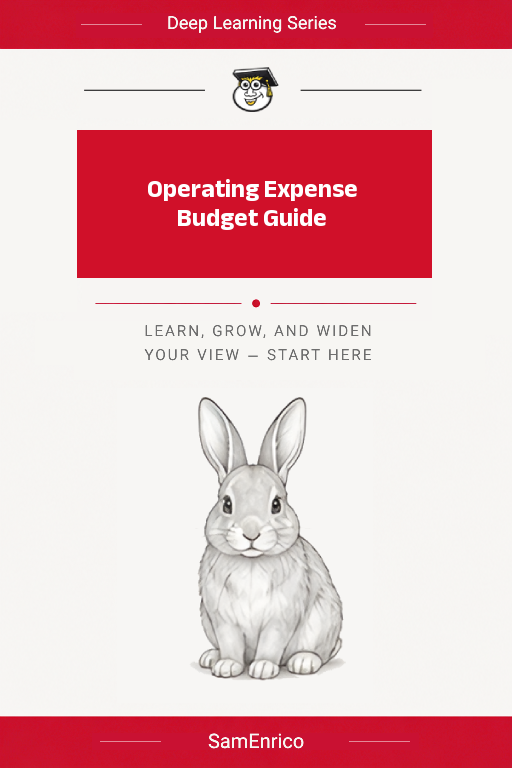
Non-FictionProfessional's Cheat SheetOPEXExpense Management
Operating Expense Budget Guide eBook
Categorize and forecast department operating expen
Categorize and forecast department operating expenses including supplies travel training and software subscriptions.
Formats
Free sample
Chapter 1: The $47,000 Mistake--I still remember the exact moment my relationship with operating expenses changed forever. It was a Tuesday afternoon in late March, and I was sitting in a glass-walled conference room on the fifteenth floor, watching a CFO named Helen flip through a printout of my department’s budget. She wasn’t angry. That would have been easier. She was quietly, methodically confused.
“Can you explain this line item called ‘Miscellaneous Subscriptions’?” she asked, tapping her pen on a number I had approved without question three months earlier. “It’s grown forty-seven percent year over year, and I don’t see a corresponding increase in headcount or output.”I had no answer. Worse, I had never thought to ask the question myself.That moment—that hollow, stomach-dropping realization that I was managing a budget I didn’t truly understand—is what drove me to write this book. Not as a finance expert who has always had perfect spreadsheets and clean variance reports, but as a manager who learned the hard way that operating expenses are not a passive burden to be monitored. They are an active, living system that rewards attention and punishes neglect.
The forty-seven thousand dollars I had allowed to leak out of my department over eighteen months was not the result of fraud or incompetence. It was the result of a far more common and insidious problem: I had been treating Op Ex as a limit to stay under rather than a resource to optimize.This chapter is not about accounting rules or spreadsheet formulas. Those will come later. This chapter is about changing how you see operating expenses entirely. It is about dismantling the belief that Op Ex is merely the cost of doing business and replacing it with a strategic mindset that turns every dollar spent into a deliberate investment.
If you finish this chapter and still think of office supplies, software subscriptions, and travel budgets as necessary evils, I will have failed. But if you finish with the uncomfortable realization that your department is almost certainly leaking money in plain sight—and that fixing those leaks is not about cutting but about seeing more clearly—then this book will deliver everything it promises.The Great Misconception: Op Ex as Necessary Evil Walk into almost any mid-sized company and ask a department head what they think about operating expenses. You will hear some variation of the same refrain: “It’s the cost of keeping the lights on.” “It’s what we have to spend to keep people productive.” “It’s the boring stuff.” This framing is not just unhelpful; it is actively dangerous. When you label something a “necessary evil,” you stop questioning it. You stop optimizing it.
You stop treating it as something that can be a source of competitive advantage.Let me be blunt: your competitors are not beating you because they have better ideas. They are beating you because they spend the same dollars more intelligently. They have figured out that a dollar saved on redundant software can be reinvested in customer acquisition. A dollar saved on unused office supplies can fund a certification program that reduces error rates. A dollar saved on poorly managed travel bookings can buy better market data.
Op Ex is not the price of staying still. It is the fuel for moving forward, and like any fuel, it can be burned efficiently or wasted through leakage.The shift from “necessary evil” to “strategic asset” requires first understanding what operating expenses actually are. Operating expenses are the recurring costs your business incurs to maintain day-to-day operations. They include everything from the toner in your printers to the airfare for your sales team to the monthly fee for your project management software. They are distinct from capital expenditures (Cap Ex), which are long-term purchases of assets like buildings, equipment, or vehicles that provide value over multiple years.
This distinction matters more than most managers realize because misclassifying an expense can distort your financial ratios, break compliance rules, and trigger audit findings. But for the purpose of this book, the most important distinction is not legal or accounting. It is strategic. Cap Ex buys things that sit on a balance sheet. Op Ex buys behavior, productivity, and capability.When you approve a software subscription, you are not buying code.
You are buying a workflow. When you approve a travel budget, you are not buying plane tickets. You are buying relationships and revenue opportunities. When you approve a training program, you are not buying slides and handouts. You are buying faster decisions and fewer mistakes.
Every dollar in Op Ex is a vote for a process, a tool, or a behavior. The question is not whether you should spend less. The question is whether you are voting intelligently.The Psychology of Department Budgeting If operating expenses are so important, why do so many managers manage them poorly? The answer is not technical. It is psychological.
Human beings are not naturally good at budgeting. We are good at pattern recognition, social navigation, and short-term survival. Budgeting requires long-term thinking, mathematical discipline, and the willingness to question our own past decisions. Four psychological traps are particularly common, and recognizing them in yourself is the first step toward escaping them.The first trap is loss aversion. Research in behavioral economics has shown that people feel the pain of a loss about twice as intensely as they feel the pleasure of an equivalent gain.
Applied to budgeting, this means managers will fight ten times harder to keep an existing budget line item than they will to justify a new one. That $500 monthly subscription nobody uses survives year after year not because it delivers value but because cutting it feels like a loss, and losses hurt. The result is budget bloat that accumulates quietly over time.The second trap is the sunk cost fallacy. Once you have spent money on something, you feel compelled to continue spending to justify the original investment. Have you ever kept a software subscription active because “we already paid for the implementation” even though no one uses it?
That is the sunk cost fallacy at work. The money is gone. The only question that matters is whether future spending is justified. Past spending is irrelevant, yet it exerts an outsized influence on budget decisions.The third trap is social proof. Managers look at what other managers are doing and assume those budgets are correct.
If the head of marketing has a $10,000 training budget, the head of sales assumes they should have a similar amount, regardless of whether their teams have different needs. This herd behavior perpetuates inefficiency across entire organizations.The fourth trap is optimism bias. We consistently overestimate how much we will use a resource and underestimate how quickly our needs will change. That new collaboration platform that seemed essential during the demo? Within six months, your team has reverted to email and Slack, but the subscription keeps auto-renewing because optimism bias convinced you that adoption was just around the corner.These traps are not signs of incompetence.
They are features of how human brains work. The managers who succeed with Op Ex are not the ones who are…
This is the end of the free sample. Get the eBook to keep going. Buy now
About this book
Details
- Author
- Poindexter Leeann
- Publisher
- SamEnrico
- Language
- English
- Genre
- Non-Fiction, Professional's Cheat Sheet, OPEX, Expense Management
- Released
- 2026-05-30
- Pages (approx.)
- 154
- Available as
- eBook, Audiobook

Read better in the ZLOADR app
Your eBooks on your phone or tablet. Sign in with your SamEnrico account and start reading.
More by Poindexter Leeann
 Obsidian Study Vault GuidePoindexter Leeann$11.99
 Digital Mapping Tools HandbookPoindexter Leeann$11.99
 Remote Retreats Legal ChecklistPoindexter Leeann$11.99
 Mastectomy Radical HistoryPoindexter Leeann$11.99
 Digital Planner Etsy Analytics GuidePoindexter Leeann$11.99
 Click & Conquer: How a College Dropout Built the Amazon EmpirePoindexter Leeann$11.99
 Beneath the Black Sun: The Lost Expedition of the *Nautilus*Poindexter Leeann$11.99
 Medical Billing and Collections SpecialistPoindexter Leeann$11.99
 BIPOC Mental Health BoardPoindexter Leeann$12.99
 Understanding Chondrodysplasia Punctata 1, X-linked RecessivePoindexter Leeann$17.99
 How to Become a Cage MakerPoindexter Leeann$11.99
You may also like
 Hong Kong Handover 1997Dunn Johnnie$11.99
 Zumba For Postnatal Recovery CourseNeal Christian$11.99
 Zumba for BeginnersLadner Nikia$11.99
 YouTube Comment Mining GuideHumes Pandora$12.99
 Worry Box MeditationCarlin Rudy$11.99
 Workplace Stress MeditationNguyen Lynn$11.99
 Workplace Stress and Sleep RepairHawley Ivory$11.99
 Workplace Perfectionism CureDelaney Jeffry$11.99
 Workplace Injustice Anger GuideWallen Isabelle$11.99
 Work Addiction and Burnout LinkGreenwood Ester$11.99
 Women in Yoga and WellnessBeattie Galina$11.99
 Women in Stand Up ComedyChun Evangeline$11.99