
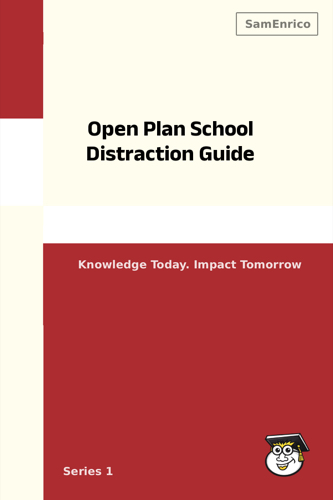
Open Plan School Distraction Guide eBook
Teaches students to focus in chaotic classrooms.
by Bean Helga
Teaches students to focus in chaotic classrooms.
Formats
Free sample
Chapter 1: The Broken Promise--–- Every morning, millions of students walk into open-plan classrooms carrying a secret shame. They sit down at their desks, open their textbooks, and wait for the chaos to begin. The kid to their left is whispering to a friend. The group behind them is laughing about something that happened at lunch. The teacher is helping another table across the room, speaking in a normal voice that carries like a broadcast.
A chair scrapes. A pencil taps. Someone walks past, close enough to brush their sleeve.And inside, the student thinks: Why can’t I just focus?This chapter is called "The Broken Promise" because that is exactly what open-plan classrooms have done to you. They made a promise—implicitly, silently, but undeniably—that you would learn better in a flexible, collaborative, modern environment. Architects promised it.
School administrators promised it. Educational researchers promised it. And you are living proof that the promise was broken.But here is the twist you did not see coming: the failure is not yours.This entire book rests on one radical claim that will either infuriate you or liberate you, depending on how long you have been blaming yourself. The claim is this: Your distractibility is not a character flaw. It is an environmental design problem.
You have been trying to solve a structural issue with willpower, and willpower was never the right tool for the job.Before we go any further, I need you to do something uncomfortable. I need you to stop reading for ten seconds and think about the last time you completely lost focus in class. Not the time you checked your phone—that is a different book. The time when you were genuinely trying to work, your brain was engaged, and then something pulled you out. A sound.
A movement. A conversation happening three feet away. Remember that feeling? The frustration? The quiet self-talk: Come on, just pay attention.
What is wrong with me?Write that moment down somewhere. Keep it with you. Because by the end of this chapter, you are going to see that moment differently. And by the end of this book, you are going to have a toolkit to prevent it from happening again.The Myth of the Perfect Student Let me name the lie that has been poisoning you since elementary school: If I were a good student, I could focus anywhere.This myth comes in many forms. You have heard all of them.
"She can study in a noisy coffee shop, so why can't you?" "He finished his worksheet even with people talking around him." "Just ignore it—tune it out—focus harder." Every variation carries the same toxic assumption: that concentration is a muscle, and if yours is weak, you just need to exercise it more.The science says otherwise.Your brain was not designed for the open-plan classroom. It was designed for the savanna. For thirty million years, the human brain evolved to do one thing exceptionally well: notice changes in the environment. A rustle in the grass could be a predator. A sudden silence could mean danger.
A voice in the distance could be friend or enemy. Your brain became a hyper-sensitive pattern-detection machine, constantly scanning for anything unusual, anything unexpected, anything that might require a split-second decision.That is why you cannot "just ignore" the kid whispering behind you. Your brain is not capable of ignoring human speech. It is biologically programmed to process language as a high-priority signal. When you hear voices, your auditory cortex activates.
Your language centers engage. Your working memory allocates resources to decoding the sounds, even when you are trying to focus on algebra. This is not a weakness. This is how every human brain works.The open-plan classroom, with its multiple simultaneous conversations, its unpredictable movements, its constant low-grade noise, is essentially a torture chamber for the attention system your ancestors spent millions of years perfecting. You are not failing.
You are being asked to do something your brain was never built to do.The Advice That Doesn't Work (And Why)Let me walk you through the standard advice students receive for focusing in chaotic environments. I want you to notice something about each piece of advice: they all assume the problem is you.Advice #1: "Just try harder."This is the most common and the most useless. Trying harder means applying more willpower. But willpower is a finite resource that depletes over time. Psychologists call this "ego depletion." Every time you force yourself to ignore a distraction, you burn a little more of your willpower reserve.
In an open-plan classroom, where distractions arrive every thirty to sixty seconds, your willpower is exhausted within the first fifteen minutes of independent work. After that, you are running on fumes. "Trying harder" is not a strategy; it is a request for you to have superhuman reserves that no human possesses.Advice #2: "Just ignore it."As we have already established, your brain cannot ignore human speech. But the problem is even deeper than that. When you try to ignore a sound, your brain first has to process the sound to determine whether it should be ignored.
That processing takes cognitive resources. So even when you successfully "ignore" a distraction, you have already spent mental energy determining that it was ignorable. That energy is now unavailable for your math homework. Ignoring is not free. It is expensive.Advice #3: "Turn off your phone."This advice is not wrong—your phone is absolutely a distraction.
But it reveals a fundamental misunderstanding of the open-plan problem. Your phone is a distraction you control. You can silence it, turn it off, leave it in your backpack. The twenty-seven other students in your classroom are distractions you cannot control. Telling an open-plan student to turn off their phone is like telling someone whose house is on fire to close the windows.
You are addressing the smallest problem while the largest problem rages around you.Advice #4: "Find a quiet place to work."This is the most infuriating advice of all because it acknowledges the truth—that quiet environments are better for concentration—while simultaneously being impossible to follow. You cannot leave your classroom. You are assigned a seat, often by a teacher who has never studied environmental psychology. The "quiet place" does not exist for you during school hours. This advice is not a solution; it is a confession that the person giving it has no idea what to tell you.The Real Problem: Environmental Mismatch Let me give you a framework that will change how you see every classroom you walk into for the rest of your life.
It is called environmental mismatch theory, and it is the central idea of this entire book.An environmental mismatch occurs when the demands of a task conflict with the features of the environment where the task must be performed. Your task—learning, reading, writing, solving problems—requires focused attention, low cognitive load, and minimal distraction. The open-plan classroom provides high cognitive load, constant interruption, and unpredictable noise. The two are mismatched.Here is the critical insight: when there is a mismatch, the environment almost always wins.You cannot will yourself to concentrate in a mismatched environment…
This is the end of the free sample. Get the eBook to keep going. Buy now
About this book
Details
- Author
- Bean Helga
- Publisher
- SamEnrico
- Language
- English
- Genre
- Non-Fiction, Self-Help, Education
- Released
- 2026-06-08
- Pages (approx.)
- 141
- Available as
- eBook, Audiobook

Read better in the ZLOADR app
Your eBooks on your phone or tablet. Sign in with your SamEnrico account and start reading.
More by Bean Helga
 The Betrayal FearBean Helga$11.99
 Parent Death and Retirement DreamsBean Helga$11.99
 The Quit Smoking Alcohol LinkBean Helga$11.99
 CrossFit Travel WODsBean Helga$11.99
 Voice Memos ReminderBean Helga$11.99
 ADHD Study StrategiesBean Helga$11.99
 EQ for Public Speaking GuideBean Helga$11.99
 Child Loss Podcast GuideBean Helga$11.99
 The Vaccine Gambit: How a Maverick Scientist Beat the Odds in the Race for PolioBean Helga$11.99
 The Banshee's Last Lament: A Celtic Spirit's CurseBean Helga$11.99
 The Heart Whisperer: How a Forgotten Surgeon Revolutionized Transplant RejectionBean Helga$11.99
 Quality Management and Six Sigma BasicsBean Helga$11.99
You may also like
 Hong Kong Handover 1997Dunn Johnnie$11.99
 Zumba For Postnatal Recovery CourseNeal Christian$11.99
 Zumba for BeginnersLadner Nikia$11.99
 YouTube Comment Mining GuideHumes Pandora$12.99
 Worry Box MeditationCarlin Rudy$11.99
 Workplace Stress MeditationNguyen Lynn$11.99
 Workplace Stress and Sleep RepairHawley Ivory$11.99
 Workplace Perfectionism CureDelaney Jeffry$11.99
 Workplace Injustice Anger GuideWallen Isabelle$11.99
 Work Addiction and Burnout LinkGreenwood Ester$11.99
 Women in Yoga and WellnessBeattie Galina$11.99
 Women in Stand Up ComedyChun Evangeline$11.99