
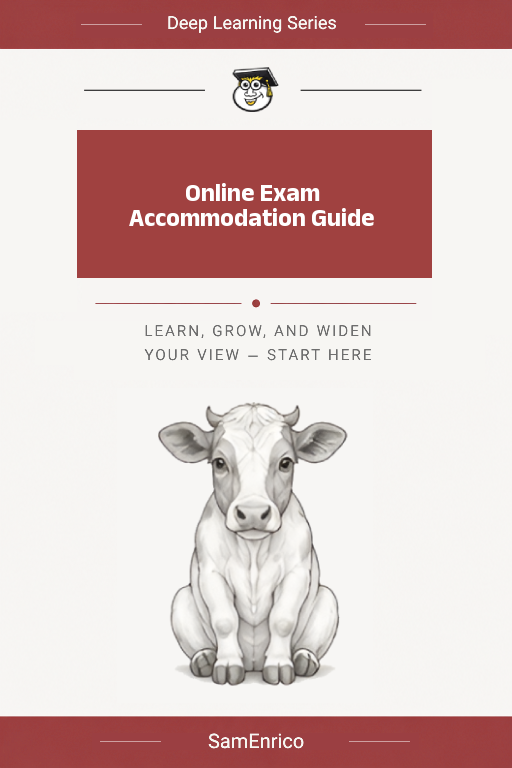
Non-FictionStudent's ShortcutAccommodations
Online Exam Accommodation Guide eBook
Request disability accommodations, extra time, or
Request disability accommodations, extra time, or alternative formats before the exam.
Formats
Free sample
Chapter 1: The Legal Shift--–- Maria had never failed a test in her life. Not in middle school, not in high school, not even in that terrifying advanced placement biology class where half the students dropped out by October. So when she saw the big red "F" on her first college midterm, she assumed there had been a grading error. She walked to her professor's office hours with confidence, ready to point out the mistake.The professor, a kind but tired woman in her fifties, pulled up Maria's exam on the screen. "You answered only thirty-two of the fifty questions," she said.
"The ones you answered were excellent. But you ran out of time."Maria stared at the screen. She remembered the clock ticking. She remembered her heart racing. She remembered reading the same question three times because the words seemed to slide off the page.
What she did not remember was any discussion of accommodations. In high school, her teachers had simply given her extra time. They had noticed she worked slowly and adjusted without being asked. Her IEP said "extended time on all assessments," and that was that."You have a diagnosed learning disability, correct?" the professor asked."Yes," Maria said. "Dyslexia.
But I have an IEP."The professor sighed—not unkindly, but with the exhaustion of someone who had given this speech a hundred times. "Maria, IEPs do not apply in college. You needed to register with Disability Services and request accommodations before the exam. I cannot go back and give you extra time now. That would be retroactive, and it wouldn't be fair to the other students."Maria walked back to her dorm room in a daze.
She had never felt disabled before. She had never felt different. But now she felt like she had been transported to a foreign country where the rules had changed overnight and no one had given her a map.This chapter is that map.Why High School and College Are Two Different Worlds The most dangerous moment in a disabled student's academic career is the transition from high school to college. Not because the coursework is harder—though it is—but because the legal framework that protects you changes completely, and almost no one tells you how.In high school, you were protected by the Individuals with Disabilities Education Act (IDEA). This law treats disability services as a civil right that the school must affirmatively seek out.
Under IDEA, schools have a legal duty to identify students with disabilities, evaluate them, and provide services. If you had an IEP or a 504 Plan in high school, your teachers knew about it. They were legally required to follow it. And if they didn't, your parents could call a meeting, escalate to the district, or even file a due process complaint.That system has a name: entitlement. The school is entitled to funding for your education, and you are entitled to services.
It is a one-way street of obligation flowing from the institution to you.College is the opposite.In college, you are protected by two different laws: Title II of the Americans with Disabilities Act (ADA) and Section 504 of the Rehabilitation Act of 1973. These laws also prohibit discrimination against people with disabilities. But they operate on a completely different principle: access, not entitlement.Here is the difference in plain language. In high school, the school has to find you. In college, you have to find the school.
In high school, the school has to provide services whether you ask for them or not. In college, if you do not ask, you do not receive. In high school, your parents can advocate for you. In college, you must advocate for yourself.This shift catches thousands of students every year. According to data from the National Center for Education Statistics, approximately 19 percent of undergraduate students report having a disability.
But of those students, fewer than half register with their college's disability services office. The other half either do not know they can register, assume their IEP carries over, or are too anxious to identify themselves as disabled.Maria fell into the second category. She assumed her IEP was a permanent document that followed her wherever she went. It is not. An IEP is a K-12 document.
It has no legal force in college. None. Zero. You cannot hand an IEP to a college professor and expect them to follow it. Some professors might try to accommodate you out of kindness, but they are not required to, and many will not.The Two Laws That Actually Protect You Let us be precise about what the ADA and Section 504 actually say.
These laws are often discussed in abstract, high-minded terms. But you need to know the specific mechanics because they determine what you can and cannot ask for.Title II of the ADA applies to all public colleges and universities. It says, in relevant part, that "no qualified individual with a disability shall, by reason of such disability, be excluded from participation in or be denied the benefits of the services, programs, or activities of a public entity."Section 504 applies to any college or university that receives federal funding—which is nearly all of them, public and private. It says, "No otherwise qualified individual with a disability shall, solely by reason of her or his disability, be excluded from the participation in, be denied the benefits of, or be subjected to discrimination under any program or activity receiving federal financial assistance."These two laws work together. The ADA covers everything.
Section 504 adds additional protections, including the right to procedural safeguards and grievance procedures.But here is what these laws do not say. They do not say that you are guaranteed success. They do not say that you are guaranteed a particular grade. They do not say that the college must lower its academic standards for you. And they do not say that accommodations must be provided retroactively—more on that in Chapter 12.What these laws do require is equal access.
That means you must have an equal opportunity to demonstrate what you have learned. If your disability creates a barrier to that demonstration—if you process written information more slowly, if anxiety causes your mind to go blank under timed conditions, if a physical disability makes typing difficult—then the college must remove that barrier, provided that doing so does not fundamentally alter the nature of the program.Reasonable Accommodation Versus Fundamental Alteration These two phrases are the most important legal terms you will learn in this book. They are the scales on which every accommodation request is weighed.A reasonable accommodation is a modification or adjustment that enables you to access the exam without changing what the exam measures. Examples include:Extra time (typically 1.5x or 2x the standard duration)A distraction-reduced environment A screen reader or text-to-speech software A human reader or scribe Stop-the-clock breaks Large-print or braille formats These are reasonable because they remove disability-related barriers while leaving the content of the exam untouched. You are still answering the same questions.
You are still being graded on the same criteria. The only thing that has changed is the conditions under which you answer.A…
This is the end of the free sample. Get the eBook to keep going. Buy now
About this book
Details
- Author
- Strother Leandra
- Publisher
- SamEnrico
- Language
- English
- Genre
- Non-Fiction, Student's Shortcut, Accommodations
- Released
- 2026-05-29
- Pages (approx.)
- 148
- Available as
- eBook, Audiobook

Read better in the ZLOADR app
Your eBooks on your phone or tablet. Sign in with your SamEnrico account and start reading.
More by Strother Leandra
 Mindful Technology Use for Stressed ParentsStrother Leandra$11.99
 Eisenhower Matrix for Life PlannersStrother Leandra$11.99
 Anger At Child's Partner ChoiceStrother Leandra$11.99
 Dribbble Shot ComparisonStrother Leandra$11.99
 Startup Inventory AccountingStrother Leandra$11.99
 Rental Property Inspection GuideStrother Leandra$11.99
 Magnesium For MoodStrother Leandra$11.99
 ESOP Tax Advantage GuideStrother Leandra$11.99
 Angels of the Ironclads: The Sisters of Mercy at Hampton RoadsStrother Leandra$11.99
 Pixels and Prophecies: The AI Oracle of Ancient BabylonStrother Leandra$11.99
 How to Produce a Suspension SystemStrother Leandra$11.99
 A Collector's Handbook to the Fiat 128 3pStrother Leandra$11.99
You may also like
 Hong Kong Handover 1997Dunn Johnnie$11.99
 Zumba For Postnatal Recovery CourseNeal Christian$11.99
 Zumba for BeginnersLadner Nikia$11.99
 YouTube Comment Mining GuideHumes Pandora$12.99
 Worry Box MeditationCarlin Rudy$11.99
 Workplace Stress MeditationNguyen Lynn$11.99
 Workplace Stress and Sleep RepairHawley Ivory$11.99
 Workplace Perfectionism CureDelaney Jeffry$11.99
 Workplace Injustice Anger GuideWallen Isabelle$11.99
 Work Addiction and Burnout LinkGreenwood Ester$11.99
 Women in Yoga and WellnessBeattie Galina$11.99
 Women in Stand Up ComedyChun Evangeline$11.99