
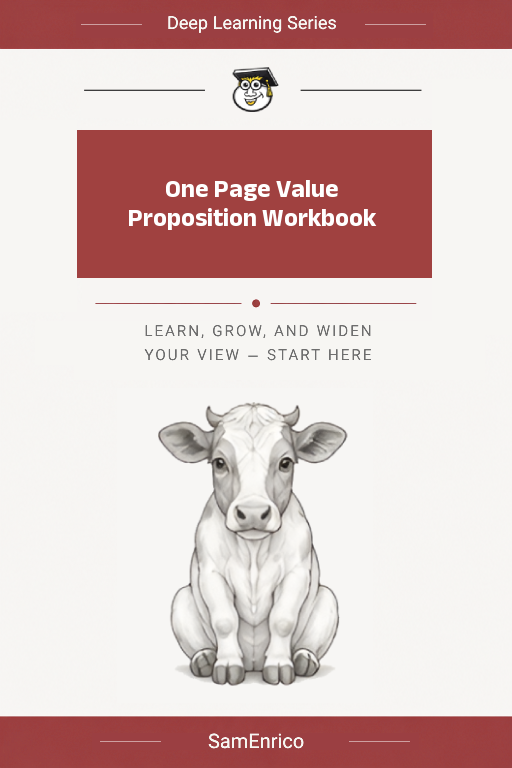
Non-FictionBusiness BriefMessaging Strategy
One Page Value Proposition Workbook eBook
Clarify your core value proposition on one page, t
Clarify your core value proposition on one page, testing and refining messaging that resonates with target customer segments.
Formats
Free sample
Chapter 1: The Jargon Monster--–- You are about to make a confession. Not to me, not to your team, but to yourself. Somewhere inside your laptop, your pitch deck, or your website right now, there is a sentence that makes you wince when you read it aloud. It is probably full of words like “synergy,” “best-in-class,” “disruptive,” “cutting-edge,” “robust,” or “world-class.” You wrote it because everyone else writes those words. You kept it because deleting it felt like losing something important.
But here is the truth that will set you free: that sentence is garbage. It means nothing to your customers. It convinces no one. And it is the single biggest reason your value proposition is failing.This chapter is called “The Jargon Monster” because I want you to visualize the enemy. The Jargon Monster is not a person.
It is a force—a gravitational pull toward vague, adjective-filled, feature-heavy language that feels safe to you but sounds like static to everyone else. The Jargon Monster feeds on your fear of being specific. Every time you write “innovative solution” instead of describing what your product actually does, you feed the monster. Every time you say “we help companies optimize workflows” instead of “we help project managers stop losing client feedback in email threads,” you feed the monster. And the monster grows fat and happy while your customers click away.By the end of this chapter, you will have performed an autopsy on your current value proposition.
You will have circled every piece of jargon, counted every empty adjective, and faced the painful gap between what you think you are saying and what customers actually hear. You will also make a promise—a constraint that will govern everything else in this workbook. That constraint is simple and brutal: your final value proposition will contain no more than fifty words plus one diagram. Anything more is cowardice dressed up as thoroughness. Anything more is the Jargon Monster winning.Let us begin with the story of how I learned to see the monster.The $100,000 Sentence A few years ago, I was consulting for a software startup that had raised a respectable seed round.
They had seven engineers, a beautiful office with exposed brick, and a product that actually worked. Their problem was not technical. Their problem was that nobody could explain what the product did without sounding like a press release.The founder, let us call her Maya, had written the company’s value proposition on the wall of the conference room in giant vinyl letters. It read: “We empower global enterprises to leverage real-time data for synergistic cross-functional alignment and scalable decision-making.”I asked Maya what that meant. She laughed nervously and said, “It means we help companies connect their CRM to their analytics dashboard.”I asked why she did not just write that on the wall.
She paused for a long time and then said, “Because it sounds too small.”That is the Jargon Monster. It convinces you that specific is small, that plain language is unsophisticated, that your product needs to sound complicated to sound valuable. The opposite is true. Specific is trustworthy. Plain language is confident.
Complicated is the language of people who do not actually understand what they are selling.Maya’s team had spent 100,000onaproductlaunchthatflopped.Theirlandingpagehadabeautifulheroimageandthatvinyl−lettersentence.Theyran100,000 on a product launch that flopped. Their landing page had a beautiful hero image and that vinyl-letter sentence. They ran 100,000onaproductlaunchthatflopped.Theirlandingpagehadabeautifulheroimageandthatvinyl−lettersentence.Theyran50,000 in Google ads. They got a 0.8 percent click-through rate. Customers who did click stayed for an average of eleven seconds—barely long enough to read the headline.When I finally convinced Maya to replace the wall sentence with “We connect your CRM to your analytics dashboard in five minutes,” her head of marketing objected.
He said it was “too narrow.” He said they were “leaving money on the table” by not mentioning all the other things the product could do. That is the Jargon Monster speaking through your team. It sounds like wisdom. It sounds like strategy. It is fear dressed in business casual.We ran an A/B test.
The “too narrow” headline got a 4.2 percent click-through rate—five times higher than the original. Time on page went from eleven seconds to forty-seven seconds. The Jargon Monster lost.The 90 Percent Problem You are not alone. Maya’s problem is the rule, not the exception. I have analyzed over two hundred value propositions from startups, Fortune 500 companies, nonprofits, and solopreneurs.
Ninety percent of them commit the same sin: they use vague, jargon-filled language that could apply to almost any product in almost any industry.Let me prove this to you. Here are five real value propositions taken from real company websites. I have changed the company names, but the words are verbatim.“We deliver innovative, end-to-end solutions that drive operational excellence and sustainable growth.”“A cutting-edge platform for data-driven insights and actionable intelligence.”“Empowering businesses to transform their digital ecosystem through seamless integration and robust security.”“World-class service delivery with a focus on customer-centric innovation and scalable infrastructure.”“Leveraging next-generation technology to unlock hidden value and optimize performance.”Now, be honest. Could you tell me what any of these companies actually does? Could you describe their product?
Their customer? The specific problem they solve? You cannot. Because these sentences contain no information. They are linguistic placeholders—empty calories that feel nourishing but provide nothing.The 90 percent problem is not a failure of intelligence or effort.
It is a failure of courage. Writing a specific value proposition requires you to make choices. You have to pick one customer, one problem, and one outcome. You have to leave everything else out. That feels dangerous because you are afraid of the customers you might lose.
But here is the counterintuitive truth: a specific value proposition loses the wrong customers and attracts the right ones. A vague value proposition attracts no one.The Napkin Test There is a simple diagnostic tool I want you to use for the rest of this book. I call it the Napkin Test. Here is how it works.Imagine you are at a coffee shop. A stranger sits down at your table.
You have thirty seconds to explain what your product does. You cannot use a slide deck, a demo, or a whiteboard. You only have a napkin and a pen. The stranger knows nothing about your industry, your competitors, or your technology.If you cannot sketch your value proposition on that napkin in thirty seconds in a way that makes the stranger say “Oh, I get it,” then your value proposition is not ready. It does not matter how polished your website is.
It does not matter how many features you have built. The napkin is the truth machine.The napkin works because it forces you to strip away everything non-essential. You cannot fit “synergistic cross-functional alignment” on a napkin. You cannot draw “best-in-class.” But you can write “We connect X to Y” or “We save Z from having to do W.” Those are napkin sentences. Those are value propositions that work.For the rest of this book, your goal is to create a One Pager that would pass the Napkin Test.
That means fifty words or fewer, plus one diagram that a stranger could understand in thirty seconds. Every word beyond…
This is the end of the free sample. Get the eBook to keep going. Buy now
About this book
Details
- Author
- Purvis Nakita
- Publisher
- SamEnrico
- Language
- English
- Genre
- Non-Fiction, Business Brief, Messaging Strategy
- Released
- 2026-05-29
- Pages (approx.)
- 140
- Available as
- eBook, Audiobook

Read better in the ZLOADR app
Your eBooks on your phone or tablet. Sign in with your SamEnrico account and start reading.
More by Purvis Nakita
 Talent Migration in Financial ServicesPurvis Nakita$11.99
 Gambling Addiction and Self WorthPurvis Nakita$11.99
 Emotional Suppression RecoveryPurvis Nakita$11.99
 Ancestor Veneration PracticePurvis Nakita$11.99
 The Amanda Knox Appeal Victory GuidePurvis Nakita$11.99
 The Dragon’s Bride: A Love Forged in FirePurvis Nakita$11.99
 Real Estate Distressed Assets GuidePurvis Nakita$12.99
 Understanding Leukemia SubleukemicPurvis Nakita$17.99
 How to Become a Collar-turner OperatorPurvis Nakita$11.99
You may also like
 Hong Kong Handover 1997Dunn Johnnie$11.99
 Zumba For Postnatal Recovery CourseNeal Christian$11.99
 Zumba for BeginnersLadner Nikia$11.99
 YouTube Comment Mining GuideHumes Pandora$12.99
 Worry Box MeditationCarlin Rudy$11.99
 Workplace Stress MeditationNguyen Lynn$11.99
 Workplace Stress and Sleep RepairHawley Ivory$11.99
 Workplace Perfectionism CureDelaney Jeffry$11.99
 Workplace Injustice Anger GuideWallen Isabelle$11.99
 Work Addiction and Burnout LinkGreenwood Ester$11.99
 Women in Yoga and WellnessBeattie Galina$11.99
 Women in Stand Up ComedyChun Evangeline$11.99