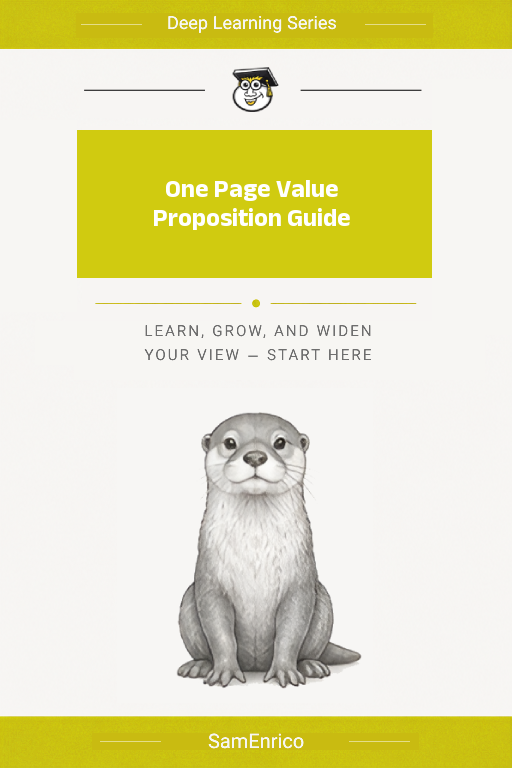
One Page Value Proposition Guide eBook
Craft a compelling unique selling proposition on o
Craft a compelling unique selling proposition on one sheet including customer pains, gains, and differentiation for clearer messaging.
Formats
Free sample
Chapter 1: The Pain Audit--–- Most entrepreneurs believe they know their customer's pain. They are almost always wrong.You think you know why people buy from you. You have a theory, probably rehearsed in a dozen investor pitches and buried somewhere on your "About Us" page. Your theory sounds something like this: "We help busy professionals save time and reduce costs through our innovative, AI-driven platform."That sentence is not a value proposition. It is a lullaby.
It is designed to put customers to sleep so you don't have to face the uncomfortable truth.The uncomfortable truth is this: You have never actually audited your customer's pain. You have guessed at it. You have inferred it from your own assumptions. You have projected your own anxieties onto strangers. And that is why your marketing feels hollow, your sales calls feel forced, and your conversion rates feel like a punishment.This chapter is the intervention.
By the time you finish reading it, you will never again use the word "solution" without first naming the specific, urgent, financially measurable wound you are trying to heal. You will learn to distinguish between surface annoyances (which customers will tolerate forever) and critical business issues (which will make them write you a check today). And you will complete a Pain Audit that will become the foundation of your One-Page Value Proposition.Let us begin by diagnosing why most pain analysis fails before it starts.The Surface Pain Epidemic Walk into any co-working space on a Tuesday morning and eavesdrop on ten conversations between founders. You will hear a chorus of surface pains masquerading as deep insights."Our customers struggle with manual data entry.""They waste too much time on scheduling.""Their current software is too complicated."These are not pains. These are observations.
They are the business equivalent of saying "water is wet." Every customer in every industry wastes time on something. Every software product has a learning curve. Manual data entry has existed since the invention of spreadsheets. None of these observations will compel a single person to pull out their credit card.Here is the brutal distinction you must internalize: Surface pain is an annoyance. Critical business issues are financial or existential threats.Surface pain is the mosquito buzzing around your ear at night.
Annoying. Irritating. But not worth getting out of bed to hunt down. You will tolerate surface pain indefinitely because the cost of solving it (time, money, cognitive load) feels higher than the cost of enduring it.Critical business issues are the house on fire. You do not tolerate a house fire.
You do not schedule a meeting to discuss the house fire. You drop everything, run outside, and pay whatever it takes to make the fire stop.Most businesses build their entire value proposition around solving surface pains. They sell mosquito swatters to people who have learned to sleep through the buzzing. And then they wonder why nobody is buying.Consider the difference in how a customer behaves when you target surface pain versus critical business issues.Surface pain pitch: "Our software automates your expense reporting." Customer response: "That's nice. My current manual process takes about two hours a month.
I usually just do it while watching Netflix. I'll think about it." Translation: I will never think about it again.Critical business issue pitch: "Your current manual expense reporting process causes you to miss an average of three tax deductions per quarter, costing you 4,500annuallyinoverpaidtaxes,andyourfinanceteamjusttoldmetheyfound4,500 annually in overpaid taxes, and your finance team just told me they found 4,500annuallyinoverpaidtaxes,andyourfinanceteamjusttoldmetheyfound12,000 in unreimbursed expenses from last year that you can never recover." Customer response: "Show me how this works. Can we implement before the end of the quarter?" Translation: Take my money now.Same product. Same features. Different pain layer.
The surface pain was an inconvenience. The critical business issue was a leak in the boat.The Problem Audit Checklist You cannot guess your way to critical business issues. You must audit them systematically. The Problem Audit Checklist is a tool designed to extract the specific, measurable, emotional cost of your customer's current state. It is not a survey.
It is not a focus group. It is an interrogation of reality.You will use this checklist in two ways. First, you will interview at least five existing customers or recent lost prospects. Second, you will interview your own sales team if you have one. The goal is not to collect opinions.
The goal is to collect numbers and narratives.Here is the complete Problem Audit Checklist. Each question is designed to push past the surface and into the critical layer.Question One: What specific problem are you trying to solve right now?This is the warm-up. The customer will give you a surface answer. "Our reporting takes too long." "We lose data between systems." Do not write this down as your final answer. Write it down as your starting point.
Then smile and ask the next question.Question Two: How much does that problem cost you in dollars per month or per year?Most entrepreneurs skip this question because they assume the customer does not know the answer. The customer knows. They may not have calculated it, but they feel it. Ask anyway. If they say "I don't know," ask them to estimate.
"Take a guess. Within fifty percent. Is it more like one thousand dollars or ten thousand dollars?" The act of estimating forces them to acknowledge that the problem has a price tag. Their answer will surprise you. It will almost always be higher than you assumed.Question Three: How many hours per week do you or your team waste because of this problem?Time is the second currency.
Calculate the hourly rate of the person doing the wasted work. If a manager earning fifty dollars per hour wastes ten hours per week, that is five hundred dollars per week, twenty-six thousand dollars per year, before you have even accounted for the direct financial cost. Write this number down. Circle it.Question Four: What is the emotional cost of this problem?This is the question most competitors never ask. Does the problem cause stress?
Anxiety? Late nights? Arguments with spouses? Fear of being fired? Fear of looking incompetent in front of peers?
The emotional cost is often higher than the financial cost because emotions are immediate and visceral. A twenty thousand dollar annual loss feels abstract. A nightly knot in your stomach feels real.Question Five: What have you already tried to solve this problem?Their answer reveals three things. First, it reveals how motivated they are. People who have tried nothing are not yet serious.
Second, it reveals what solutions they have rejected. If they tried a competitor and hated it, you now know what not to do. Third, it reveals their budget. People who have spent money on failed solutions are often willing to spend more money on the right solution.Question Six: What happens if this problem never gets solved?This is the existential question. Paint the future where the problem persists.
Do they lose clients? Do they miss revenue targets? Does the business become less valuable? Does a key employee quit out of…
This is the end of the free sample. Get the eBook to keep going. Buy now
About this book
Details
- Author
- Heffner Kareem
- Publisher
- SamEnrico
- Language
- English
- Genre
- Non-Fiction, Business Brief, Messaging
- Released
- 2026-06-01
- Pages (approx.)
- 124
- Available as
- eBook, Audiobook

Read better in the ZLOADR app
Your eBooks on your phone or tablet. Sign in with your SamEnrico account and start reading.
More by Heffner Kareem
 Executive Sleep OptimizationHeffner Kareem$11.99
 Mindful Gardening Practice ManualHeffner Kareem$11.99
 Emotion Regulation Eating GuideHeffner Kareem$11.99
 Awkward Silence Rescue GuideHeffner Kareem$11.99
 Parent Death and Adoption ReunionHeffner Kareem$11.99
 The Last Hurrah: The Rise and Fall of the 1976 Montreal OlympicsHeffner Kareem$11.99
 The Last Pharaoh's Gambit: Cleopatra's Secret War for EgyptHeffner Kareem$11.99
 Understanding Glycogen Storage Disease Type ViiiHeffner Kareem$17.99
 Grants for Youth NonprofitsHeffner Kareem$12.99
 How to Become a Track SupervisorHeffner Kareem$11.99
 Order Filler PickerHeffner Kareem$11.99