
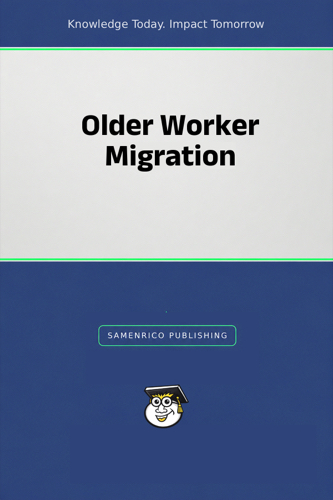
Older Worker Migration eBook
Forecasts movement of experienced professionals ag
by Parham Emely
Forecasts movement of experienced professionals aged 50+.
Formats
Free sample
Chapter 1: The Demographic Earthquake--The numbers arrived like tremors before the quake—unnoticed by most, dismissed by many, but undeniable to those paying attention. In 1990, across the developed economies of North America, Europe, and East Asia, the labor force resembled a pyramid: a wide base of young workers supporting a narrowing peak of older employees nearing retirement. By 2020, that pyramid had inverted. And by 2030, if current demographic projections hold, something unprecedented will occur: the number of workers aged fifty and older will surpass the number of workers under thirty in most G20 nations.This is not a slow, gentle aging of the population that economists have been predicting for decades. This is a demographic earthquake—a sudden, seismic shift in the composition of the workforce that has already begun to reshape labor markets, housing patterns, and migration flows.
And like any earthquake, its aftershocks will be felt for generations.The purpose of this chapter is to establish the macro-level foundation for everything that follows in this book. Before we can understand why older workers migrate, where they go, what barriers they face, and how policy might respond, we must first understand the sheer scale of what is happening. The graying of the workforce is not a trend. It is a transformation. And it is happening faster than almost anyone anticipated.Consider the numbers.
In the United States, labor force participation among workers aged fifty-five and older has risen from 29 percent in 1990 to over 40 percent today. That increase represents millions of additional older workers remaining in or re-entering the workforce at precisely the moment when younger labor force participation has stagnated or declined. In Japan, the most rapidly aging society on earth, nearly one in four workers is now aged sixty-five or older—a statistic that would have been unthinkable a generation ago. In Germany, the federal government has quietly abandoned its early retirement incentives and is now actively recruiting older workers to fill labor shortages. In South Korea, where the population is aging faster than any other OECD nation, the mandatory retirement age has been raised to sixty, and discussions continue about pushing it even higher.What is driving this transformation?
The answer is not simple, but it can be distilled into three interconnected forces: increasing longevity, declining birth rates, and the collapse of the traditional lifetime employment system.Let us examine each in turn.The Longevity Revolution At the beginning of the twentieth century, life expectancy at birth in developed economies hovered around fifty years. By 1950, it had climbed to sixty-five. By 2000, it reached seventy-eight. Today, a child born in Japan, Switzerland, or Singapore can expect to live well into their eighties, and a significant portion of that child's cohort will celebrate their hundredth birthday. This is the longevity revolution—one of the most remarkable achievements in human history, and one of the most disruptive.Living longer means, quite simply, that the traditional three-stage life—education, work, retirement—no longer fits.
The old model assumed that workers would spend approximately forty years in the workforce, from their mid-twenties to their mid-sixties, followed by a decade or two of retirement funded by pensions and savings. But if workers are living into their eighties and nineties, a forty-year career leaves thirty years of retirement to fund. For most people, that mathematics simply does not work.The result is that older workers are staying in the workforce longer—not because they want to, necessarily, but because they have to. They need the income. They need the health insurance.
They need the continued contributions to their retirement accounts. And so they keep working, year after year, pushing the average retirement age steadily upward.But here is the paradox: while older workers are staying in the workforce longer, the labor market is becoming increasingly hostile to them. This is the central tension that animates this entire book. Demographics demand that we keep older workers productive. But corporate practices, hiring algorithms, and cultural biases push them out.The Birth Rate Collapse The second force driving the demographic earthquake is the collapse of birth rates across the developed world.
In 1960, the average woman in an OECD country had approximately three children. By 2020, that number had fallen to 1.5—well below the replacement rate of 2.1 needed to maintain a stable population without immigration.The consequences of this decline are profound and widely misunderstood. A falling birth rate does not simply mean fewer children. It means, twenty and thirty years later, fewer young workers entering the labor force. It means a shrinking base of the population pyramid supporting a growing peak.
It means that, for the first time in modern history, many developed economies are facing absolute declines in their working-age populations.Consider Japan. The country's working-age population peaked in 1995 and has been declining ever since. By 2040, it is projected to fall by another 20 percent. Germany faces a similar trajectory. Italy, Spain, Portugal, Greece—all are shrinking from within.
Even the United States, with its relatively higher birth rates and robust immigration, is not immune. The U.S. working-age population grew by only 0.2 percent in 2020, the slowest rate on record.The implications for labor markets are staggering. When the number of young workers entering the workforce is smaller than the number of older workers leaving it, labor shortages become inevitable. Employers begin to compete for talent in ways they have not had to for generations.
Wages rise for in-demand skills. And older workers—who were once pushed toward the exit—suddenly find themselves courted and valued.But this shift is happening unevenly, and it is happening against the backdrop of a third force: the collapse of the traditional employment system.The End of Lifetime Employment For much of the twentieth century, a dominant employment model prevailed across the developed world, albeit with national variations. In Japan, it was called shūshin koyō—lifetime employment. In Germany, the Sozialstaat provided a thick cushion of social protections and job security. In the United States, the post-war compact between labor and capital gave rise to the "organization man" who could expect to spend his entire career with a single company, climbing the ladder from entry-level to executive suite.That world is gone.
It has been replaced by something far more fluid, far more precarious, and far more demanding of workers at every age.The neoliberal turn of the 1980s and 1990s brought with it a set of assumptions that now seem almost quaint in their brutality: labor markets should be flexible, workers should be mobile, and loyalty between employer and employee is an antiquated relic. Shareholder primacy replaced stakeholder capitalism. Quarterly earnings replaced long-term investment. And the implicit promise that hard work would be rewarded with a stable career and a dignified retirement was quietly abandoned.What emerged is what economists call the "gig economy" but what might more accurately be described as the "precarious economy." Full-time, benefit-bearing positions have given way to contract work, part-time arrangements, and platform-mediated labor. Workers are expected to be entrepreneurs of their own careers, constantly retraining, relocating, and reinventing themselves.For young workers, this new world is challenging but familiar.
They have never known anything different. For older workers, however, the transition has been brutal. Having spent decades internalizing the…
This is the end of the free sample. Get the eBook to keep going. Buy now
About this book
Details
- Author
- Parham Emely
- Publisher
- SamEnrico
- Language
- English
- Genre
- Non-Fiction, Forecast & Outlook, Aging Workforce
- Released
- 2026-06-09
- Pages (approx.)
- 151
- Available as
- eBook, Audiobook

Read better in the ZLOADR app
Your eBooks on your phone or tablet. Sign in with your SamEnrico account and start reading.
More by Parham Emely
 Meditation for Abandonment FearParham Emely$11.99
 Metta For Social AnxietyParham Emely$11.99
 Fishery Quota SystemsParham Emely$11.99
 Assertive Communication HandbookParham Emely$11.99
 Mindful Conflict Resolution GuideParham Emely$11.99
 Food Insecurity Student GuideParham Emely$11.99
 Parent Caregiver Grief GuideParham Emely$11.99
 Self Worth And Body ImageParham Emely$11.99
 The Whispering Apothecary: Ancient Nubia's Forgotten HealersParham Emely$11.99
 The Platters: Only You, Only ThemParham Emely$11.99
 The Last Whistle: The Haunting of the Centralia Mine FireParham Emely$11.99
 Growing DovyalisParham Emely$11.99