
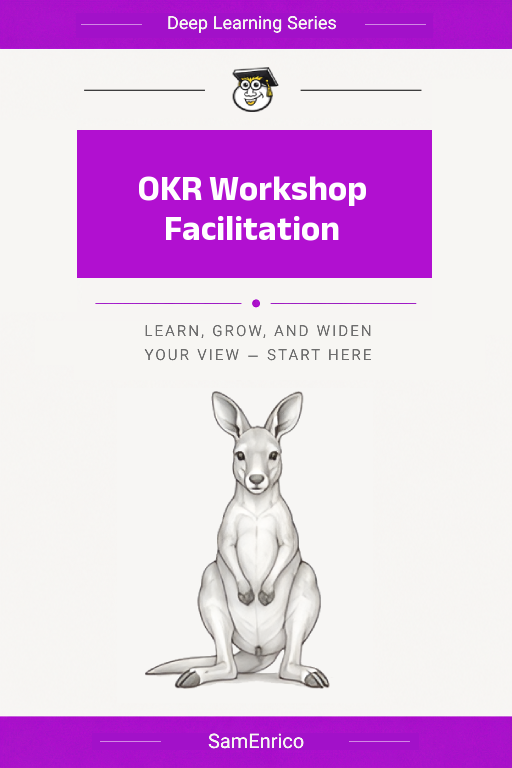
Non-FictionProfessional's Cheat SheetWorkshop
OKR Workshop Facilitation eBook
Run 2-hour OKR setting workshops that engage the w
Run 2-hour OKR setting workshops that engage the whole team without burnout.
Formats
Free sample
Chapter 1: The Math of Misery--–- It begins with a calendar invite.The subject line reads: "Q3 OKR Planning Workshop – All Day (8:00 AM – 5:00 PM)." Catering will be provided. There is a Miro board link that no one will look at until five minutes before the start. There is a pre-reading document that runs to forty-seven pages. And there is a familiar, sinking feeling in the stomach of every single person on that invite list.They know what is coming. The facilitator knows it too.Eight hours.
Three breakout sessions. Two sticky-note graveyards. One argument about whether "improve customer satisfaction" is measurable enough. Zero decisions that feel final. And by 4:00 PM, the team will be glassy-eyed, hungry, and secretly resenting the very concept of goals.This is not a failure of the team.
It is a failure of the format. And it is the single biggest reason OKRs fail not in theory, but in practice.Most organisations treat OKR workshops like weddings: they happen once a quarter, they take all day, and everyone feels obligated to attend even though they would rather be doing actual work. But the research on decision-making, creative energy, and group dynamics tells a very different story. The all-day workshop is not just inefficient. It is neurologically counterproductive.This chapter will make the case for a radical alternative: the two-hour OKR workshop.
It will show you why shorter sessions produce better goals, how to structure a "Clean Quarter" around multiple short touchpoints, and how to adapt the two-hour window for different team contexts. By the end of this chapter, you will never again book a full-day offsite for goal-setting. And your teams will thank you.The Hidden Cost of the All-Day Workshop Let us start with a simple question. If you gave a team eight hours to set their OKRs, how many of those hours would be genuinely productive?The honest answer, backed by observation studies of corporate workshops, is somewhere between two and three hours. The remaining five to six hours are consumed by what organisational psychologists call "social performance" – the behaviours we exhibit not because they advance the work, but because we are being watched.Social performance takes many forms.
There is the repetition loop, where the same idea gets rephrased by three different people to demonstrate their engagement. There is the status battle, where senior team members talk past each other to establish dominance rather than alignment. There is the polite silence, where everyone knows an idea is bad but no one wants to be the person who says so. And there is the afternoon slump, where the combination of a heavy lunch and cognitive exhaustion reduces contributions to "mm-hmm" and nodding.None of these behaviours produce better OKRs. But they thrive in long meetings because the brain runs out of the fuel required to suppress them.The psychologist Roy Baumeister's work on decision fatigue is instructive here.
His research shows that each decision a person makes depletes a finite reservoir of mental energy. As the reservoir empties, the brain becomes more impulsive, more passive, and more likely to default to the easiest option rather than the best option. This is why judges give harsher sentences before lunch and why shoppers buy more candy at the checkout. The same dynamic destroys workshops.In an all-day OKR session, a participant might make hundreds of small decisions: whether to speak or listen, whether to agree or challenge, whether to write a goal as "increase" or "improve," whether to vote for cluster A or cluster B. By hour six, their decision-making capacity is shot.
They stop pushing for clarity. They stop asking "so what?" They start agreeing to whatever gets them out of the room fastest.The result is OKRs that look good on a whiteboard and dissolve on contact with reality.The Neuroscience of the Two-Hour Window If decision fatigue sets in after roughly ninety minutes of intense cognitive work, the logical conclusion is not to push through. It is to stop.The two-hour window is not an arbitrary preference. It is a ceiling based on how the human brain processes complex, ambiguous problems like goal-setting. Here is what the research tells us.First, creative problem-solving has a hard limit of approximately ninety minutes of peak performance.
In a study of knowledge workers conducted by the Draugiem Group, researchers found that the most productive employees worked in focused sprints of fifty-two minutes followed by seventeen-minute breaks. The least productive employees worked in erratic bursts with no pattern. The key insight is that deep creative work cannot be sustained indefinitely. It requires recovery.Second, group decision-making quality declines significantly after two hours of continuous work. A study published in the journal Organizational Behavior and Human Decision Processes found that the quality of group decisions dropped by nearly forty percent between the first hour and the fourth hour of continuous deliberation.
The groups did not notice the decline. They believed they were getting better. But objective measures showed the opposite.Third, the presence of a time constraint improves focus and reduces political behaviour. When a group knows it has limited time, it becomes more selective about what it discusses. Off-topic tangents are shut down faster.
Status battles are deferred. The group develops what sociologists call "time-induced cooperation" – a willingness to compromise because the alternative is no decision at all.This is the paradox of workshop design. More time does not produce better outcomes. It produces more politics, more fatigue, and more mediocre compromises. Less time produces focus, discipline, and surprisingly better results.The two-hour OKR workshop works because it forces the team to do only what matters.
There is no time for the forty-seven-page pre-reading document. There is no time for the third breakout session. There is only time for the essential work of setting goals: reviewing what happened, deciding what matters next, and turning that into measurable commitments.Introducing the Clean Quarter The two-hour workshop does not exist in isolation. It is the centrepiece of a broader rhythm called the Clean Quarter.The Clean Quarter is a structured, multi-day rollout that spans approximately two weeks from start to finish. It ensures that the workshop itself is a confirmation of pre-work and a kickoff for action, not a creation session from scratch.
Here is how it works.Day -14: Leadership Guardrails Two weeks before the workshop, the facilitator meets with the Decider (the person with final authority) for the Strategic Brief. This thirty-minute conversation establishes the boundaries within which the team will operate. What is the budget for the quarter? What is the team's capacity in terms of people and hours? What strategic priorities are non-negotiable?
What risks must be avoided?Without these guardrails, teams generate what practitioners call "fantasy OKRs" – ambitious goals that are impossible to achieve given real-world constraints. The facilitator's job is not to set the guardrails but to extract them from leadership before the workshop begins.Day -7: Prep Packet Distributed One week before the workshop, the facilitator distributes the Prep Packet. This document is designed to be read in fifteen minutes or less. It contains three things: (1) the hard numbers from the previous quarter (actual versus target KRs), (2) the capacity data for…
This is the end of the free sample. Get the eBook to keep going. Buy now
About this book
Details
- Author
- Braswell Janell
- Publisher
- SamEnrico
- Language
- English
- Genre
- Non-Fiction, Professional's Cheat Sheet, Workshop
- Released
- 2026-05-29
- Pages (approx.)
- 152
- Available as
- eBook, Audiobook

Read better in the ZLOADR app
Your eBooks on your phone or tablet. Sign in with your SamEnrico account and start reading.
More by Braswell Janell
 Business Continuity Pandemic DrillsBraswell Janell$11.99
 Project Weekly Review GuideBraswell Janell$11.99
 Glycogen Replenishment GuideBraswell Janell$11.99
 Emotion Diary Card WorkbookBraswell Janell$11.99
 Pushing Lawn MowerBraswell Janell$11.99
 Foster Care Birthday JournalBraswell Janell$11.99
 Gig Economy Tax Deduction GuideBraswell Janell$11.99
 Selling the Family HomeBraswell Janell$11.99
 The Silk & Steel of Sydney: Rose Seidler and the Modernist RevolutionBraswell Janell$11.99
 How to Produce Marine SuppliesBraswell Janell$11.99
 Service Providers Guide to Transcript DigestingBraswell Janell$11.99
 How to Produce WheelchairsBraswell Janell$11.99
You may also like
 Hong Kong Handover 1997Dunn Johnnie$11.99
 Zumba For Postnatal Recovery CourseNeal Christian$11.99
 Zumba for BeginnersLadner Nikia$11.99
 YouTube Comment Mining GuideHumes Pandora$12.99
 Worry Box MeditationCarlin Rudy$11.99
 Workplace Stress MeditationNguyen Lynn$11.99
 Workplace Stress and Sleep RepairHawley Ivory$11.99
 Workplace Perfectionism CureDelaney Jeffry$11.99
 Workplace Injustice Anger GuideWallen Isabelle$11.99
 Work Addiction and Burnout LinkGreenwood Ester$11.99
 Women in Yoga and WellnessBeattie Galina$11.99
 Women in Stand Up ComedyChun Evangeline$11.99