
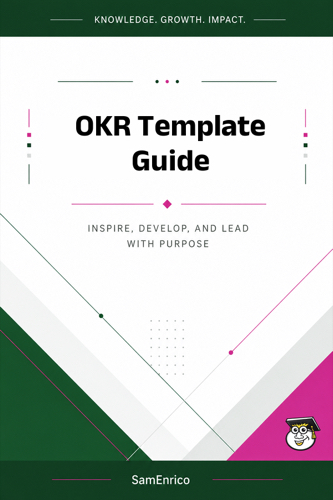
OKR Template Guide eBook
Use fill in the blank OKR worksheets.
by Newby Samuel
Use fill in the blank OKR worksheets.
Formats
Free sample
Chapter 1: The Task Trap--–- Every failed OKR implementation starts with the same innocent mistake. A team sits down to plan their quarter. Someone opens a spreadsheet or a template. They write down what they intend to do. "Launch the new website by April 15th." "Increase customer satisfaction." "Hold three training sessions." These sound like goals.
They look like goals. They feel productive and concrete. And they are almost entirely useless.I have watched this scene play out more than two hundred times across startups, scale-ups, and Fortune 500 enterprises. The pattern is uncanny. Well-intentioned leaders, smart teams, plenty of resources, and a genuine desire to improve.
They have read about OKRs. They have heard that Google uses them, that Intel invented them, that John Doerr wrote a bestseller about them. So they gather in a conference room, armed with sticky notes and enthusiasm, and they begin writing.Within an hour, they have produced something that looks like an OKR framework. There are Objectives at the top, bold and inspiring. There are Key Results underneath, numbered neatly.
The spreadsheet is formatted beautifully. Someone volunteers to be the "OKR Champion." Another person offers to build a dashboard. Everyone feels a sense of progress.And then the quarter ends. Nothing changed.Not because the team was lazy. Not because the goals were too ambitious.
Not because of politics or incompetence or bad luck. The OKRs failed for one simple, preventable reason: the team confused tasks with outcomes. They wrote a to-do list and called it a strategy. They measured activity and called it progress. And they walked straight into what I call the Task Trap.This chapter is about avoiding that trap.
It is the single most important chapter in this book because every worksheet, every template, and every process that follows depends on you mastering the distinction between tasks and outcomes. If you skip this foundation, the remaining eleven chapters will give you elegant tools for managing the wrong things. If you master this chapter, everything else becomes simple.We will start by dissecting the anatomy of a genuine OKR. Then we will introduce a two‑question filter that will change how you think about goals forever. We will walk through concrete examples, common mistakes, and the precise language that separates high‑performing teams from the rest.
By the end of this chapter, you will never look at a quarterly plan the same way again.The Hidden Epidemic of Fake Goals Let me share a story that haunts me. A few years ago, I was invited to review the OKR process at a mid‑sized software company. They had been running OKRs for three full years. Three years. They had a dedicated OKR coordinator, a custom‑built tracking tool, and a quarterly off‑site that cost tens of thousands of dollars.
The CEO was frustrated. "We keep missing our targets," she told me. "I don't understand. We have more discipline than anyone I know."I asked to see their OKRs from the previous quarter. The coordinator proudly opened the dashboard.
There were twelve Objectives, each with three to five Key Results. Over fifty goals for a company of a hundred and twenty people. I scanned the list."Launch the mobile app redesign by February 15.""Hold quarterly business reviews with all key accounts.""Implement the new CRM system.""Hire three backend engineers.""Complete security audit."I stopped reading. "These aren't Key Results," I said. "These are tasks."The coordinator looked confused.
"But we completed most of them. Look at the checkmarks."She was right. They had checkmarks next to seventy percent of the items. By their own measurement, they were succeeding. And yet the CEO was furious because revenue was flat, churn was up, and customer satisfaction had dropped.
The team had been busy. Very busy. They launched the app redesign. They held the reviews. They implemented the CRM.
They hired the engineers. They completed the audit. They did everything they said they would do. And none of it moved the metrics that mattered.This is the hidden epidemic of modern management. Teams are drowning in activity and starving for outcomes.
We celebrate the launch, the feature, the hire, the audit, the report. We check boxes and feel productive. But the business doesn't care about your activity. The business cares about what changes because of that activity.The app redesign launched. Did conversion rates increase?
Unknown, because no one measured before and after. The quarterly business reviews happened. Did account retention improve? Unknown, because no one tracked renewal rates. The CRM was implemented.
Did sales velocity increase? Unknown, because the team was too busy implementing to establish a baseline.The Task Trap is seductive because tasks are safe. You can control a task. You can schedule it, assign it, track it, and complete it. Outcomes are not safe.
You can do everything right and still miss an outcome because the market shifted, a competitor launched, or customer behavior changed. Outcomes require vulnerability. And most organizations, most leaders, most teams are deeply uncomfortable with vulnerability. So they retreat to tasks. They write OKRs that look like project plans.
And then they wonder why their strategy never materializes.The Anatomy of a Genuine OKRBefore we can escape the Task Trap, we need to understand what we are escaping toward. A genuine OKR has two components, and they serve completely different functions.The Objective is the destination. It answers the question: where are we going? A well‑written Objective is qualitative, inspiring, and time‑bound. It describes a future state that does not currently exist.
It makes you feel something. It fits on a sticky note. It contains no numbers.Examples of genuine Objectives:"Delight every customer who contacts support.""Make our mobile app feel instantaneous.""Transform how our sales team uses data.""Protect customer privacy without compromising trust."Notice what is missing. No percentages. No dates.
No specific targets. The Objective is the "what" and the "why" compressed into a single, memorable statement.The Key Result is the measurement. It answers the question: how will we know we are succeeding? A well‑written Key Result is quantitative, specific, and time‑bound. It takes the form of a metric that moves from a baseline to a target.
It contains numbers, dates, and nothing else.Examples of genuine Key Results (paired with the Objectives above):From 3.2 → to 4.8 customer satisfaction score by June 30.From 2.8 seconds → to 1.2 seconds average app load time by end of quarter.From 45 days → to 30 days average sales cycle length by September 15.From 12 → to 2 privacy support tickets per week by March 31.Notice what is missing. No verbs like "launch," "build," "implement," or "create." Those are activity words. Key Results describe outcomes, not outputs. An output is something you produce. An outcome is something that changes because of what you produced.The relationship between Objective and Key Results is not hierarchical.
It is symbiotic. The Objective provides direction and motivation. The Key Results provide feedback and accountability. Without an Objective, Key Results are just metrics—data without meaning. Without Key Results, an Objective is just a wish—inspiration without traction.The Task‑or‑Result Filter: A Two‑Question Salvation Now we arrive at the most important practical tool in this entire book.…
This is the end of the free sample. Get the eBook to keep going. Buy now
About this book
Details
- Author
- Newby Samuel
- Publisher
- SamEnrico
- Language
- English
- Genre
- Non-Fiction, Self-Help, OKR Template
- Released
- 2026-06-08
- Pages (approx.)
- 143
- Available as
- eBook, Audiobook

Read better in the ZLOADR app
Your eBooks on your phone or tablet. Sign in with your SamEnrico account and start reading.
More by Newby Samuel
 Freelance Financial StressNewby Samuel$11.99
 Burnout Recovery For Sales ProfessionalsNewby Samuel$11.99
 Jimmy Hoffa Organized Crime Enforcer ProfilesNewby Samuel$11.99
 The Brag Sheet Mastery HandbookNewby Samuel$11.99
 WFH Productivity HandbookNewby Samuel$11.99
 Goodreads Reading Challenge ComparisonNewby Samuel$11.99
 First Week WorkoutNewby Samuel$11.99
 Valkyrie's Oath: The Forgotten Shieldmaiden of AsgardNewby Samuel$11.99
 Growing Brassaia (Octopus Tree)Newby Samuel$11.99
 UAE Free Zone VAT ComplianceNewby Samuel$12.99
 Citation Management Tools GuideNewby Samuel$12.99
 A Collector's Handbook to the Rover 2000scNewby Samuel$11.99