
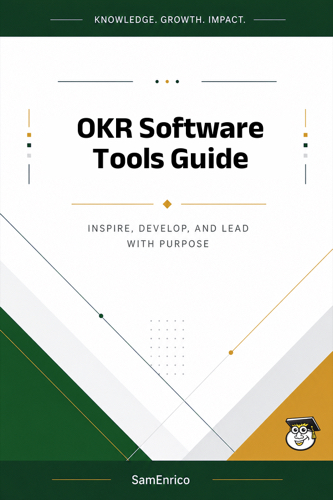
Non-FictionSelf-HelpProductivity Tech
OKR Software Tools Guide eBook
Reviews Gtmhub, Workboard, and other digital platf
Reviews Gtmhub, Workboard, and other digital platforms.
Formats
Free sample
Chapter 1: The Spreadsheet Delusion--–- In 2018, the leadership team at a fast-growing Saa S company called Brightline did everything right. They read Measure What Matters. They hired an OKR consultant. They spent two weeks crafting the perfect company Objectives and cascading Key Results into a beautifully formatted Google Sheet. The CEO printed it out and put it on every manager’s desk.
The CFO built a dashboard with color-coded progress bars. The Head of People scheduled quarterly review meetings. For exactly thirty days, Brightline was an OKR success story.Then reality arrived.The CEO asked for a mid-quarter progress update. The Head of Product spent four hours manually pulling data from Jira, Salesforce, and their data warehouse, then another two hours reconciling conflicting numbers. The Head of Marketing admitted she hadn’t looked at the spreadsheet in three weeks.
The Sales Director confessed that his team’s Key Results were still showing the same numbers they had entered on day one—not because they were on track, but because no one remembered the password to the shared drive where the spreadsheet lived.Brightline had fallen victim to what this chapter calls the Spreadsheet Delusion: the mistaken belief that the tool that got you to fifty employees will carry you to five hundred. It will not. And the gap between philosophical inspiration and operational reality is where most OKR initiatives go to die.This chapter is not an attack on John Doerr, Christina Wodtke, or any of the brilliant minds who gave the world OKRs. Their work is foundational, and this book stands on their shoulders. But there is a dangerous gap in the bestselling literature: they tell you what to do—set ambitious goals, align your teams, measure what matters—but they do not tell you how to make it survive contact with the messy, chaotic, distraction-filled reality of a growing company.
This chapter bridges that gap. It explains why spreadsheets fail, why the “weekly check-in” habit dies, and why software is not a luxury but a necessity for any organization serious about strategy execution. Most importantly, it introduces the 3 Pillars of OKR Software—the unified framework that will guide every subsequent chapter of this book.The Bestsellers Were Right (But Incomplete)Let us be clear about what the OKR canon gets right. John Doerr’s Measure What Matters is not overrated; it is under-implemented. The book brilliantly articulates the why of OKRs: ambitious Objectives that stretch an organization, measurable Key Results that define success, and the cadence of CFRs (Conversations, Feedback, Recognition) that keeps the system alive.
Christina Wodtke’s Radical Focus adds the critical insight that OKRs are not a set-it-and-forget-it exercise—they require weekly attention and a willingness to kill what is not working. Ben Lamorte and Paul Niven’s Objectives and Key Results provides the tactical playbook for cascading and alignment.These books share a common limitation: they assume a level of organizational hygiene that few companies possess. They assume that everyone will update their progress on time. They assume that version control will magically resolve itself. They assume that the CEO can look at a single dashboard and see real-time health across the entire organization.
In a spreadsheet-based world, none of these assumptions hold.Consider the anatomy of a spreadsheet-based OKR system. A typical company of 150 people might have:One master spreadsheet for company-level OKRs (read-only for most employees)Twelve department-level spreadsheets (each with different formatting, different update schedules, and different owners)Countless individual tracking documents (hidden in personal drives, updated inconsistently)A quarterly “consolidation” process that requires two days of manual data entry This is not alignment. This is organized chaos. And it fails for three fundamental reasons that no amount of consulting or training can fix.The Three Fatal Flaws of Spreadsheet-Based OKRs Flaw 1: The Accountability Vacuum Spreadsheets do not send notifications. They do not remind anyone to check in.
They do not escalate overdue updates to managers. In a spreadsheet-based system, accountability is entirely manual and entirely social.Here is what that means in practice. On Monday morning, a product manager named Sarah knows she needs to update her Key Result on feature adoption. But she has a customer escalation, a product launch meeting, and a performance review to write. The spreadsheet does not ping her.
Her manager does not get an automated alert. Friday arrives, and the number is still last quarter’s baseline. No one notices until the quarterly review, at which point the data is so stale that no actionable decision can be made.The research on this is unambiguous. A study of 247 companies using spreadsheet-based OKRs found that after sixty days, only 34% of individuals were still updating their progress. By day ninety, that number dropped to 12%.
The pattern is so predictable that consultants have a name for it: the Ninety-Day OKR Graveyard.Contrast this with a software-based system that includes automated check-in reminders via Slack or Microsoft Teams. The same product manager receives a simple message on Wednesday at 10 AM: “Sarah, how is your ‘Increase trial-to-paid conversion to 35%’ Key Result tracking this week?” She clicks a button, enters 32%, adds a brief comment about a new pricing test, and moves on. Total time: thirty seconds. Accountability is built into the workflow, not dependent on memory or heroics.Flaw 2: The Version Control Nightmare Spreadsheets have a dirty secret: they are designed for one person at a time. When fifteen department heads all need to update their team’s OKRs, the spreadsheet becomes a game of turn-taking, overwriting, and “who saved over my formulas?”The typical scenario unfolds like this.
The VP of Sales opens the master OKR spreadsheet on Tuesday morning. She spends an hour updating her team’s numbers. She saves and closes the file. Unbeknownst to her, the VP of Marketing had opened the same file an hour earlier, made her own changes, and saved a conflicting version to a different folder. No one knows which version is correct.
The CEO requests the “latest” numbers, and both VPs send different files. The meeting descends into an argument about data governance rather than a discussion about strategy.This is not a process failure. This is a tool failure. Spreadsheets have no native concept of change history, no automatic conflict resolution, no audit trail that shows who changed what and when. The only way to recover is to compare files line by line—a task that consumes hours and generates zero strategic value.Software platforms solve this with atomic updates, real-time synchronization, and immutable audit logs.
Every change is recorded. Every update is timestamped. Every user sees the same numbers at the same time. The debate shifts from “which file is right?” to “what do these numbers tell us?”Flaw 3: The Manual Cascading Trap Cascading is the heart of OKR theory. The company Objective cascades to department Objectives, which cascade to team Objectives, which cascade to individual Key Results.
In theory, this creates a golden thread from the CEO’s vision to the frontline employee’s daily work.In spreadsheet practice, cascading is a manual, error-prone, almost always broken process.To cascade an Objective in a spreadsheet, someone must:Copy the company Objective from the master sheet Paste it into each department sheet Manually link…
This is the end of the free sample. Get the eBook to keep going. Buy now
About this book
Details
- Author
- Burdick Novella
- Publisher
- SamEnrico
- Language
- English
- Genre
- Non-Fiction, Self-Help, Productivity Tech
- Released
- 2026-06-06
- Pages (approx.)
- 153
- Available as
- eBook, Audiobook

Read better in the ZLOADR app
Your eBooks on your phone or tablet. Sign in with your SamEnrico account and start reading.
More by Burdick Novella
 One Percent Better DailyBurdick Novella$11.99
 Child Cancer Anticipatory GriefBurdick Novella$11.99
 Shopping Addiction Home InventoryBurdick Novella$11.99
 The Postpartum and Body ImageBurdick Novella$11.99
 Entomology Crime ReconstructionBurdick Novella$11.99
 Self Hypnosis for Masturbation HabitsBurdick Novella$11.99
 Nonverbal Cues for Wedding PlannersBurdick Novella$11.99
 The Shadow of the Southern Cross: Australia's Cold War Espionage MurdersBurdick Novella$11.99
 The Unseen Mentor: How a 19th-Century African Woman Revolutionized Women's SportsBurdick Novella$11.99
 Neapolitan Mastiffs: Wrinkled GiantBurdick Novella$11.99
 Amazon FBA Restrictions GuideBurdick Novella$12.99
 Alibaba Supplier Communication ScriptsBurdick Novella$12.99
You may also like
 Hong Kong Handover 1997Dunn Johnnie$11.99
 Zumba For Postnatal Recovery CourseNeal Christian$11.99
 Zumba for BeginnersLadner Nikia$11.99
 YouTube Comment Mining GuideHumes Pandora$12.99
 Worry Box MeditationCarlin Rudy$11.99
 Workplace Stress MeditationNguyen Lynn$11.99
 Workplace Stress and Sleep RepairHawley Ivory$11.99
 Workplace Perfectionism CureDelaney Jeffry$11.99
 Workplace Injustice Anger GuideWallen Isabelle$11.99
 Work Addiction and Burnout LinkGreenwood Ester$11.99
 Women in Yoga and WellnessBeattie Galina$11.99
 Women in Stand Up ComedyChun Evangeline$11.99