
Non-FictionSelf-HelpCorporate Strategy
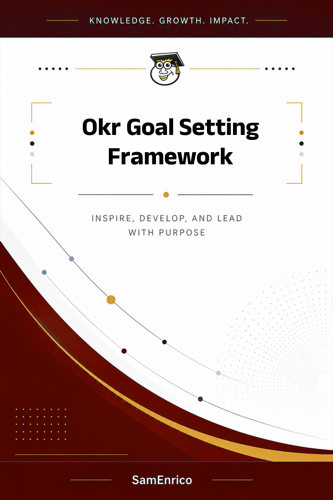
Okr Goal Setting Framework eBook
Applies objectives and key results for business.
Applies objectives and key results for business.
Formats
Free sample
Chapter 1: The 90% Lie--–- In a conference room overlooking a rain-streaked San Francisco skyline, a CEO named Sarah had just finished presenting what she believed was a brilliant three-year strategy. The slides were beautiful. The logic was sound. The team had nodded along enthusiastically. Eight months later, not a single strategic initiative had moved the needle.
Revenue was flat. The new product launch was delayed. And when Sarah asked her leadership team why, she received twenty-seven different excuses but zero actionable answers. Her company had not failed at strategy. They had failed at execution.
And they were far from alone.This opening scene captures a truth that most leaders would rather ignore: strategy is easy compared to execution. The business world is littered with brilliant plans that never saw the light of day, well-funded initiatives that died in committee meetings, and ambitious goals that evaporated the moment quarterly priorities shifted. The problem is not a lack of intelligence, effort, or resources. The problem is a systematic failure of goal-setting infrastructure. This chapter exposes the anatomy of that failure, introduces the research that explains why traditional goal systems collapse, and establishes the foundation upon which the entire OKR framework rests.
Without understanding the depth of the execution crisis, no tool—no matter how elegant—can save you.The Staggering Cost of Failed Execution Let us begin with a number that should haunt every leader reading this book: ninety percent. According to a multi-year study by the Harvard Business Review spanning over seven thousand companies across twenty-two industries, roughly ninety percent of organizations fail to execute their strategies effectively. That is not a typo. Nine out of ten companies systematically underperform relative to their own strategic plans. They are not failing because their strategies are bad—though some certainly are.
They are failing because their goal-setting and execution systems are broken at a fundamental level.To understand why, consider a simple thought experiment. Imagine you are the head of product at a mid-sized software company. Your CEO announces a new strategic priority: "Become the market leader in customer data privacy by the end of next year." This sounds inspiring. It is the kind of statement that belongs on a coffee mug or a company all-hands slide. But what does it actually mean?
How do you know if you are making progress? What does success look like on a Tuesday morning in February? The statement is specific enough to feel directional but vague enough to be functionally useless for daily decision-making.Now imagine a different scenario. Your CEO says: "By the end of Q4, we will have achieved SOC2 Type II certification, reduced customer support tickets related to data access by sixty percent, and increased the percentage of users who can locate our privacy policy in under five seconds from twelve percent to eighty percent." This second statement is not as poetic. It will not fit on a coffee mug.
But it provides something infinitely more valuable: clarity. You know exactly what to measure, when to measure it, and what success looks like. This is the difference between a strategic wish and an executable goal.The ninety percent failure rate exists because most organizations operate in the first mode. They mistake aspiration for execution. They confuse annual planning with actual progress tracking.
They build elaborate strategic documents that are celebrated at creation and ignored thereafter. The goal-setting systems inherited from twentieth-century management were designed for a world of predictable annual cycles, stable markets, and hierarchical command structures. That world no longer exists. In today's environment of rapid change, cross-functional teams, and distributed work, those old systems are not just ineffective—they are actively harmful.The Goal-Setting Theory You Were Never Taught Before we can fix a broken system, we need to understand what a functional system requires. Enter the work of Edwin Locke and Gary Latham, two organizational psychologists whose research fundamentally reshaped our understanding of goal-setting.
Over the course of several decades and hundreds of studies, Locke and Latham established what is now known as Goal Setting Theory. The core finding is deceptively simple and profoundly important: specific and difficult goals lead to higher performance than vague or easy goals.Let us unpack that statement carefully. The first variable is specificity. A specific goal answers the questions "how much?" and "by when?" A vague goal says "do your best" or "improve customer satisfaction." A specific goal says "increase customer satisfaction scores from 72 to 85 by the end of Q3." The difference may seem minor, but the research shows it is transformative. Specificity eliminates ambiguity about what success looks like, provides a clear target for resource allocation, and enables accurate progress tracking.
When goals are vague, teams default to whatever feels urgent in the moment—which is rarely the thing that matters most strategically.The second variable is difficulty. Difficult goals are not impossible goals—a critical distinction that we will revisit throughout this book. A difficult goal stretches a team beyond their current capabilities but remains achievable with sustained effort and creative problem-solving. The research shows that as goal difficulty increases, performance increases proportionally—up to the point where the goal becomes impossible. This is not a linear relationship forever.
When goals become genuinely impossible, performance collapses as teams give up. But within the stretch zone—that sweet spot between comfortable and impossible—harder goals consistently produce better results than easy ones.Here is where the research becomes uncomfortable for many organizations. Most companies set goals that are either too vague to be useful or too easy to be meaningful. They do this for understandable reasons. Vague goals avoid accountability.
Easy goals guarantee success. But both choices sacrifice performance for comfort. The annual planning process, with its predictable cycle of negotiating targets down and sandbagging estimates up, is not a sign of prudent management. It is a sign of a system that has traded effectiveness for political safety.Locke and Latham also identified several moderating factors that influence goal-setting effectiveness. Feedback is essential—goals without feedback loops are like driving a car with a blindfold on.
Commitment matters—goals imposed from above without team buy-in consistently underperform goals that teams help shape. Task complexity requires attention—simple goals work differently than complex, multi-stakeholder goals. And perhaps most importantly, self-efficacy—a team's belief in their ability to achieve the goal—mediates the relationship between goal difficulty and performance.These findings are not academic curiosities. They are actionable insights that directly inform the OKR framework. OKRs embody specificity through their dual structure of qualitative Objectives and quantitative Key Results.
They embody difficulty through the distinction between Committed OKRs (must hit 1.0) and Aspirational OKRs (70% completion signals success). They build in feedback through the weekly check-in rhythm. They enhance commitment through backbriefing and team-driven goal development. Locke and Latham provided the scientific foundation; OKRs provide the architectural implementation.Why Annual Goals Are Killing Your Agility If specific and difficult goals outperform vague and easy ones, why do most organizations default to annual planning cycles that produce precisely the wrong kind of goals? The answer lies in the mismatch between organizational structure and environmental reality.The annual planning process—with its September kickoffs, December deadlines, and January launches—was designed…
This is the end of the free sample. Get the eBook to keep going. Buy now
About this book
Details
- Author
- Stewart Sadie
- Publisher
- SamEnrico
- Language
- English
- Genre
- Non-Fiction, Self-Help, Corporate Strategy
- Released
- 2026-06-09
- Pages (approx.)
- 153
- Available as
- eBook, Audiobook

Read better in the ZLOADR app
Your eBooks on your phone or tablet. Sign in with your SamEnrico account and start reading.
More by Stewart Sadie
 The Memory Peg SystemStewart Sadie$11.99
 Dream Journal Prompts BookStewart Sadie$11.99Dream Journal Prompts BookStewart Sadie$11.99
 Walking Meditation in the AirportStewart Sadie$11.99
 Pet Burial GuideStewart Sadie$11.99
 Home Modifications for Aging in PlaceStewart Sadie$11.99
 Light Blocking Nap GuideStewart Sadie$11.99
 Calcium Bone HealthStewart Sadie$11.99
 The Tunnel of Shadows: The 2015 Iranian Prison Break That Shocked the WorldStewart Sadie$11.99
 The Great Prime Number Heist: How a Math Genius Cracked the Code of the UniverseStewart Sadie$11.99
 How to Produce Kitchen Appliance ManualsStewart Sadie$11.99
 Service Providers Guide to Ticket Broker ServicesStewart Sadie$11.99
You may also like
 Hong Kong Handover 1997Dunn Johnnie$11.99
 Zumba For Postnatal Recovery CourseNeal Christian$11.99
 Zumba for BeginnersLadner Nikia$11.99
 YouTube Comment Mining GuideHumes Pandora$12.99
 Worry Box MeditationCarlin Rudy$11.99
 Workplace Stress MeditationNguyen Lynn$11.99
 Workplace Stress and Sleep RepairHawley Ivory$11.99
 Workplace Perfectionism CureDelaney Jeffry$11.99
 Workplace Injustice Anger GuideWallen Isabelle$11.99
 Work Addiction and Burnout LinkGreenwood Ester$11.99
 Women in Yoga and WellnessBeattie Galina$11.99
 Women in Stand Up ComedyChun Evangeline$11.99