
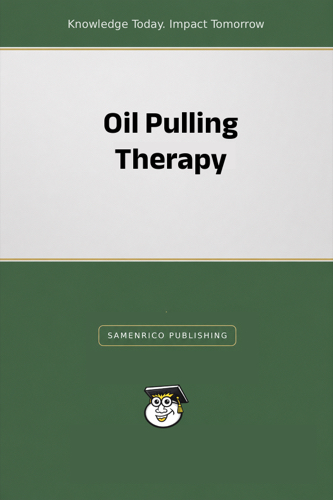
Non-FictionHealth & WellnessOil Pulling
Oil Pulling Therapy eBook
Swishing oil for oral and systemic health benefits
by Akers Barton
Swishing oil for oral and systemic health benefits.
Formats
Free sample
Chapter 1: The Bleeding Gums Deception–- You have been lied to—not by a single person or a malicious conspiracy, but by a slow accumulation of assumptions that have quietly shaped modern dentistry and, by extension, your daily routine. The lie sounds reassuring. It sounds like common sense. Here it is: If your gums bleed when you brush, you are brushing too hard.This is what most dentists tell you. This is what your parents believed.
This is what the toothpaste commercials imply when they show soft bristles gliding across perfect, pink gums. The message is seductive in its simplicity: bleeding equals trauma, so be gentler. Use a soft brush. Switch to a “gentle” toothpaste. Floss more carefully.
And for a few days, maybe the bleeding stops. Maybe it doesn’t. Either way, you have been redirected away from the truth.The truth is far less comfortable but infinitely more important: Healthy gums do not bleed. Not when you brush. Not when you floss.
Not when you poke them with a toothpick or bite into an apple. Bleeding gums are a sign of active, chronic inflammation—specifically, a condition called gingivitis in its early stages and periodontitis as it advances. And that inflammation is not merely a dental problem. It is a systemic alarm bell.This chapter is not about oil pulling. Not yet.
Before we can talk about the solution, you must fully understand the scope of the problem you did not know you had. By the time you finish reading these pages, you will see your morning sink routine differently. You will understand why the pink tinge in the foam after brushing is not a minor inconvenience but a medical signal. And you will be ready—truly ready—for the ancient therapy that follows in the rest of this book.The Epidemic Hiding in Plain Sight Let us begin with numbers, because numbers do not flinch. According to the Centers for Disease Control and Prevention (CDC), nearly half of all adults aged thirty and older in the United States—approximately 64 million people—have some form of periodontitis, the advanced stage of gum disease.
Among adults aged sixty-five and older, that figure rises to 70 percent. Globally, the World Health Organization estimates that severe periodontitis is the sixth most prevalent human disease, affecting nearly 1.1 billion people.Those are the diagnosed and documented cases. The real number is almost certainly higher because early-stage gum disease—gingivitis—is so normalized that most people do not even consider it a disease. They call it “sensitive gums” or “brushing too hard” or “just the way my mouth is.” They do not report it to their dentists because they do not think to report it. And dentists, overburdened and trained primarily in surgical and restorative interventions, often do not flag mild bleeding as an urgent concern.
After all, nearly every patient bleeds a little.But here is the number that should stop you cold: the average adult loses at least one tooth to gum disease by age sixty. Not to decay. Not to trauma. To inflammation that slowly, silently destroys the bone anchoring your teeth. And that bone loss is irreversible.This is the epidemic hiding in plain sight.
It is chronic, progressive, and almost entirely preventable. Yet it remains the leading cause of tooth loss in adults worldwide—not cavities, not accidents, but gum disease. And because gum disease is fundamentally an inflammatory condition, its reach extends far beyond your mouth.The Anatomy of a False Assumption To understand why bleeding gums have been so thoroughly dismissed, we must examine the faulty logic that enabled this deception. The assumption that bleeding equals trauma comes from a reasonable place: if you scrape your knee, it bleeds. If you rub your skin raw, it bleeds.
So if your gums bleed when you brush, the brush must be the cause.The problem is that gums are not skin. They are mucous membrane tissue with a different structure, different blood supply, and different healing properties. Healthy gums are resilient. They are designed to withstand the mechanical forces of chewing, grinding, and even aggressive brushing. When you brush healthy gums, they do not bleed.
They might feel pressure. They might even feel a mild friction. But they do not bleed.Bleeding occurs when the gum tissue is already compromised. Specifically, bleeding is the result of chronic inflammation that has weakened the epithelial lining, dilated the blood vessels, and made the tissue friable and fragile. In other words, your gums bleed when you brush because they are already injured, not because you injured them.
The brush is simply revealing an underlying pathology.This distinction is not merely semantic. It determines whether you treat the symptom (bleeding) or the cause (inflammation). Treating the symptom means buying a softer brush, changing your technique, or avoiding the area altogether. These actions may reduce bleeding temporarily, but they allow the underlying inflammation to progress. Treating the cause means addressing the bacterial biofilm—the plaque—that is driving the inflammatory response.
And that requires a different approach entirely.The Biofilm You Cannot See Dental plaque is not simply a layer of food debris and bacteria. It is a biofilm—a complex, organized community of microorganisms that adhere to surfaces and to each other, embedded in a self-produced matrix of extracellular polymeric substances. That is a scientific way of saying that plaque is a fortress. The bacteria inside it communicate with one another through quorum sensing, share nutrients, and collectively resist removal.When you brush your teeth, you remove the loose, superficial layer of this biofilm. But the deeper layers, particularly along and just below the gum line, remain intact.
Within hours, the surviving bacteria begin to repopulate the surface. Within twenty-four hours, the biofilm has largely reformed. Within forty-eight to seventy-two hours, if undisturbed, the biofilm matures and becomes significantly more difficult to remove.This is why your dentist tells you to brush twice a day and floss once a day. The recommendation is not arbitrary; it is calibrated to the growth cycle of the oral biofilm. But here is the uncomfortable truth that most dental professionals do not emphasize: even perfect brushing and flossing remove only about 60 to 70 percent of the biofilm from the average mouth.
The remaining 30 to 40 percent resides in the interproximal spaces (between the teeth), the gingival sulcus (the tiny gap between the tooth and the gum), and the pits and fissures of the chewing surfaces.Over time, the undisturbed biofilm mineralizes into calculus—tartar—which cannot be removed by brushing at all. Calculus is essentially fossilized bacteria, and its rough surface provides an ideal substrate for new biofilm to attach. This is the beginning of a vicious cycle: biofilm causes inflammation, inflammation deepens the gingival sulcus, a deeper sulcus harbors more biofilm, and more biofilm causes more inflammation.By the time your gums bleed, this cycle has been running for weeks, months, or even years. The bleeding is not the beginning. It is a late-stage warning.The Systemic Spillover: How Your Mouth Infects Your Body If gum disease were confined to the mouth, it would still be a problem worth solving.
Tooth loss, chronic pain, bad breath, and the social embarrassment of deteriorating oral health are significant quality-of-life issues. But gum…
This is the end of the free sample. Get the eBook to keep going. Buy now
About this book
Details
- Author
- Akers Barton
- Publisher
- SamEnrico
- Language
- English
- Genre
- Non-Fiction, Health & Wellness, Oil Pulling
- Released
- 2026-06-07
- Pages (approx.)
- 155
- Available as
- eBook, Audiobook

Read better in the ZLOADR app
Your eBooks on your phone or tablet. Sign in with your SamEnrico account and start reading.
More by Akers Barton
 CEO Morning BlueprintAkers Barton$11.99
 Tower Dream SymbolAkers Barton$11.99
 Reverse 1031 Exchange HandbookAkers Barton$11.99
 The Energy Engineer InnovationAkers Barton$11.99
 Audiobooks for Traffic PeaceAkers Barton$11.99
 Hu JiaAkers Barton$11.99
 Caregiver Feeding GuideAkers Barton$11.99
 Special Forces Master GuideAkers Barton$11.99
 The Billionaire’s Floating Empire: How Jeff Bezos’ Yacht Redefined Luxury at SeaAkers Barton$11.99
 The Hummingbird Protocol: The Unseen War Inside Your MindAkers Barton$11.99
 The Guns of Bussaco: Wellington's Stand Against Napoleon's JuggernautAkers Barton$11.99
 Understanding AgnathiaAkers Barton$17.99
You may also like
 Hong Kong Handover 1997Dunn Johnnie$11.99
 Zumba For Postnatal Recovery CourseNeal Christian$11.99
 Zumba for BeginnersLadner Nikia$11.99
 YouTube Comment Mining GuideHumes Pandora$12.99
 Worry Box MeditationCarlin Rudy$11.99
 Workplace Stress MeditationNguyen Lynn$11.99
 Workplace Stress and Sleep RepairHawley Ivory$11.99
 Workplace Perfectionism CureDelaney Jeffry$11.99
 Workplace Injustice Anger GuideWallen Isabelle$11.99
 Work Addiction and Burnout LinkGreenwood Ester$11.99
 Women in Yoga and WellnessBeattie Galina$11.99
 Women in Stand Up ComedyChun Evangeline$11.99