
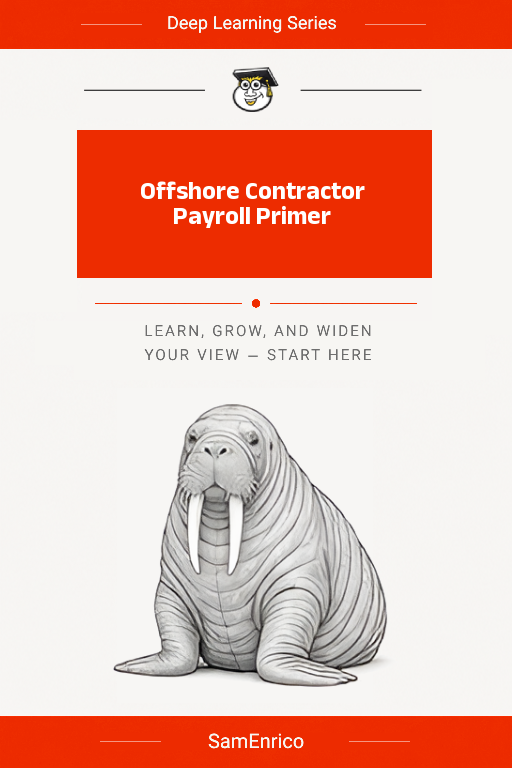
Non-FictionNon-Obvious CareerGlobal Hiring PlatformsPayroll Guide
Offshore Contractor Payroll Primer eBook
Get paid in USD, GBP, or EUR via Deel, Remote.com,
Get paid in USD, GBP, or EUR via Deel, Remote.com, or local banks. Covers fee reduction strategies, tax treaty benefits, and invoicing for African remote professionals.
Formats
Free sample
Chapter 1: The $940 Illusion--Imagine waking up to a notification on your phone. A client in London has just transferred 1,000foryourwork.Youfeeltherush—thevalidation,thefreedom,theproofthatyourskillscanearninhardcurrency.Youcheckyourlocalbankaccountthreedayslater.₦1,500,000hasarrived.Youdidthemathattheofficialrate:1,000 for your work. You feel the rush—the validation, the freedom, the proof that your skills can earn in hard currency. You check your local bank account three days later. ₦1,500,000 has arrived.
You did the math at the official rate: 1,000foryourwork.Youfeeltherush—thevalidation,thefreedom,theproofthatyourskillscanearninhardcurrency.Youcheckyourlocalbankaccountthreedayslater.₦1,500,000hasarrived.Youdidthemathattheofficialrate:1,000 times 1,500 equals ₦1.5 million. Perfect.Now walk to the market. Your neighbor, who runs a small import business, tells you he just exchanged $1,000 for ₦2,000,000 from a street-side bureau de change. Same dollar. Same day.
Same city. You have ₦1.5 million. He has ₦2 million. You earned the dollars. He just traded them.This is not a story about corruption or black markets.
This is a story about information asymmetry—the gap between what you know and what you need to know to keep your money. Every day, thousands of African remote professionals lose 20%, 30%, sometimes 60% of their international income without ever making a bad investment or a frivolous purchase. They lose it to systems they do not see, fees they do not question, and exchange rates they assume are fair.This book exists to close that gap. By the time you finish this chapter, you will understand exactly where your money disappears. By the end of this book, you will know how to keep 15-30% more of every dollar, pound, and euro you earn—without working a single extra hour.The Three Silent Killers of Your International Income Let us name your enemies.
They are not malicious individuals. They are structural features of the global payment system that most professionals never question. I call them the three silent killers because they operate in the background, deducting value before you ever see your money.Silent Killer One: The Exchange Rate Gap. This is the difference between the rate your bank uses to convert currency and the real market rate. Banks do not use the mid-market rate you see on Google.
They use their own rates, marked up by 2-5%. On a 1,000transfer,thatis1,000 transfer, that is 1,000transfer,thatis20-50 gone before you touch it.Silent Killer Two: The Fee Stack. Every time money crosses a border, intermediaries take their cut. Your payroll platform charges a withdrawal fee. The SWIFT network charges correspondent bank fees.
Your local bank charges a receiving fee. These fees stack on top of each other, and most are invisible on your final statement.Silent Killer Three: The Parallel Market Penalty. This only applies to countries where the official exchange rate differs from the rate available on the open market—Nigeria, Ethiopia, Sudan, Zimbabwe, and others. If your bank converts at the official rate while the real value of your dollars is higher on the street, you lose purchasing power without ever seeing a transaction line.By the end of this chapter, you will understand how these three killers interact. You will also learn the single most important distinction in this entire book: the difference between fee loss and purchasing power loss.
These terms will appear in every chapter that follows. Master them now, and you master the book.Defining the Two Types of Loss Let me introduce a framework that will guide everything you read from this point forward. Every time you receive an international payment, you suffer two distinct types of loss. Most professionals confuse them, which is why they never fully solve the problem.Fee Loss is the actual money deducted from your transfer. You can see it on your bank statement if you know where to look.
Examples include the 5Deelwithdrawalfee,the5 Deel withdrawal fee, the 5Deelwithdrawalfee,the15 SWIFT correspondent fee, the $10 local bank receiving fee, and the 2-5% conversion spread your bank charges. Fee loss is measurable, trackable, and avoidable.Purchasing Power Loss is different. This is the difference between what your dollars could buy if converted at the best available rate versus what they actually buy at your bank's rate. In countries with parallel markets—where the street rate for dollars is higher than the official bank rate—purchasing power loss can dwarf fee loss. You did not lose any money in the transaction.
You lost spending power because your bank used a rate that does not reflect reality.Here is the key insight that 90% of remote professionals miss: Fee loss and purchasing power loss are solved with different strategies. Reducing fee loss requires changing how you route your money (Chapter 3). Reducing purchasing power loss requires changing where you convert your currency (also Chapter 3, but with different tools).For the rest of this chapter, I will break down each type of loss with real numbers. I will use the Nigerian Naira as my primary example because it has one of the widest parallel market gaps in the world, but the principles apply anywhere. If you live in South Africa, Kenya, Ghana, or Egypt, your numbers will be smaller, but the structure is identical.The Anatomy of a $1,000 Payment – Fee Loss Only Let us walk through a typical $1,000 payment from a US client to a remote professional in Lagos, Nigeria.
We will assume the professional uses Deel (the most common payroll platform) and withdraws directly to their local bank account. We will calculate only fee loss first. We will add purchasing power loss in the next section.Step One: Client pays Deel $1,000. Deel receives the full amount. No fee yet.Step Two: You initiate withdrawal from Deel to your local bank.
Deel charges a 5withdrawalfee.Yourbalanceisnow5 withdrawal fee. Your balance is now 5withdrawalfee.Yourbalanceisnow995. This fee appears on your Deel dashboard. You can see it.Step Three: Deel sends the money via SWIFT to your local bank. The SWIFT network charges what are called "correspondent bank fees." These are fees paid to intermediary banks that route your money from Deel's bank in the US to your bank in Nigeria.
These fees range from 15to15 to 15to30. You never see them on your statement because they are deducted before the money arrives. They are invisible but real.Step Four: Your local bank receives the money. Most Nigerian banks charge a receiving fee for international wires, typically $10. This fee appears on your bank statement, often labeled "inward transfer fee."Step Five: Your local bank converts USD to NGN.
This is where fee loss gets interesting. Banks do not convert at the mid-market rate (the rate you see on Google). They add a spread—typically 3-5%. On 950(afterpreviousfees),a4950 (after previous fees), a 4% spread costs you 950(afterpreviousfees),a438. This spread is partially a fee and partially how banks make money.
It appears nowhere on your statement. You only see the final NGN amount.Let us add it up:Fee Type Amount Visible?Deel withdrawal fee$5Yes (Deel dashboard)SWIFT correspondent fees$20 (average)No Local bank receiving fee$10Yes (bank statement)Conversion spread (4%)$38No Total fee loss$73On a 1,000payment,youhavelost1,000 payment, you have lost 1,000payment,youhavelost73 to fees alone. That is 7.3% of your gross income. If you earn 50,000peryear,feelossalonecostsyou50,000 per year, fee loss alone costs you 50,000peryear,feelossalonecostsyou3,650 annually—money that went to banks and platforms, not to you.But this is just the beginning. For professionals in countries with parallel markets, the real damage comes next.The Anatomy of…
This is the end of the free sample. Get the eBook to keep going. Buy now
About this book
Details
- Author
- Andres Luetta
- Publisher
- SamEnrico
- Language
- English
- Genre
- Non-Fiction, Non-Obvious Career, Global Hiring Platforms, Payroll Guide
- Released
- 2026-05-29
- Pages (approx.)
- 154
- Available as
- eBook, Audiobook

Read better in the ZLOADR app
Your eBooks on your phone or tablet. Sign in with your SamEnrico account and start reading.
More by Andres Luetta
 Trauma Triggered Anger GuideAndres Luetta$11.99
 The Governor's Trade MissionAndres Luetta$11.99
 Financial Stress and Self Care GuideAndres Luetta$11.99
 SaaS Pricing Page HacksAndres Luetta$11.99
 The Last Broadcast of the Babel TowerAndres Luetta$11.99
 The Bench That Shook the World: The Untold Story of Justice Ruth Bader Ginsburg's Early YearsAndres Luetta$11.99
 Employer Telehealth Benefits OutlookAndres Luetta$12.99
 How to Start a Passport Photography Business (Beginners Guide)Andres Luetta$11.99
 Mud RacingAndres Luetta$11.99
 Understanding HypercementosisAndres Luetta$17.99
You may also like
 Hong Kong Handover 1997Dunn Johnnie$11.99
 Zumba For Postnatal Recovery CourseNeal Christian$11.99
 Zumba for BeginnersLadner Nikia$11.99
 YouTube Comment Mining GuideHumes Pandora$12.99
 Worry Box MeditationCarlin Rudy$11.99
 Workplace Stress MeditationNguyen Lynn$11.99
 Workplace Stress and Sleep RepairHawley Ivory$11.99
 Workplace Perfectionism CureDelaney Jeffry$11.99
 Workplace Injustice Anger GuideWallen Isabelle$11.99
 Work Addiction and Burnout LinkGreenwood Ester$11.99
 Women in Yoga and WellnessBeattie Galina$11.99
 Women in Stand Up ComedyChun Evangeline$11.99