
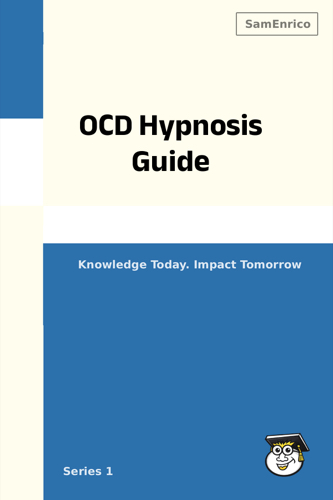
Free sample
Chapter 1: The Locked Gear...--–- You already know the feeling. It comes without warning, settling into your chest like a cold stone. You have just locked the front door. You are already walking toward the car. And then it hits you—a sudden, electrical jolt of doubt.
Did I really lock it? You saw yourself turn the key. You heard the click. But the question is already gnawing at the edges of your mind, and no amount of logical reassurance seems to help. So you turn back.
You climb the stairs. You jiggle the handle. It is locked. Of course it is locked. You knew it was locked.
But the relief lasts only as long as it takes you to reach the bottom of the stairs again. Then the doubt returns, softer this time but still insistent. Did you check it properly? Maybe you only thought you checked it. So you go back again.This is the architecture of OCD.
It is not a quirk, not a preference for neatness, not a harmless habit of double-checking. It is a neurological loop that feeds on itself, growing stronger each time you feed it. The more you check, the less you trust your memory. The more you wash, the more contaminated everything feels. The more you pray or confess or rearrange, the louder the intrusive thoughts become.
You are caught in a locked gear—a brain lock—and the terrible irony is that every attempt to escape only tightens the mechanism.If you are reading this book, you already know this cycle intimately. Perhaps you have spent years trying to argue your way out of it. You have told yourself that the thought is irrational, that the risk is vanishingly small, that you have checked the stove seven times already and it has never been on. But the anxiety does not respond to reason. It does not care about statistics or logic or your exhausted pleas for quiet.
It speaks a different language entirely—the language of pure sensation: fear, disgust, urgency, dread. And as long as you try to fight it with the tools of the conscious mind, you will lose.This chapter is not about hypnosis yet. Before we can rewire anything, you need to understand what you are up against. You need to see the shape of the cage you have been living in. Because once you truly understand how OCD works—not as a moral failing or a personality flaw, but as a specific neurological and psychological loop—you will realize something extraordinary.
You are not broken. You have learned a response that once made sense, and now it runs automatically. And if it was learned, it can be unlearned. But first, you have to stop trying to argue with a smoke alarm.The Paradox at the Heart of OCDLet us begin with a simple question that has probably occurred to you a thousand times: Why can't I just stop?You know the compulsion is irrational. When you are standing at the sink washing your hands for the fifteenth time, some part of your brain is fully aware that your hands have been clean for at least fourteen washes.
When you are driving around the block for the third time to check that you did not hit someone (even though you felt no impact, heard no sound, and saw nothing in the rearview mirror), you know, rationally, that the fear is unfounded. When you are silently repeating a prayer or a phrase in your head to neutralize a blasphemous thought, you know that the repetition changes nothing.And yet you cannot stop.This is the central paradox of OCD: intellectual insight without emotional relief. You know the fear is irrational, but you feel it anyway. Your conscious mind—the part of you that can do math, plan a meal, write a sentence—is completely powerless against the wave of anxiety that rises up when a trigger appears. It is like standing in front of a speeding train and trying to stop it with a stern word.
The train does not hear you. It does not care about your arguments. It only follows its tracks.This is not a failure of willpower. It is not a sign that you are weak or undisciplined or secretly enjoying the rituals. It is the predictable result of how your brain has learned to process threat.
And the first step toward freedom is to stop blaming yourself for a mechanism you did not choose.The Neurology of Stuckness: Why Your Brain Won't Let Go To understand why logic fails, we have to look under the hood. The brain is not a single, unified organ. It is a collection of systems that evolved at different times and often compete with one another. The part of your brain that knows the stove is off lives in the prefrontal cortex—the rational, planning part of the brain that sits just behind your forehead. This is the CEO.
It speaks in words and numbers and probabilities.The part of your brain that screams danger lives much deeper, in a small, almond-shaped cluster called the amygdala. The amygdala does not speak in words. It speaks in raw sensation: heart pounding, palms sweating, stomach clenching. It evolved to detect threats long before you could consciously name them. And here is the crucial point: the amygdala does not care what you know.
It does not read statistics. It does not understand that the doorknob is statistically safe. It only responds to learned associations.In the brain of a person with OCD, the communication between these systems has gone wrong. The orbitofrontal cortex (OFC)—a region that acts as an error-detection system—fires constantly. It sends signal after signal: Something is wrong.
Something is not right. Check again. Normally, the caudate nucleus acts as a brake or a gear shifter. It receives the error signal and says, "Yes, I saw that. You can relax now.
Move on to the next thing." But in OCD, the caudate nucleus fails to do its job. The signal keeps looping. The OFC keeps firing. The amygdala keeps sounding the alarm.This is what Dr. Jeffrey Schwartz, in his groundbreaking book Brain Lock, called the "stuck gear." Imagine a fire alarm that continues ringing long after the toast has been removed from the toaster.
The alarm is not responding to the current reality. It is stuck in a loop, playing an old recording. And no amount of shouting at the alarm will make it stop. You have to go in and physically reset the mechanism.That is what this book will teach you to do—not by shouting at the alarm (arguing with the obsession), but by accessing the deeper circuits where the alarm is controlled. You cannot reason with the amygdala.
But you can retrain it. And the most powerful tool for retraining the deep brain is not logic. It is trance.The OCD Loop: Breaking Down the Machine Before we can retrain anything, we need to see the loop clearly. Every episode of OCD—whether it lasts thirty seconds or three hours—follows the same five-stage structure. Once you learn to recognize these stages, you will…
This is the end of the free sample. Get the eBook to keep going. Buy now
About this book
Details
- Author
- Headley Florinda
- Publisher
- SamEnrico
- Language
- English
- Genre
- Non-Fiction, Self-Help
- Released
- 2026-06-06
- Pages (approx.)
- 142
- Available as
- eBook, Audiobook

Read better in the ZLOADR app
Your eBooks on your phone or tablet. Sign in with your SamEnrico account and start reading.
More by Headley Florinda
 Networking for Lawyers GuideHeadley Florinda$11.99
 The Gaming Industry Capital StrategyHeadley Florinda$11.99
 Antwerp Heist UnderworldHeadley Florinda$11.99
 Substance Use ConversationsHeadley Florinda$11.99
 Loneliness Community TheaterHeadley Florinda$11.99
 Senior Fall Recovery EsteemHeadley Florinda$11.99
 Recovery from Creative BurnoutHeadley Florinda$11.99
 The Trespasser in the Restricted ZoneHeadley Florinda$11.99
 The Last Blockbuster: When the Reel Stopped RollingHeadley Florinda$11.99
 The Battle of the Delta: Rome's First Naval Triumph (306 BC)Headley Florinda$11.99
 Burj Khalifa: The Sky’s LimitHeadley Florinda$11.99
 Investment Portfolio ManagementHeadley Florinda$11.99
You may also like
 Workplace Stress MeditationNguyen Lynn$11.99
 Volcano Monitoring ScientistCox Alexis$11.99
 The Tech Professional NetAguiar Nevada$11.99
 The Morning Metta RitualCanales Anya$11.99
 The Chunking Memory TechniqueClanton Hyacinth$11.99
 The Beginner Mistake FixAmmons Cassondra$11.99
 Surrendering to What IsGrimm Reatha$11.99
 Self Hypnosis for Fear of FireBillups Eli$11.99
 Road Rage for Professional DriversBrackett Janise$11.99
 Psychiatric Ward Nurse StressDunning Wyatt$11.99
 Observation vs Evaluation NVCTimmons Alda$11.99
 Networking for Nonprofit ProfessionalsPoole Jesse$11.99