
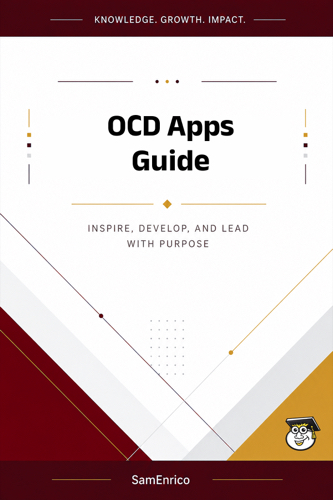
OCD Apps Guide Audiobook
undefined
by Mccurdy Suzy
undefined
Formats
Free sample
Chapter 1: The Doubting Disease--–- The first time Sarah touched a doorknob with her bare hand, she was seven years old. Nothing happened. No infection, no illness, no catastrophe. But her brain didn't remember what happened. It remembered what could have happened.
By the time she was twenty-two, Sarah had downloaded twelve mental health apps. She had a panic button app, a thought logging app, a breathing exercise app, a habit tracker, a mood diary, a CBT worksheet app, an ERP game, a meditation app, a sleep app, a "worry time" app, a symptom checker, and a forum app where she could ask strangers if her fears were reasonable. She used them all. She used them every day. And after eight months of diligent, desperate app usage, her contamination OCD had gone from disruptive to disabling.
She could no longer touch her own front door without three minutes of handwashing. The apps hadn't failed her. She had failed to understand what they actually were. And no one had told her the truth: that OCD is not a quirk, not a personality trait, not a preference for cleanliness or order. It is a neurological disorder of doubt.
And until you understand what you are fighting, no app—no matter how well designed—will ever set you free.The Most Misunderstood Disorder in Mental Health Let us begin with a confession that most books are too polite to make: OCD is a terrible name for what this disorder actually is. "Obsessive-Compulsive Disorder" sounds clinical, sterile, almost administrative. It conjures images of someone who likes their books alphabetized or their desk perfectly neat. Popular culture has done the rest. We have all heard someone say, "I'm so OCD about my closet" or "She's OCD about cleaning." This casual misuse of the term has caused enormous harm.
It has turned a devastating neurological condition into a personality quirk. It has convinced millions of sufferers that their symptoms are just an exaggerated version of normal fastidiousness. And it has delayed treatment for years—sometimes decades—because people do not realize they are sick.Sarah did not realize she was sick until her therapist, during their third session, asked a simple question: "How many hours per day do you spend on rituals?"Sarah laughed. She didn't have rituals. She wasn't one of those people who flicked light switches or counted ceiling tiles.
She just... checked things. Reassured herself. Made sure. Was there anything wrong with wanting to be sure?Her therapist waited.…
This is the end of the free sample. Get the Audiobook to keep going. Buy now
About this book
Details
- Author
- Mccurdy Suzy
- Publisher
- SamEnrico
- Language
- English
- Genre
- Non-Fiction, Health & Wellness / Technology
- Released
- 2026-06-06
- Pages (approx.)
- 154
- Available as
- eBook, Audiobook

Listen in the VoxFlicks app
Audiobooks and audio dramas wherever you go. Sign in with your SamEnrico account and press play.
More by Mccurdy Suzy
 The Old Oak Tree RestMccurdy Suzy$11.99
 The Cybersecurity Analyst StressMccurdy Suzy$11.99
 Group Hypnosis Script WritingMccurdy Suzy$11.99
 Chloride Electrolyte Balance GuideMccurdy Suzy$11.99
 Founder Vesting StudyMccurdy Suzy$11.99
 The Toastmasters CompanionMccurdy Suzy$11.99
 Time Blocking For RetirementMccurdy Suzy$11.99
 The Silk Throne: How a Female Crime Boss Ruled Hong Kong’s UnderworldMccurdy Suzy$11.99
 The Unseen Hand: The Mysterious Disappearance of Louis Le PrinceMccurdy Suzy$11.99
 Prompt Engineering for Cybersecurity AnalysisMccurdy Suzy$11.99
 Third Party Endorsement During ScandalMccurdy Suzy$12.99
 Employer Obligations for LLC GuideMccurdy Suzy$12.99
You may also like
 Metabolic Adaptation AppsMercer Rosia$11.99
 Pelvic Floor AppsKinder Jaimee$11.99
 Neuropathic Pain AppsMclain Myrle$11.99
 Bipolar Apps GuideNorth Pamula$11.99
 Thyroid AppsRobert Margeret$11.99
 Cannabis Use Disorder AppsMayberry Julianna$11.99
 Sleep Apnea AppsLadner Joella$11.99
 Stimulant Recovery AppsUpchurch Cristopher$11.99