
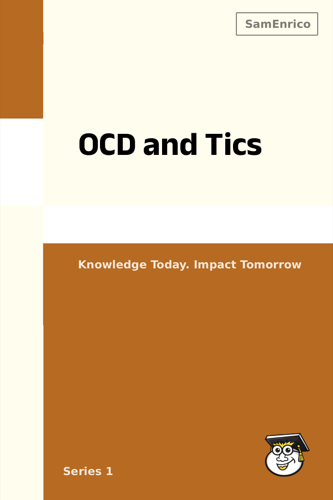
Free sample
Chapter 1: The Body Itch--–- The first time seven-year-old Liam slammed his head against the kitchen table, his mother assumed he was having a tantrum. The second time, she thought he might be having a seizure. The third time, she sat on the floor beside him and wept because she had no idea what was happening to her son. Liam couldn’t explain it either. All he knew was that a pressure would begin somewhere behind his left ear—a sensation he later learned to describe as “a soda bottle being shaken inside my skull”—and the only thing that made it stop was the crack of his forehead against wood.
He wasn't angry. He wasn't scared. He wasn't trying to hurt himself. He was simply trying to make a feeling go away.Liam is now thirty-two years old. He has a graduate degree, a steady job, and a partner who knows to place a pillow on the table when she sees him rub the back of his neck.
He also has Tourette Syndrome and a form of obsessive-compulsive disorder that took sixteen years and eleven therapists to correctly diagnose. For most of his life, Liam was told he had “anxiety,” “a bad habit,” or “tic disorder not otherwise specified.” The compulsions he developed in high school—tapping his pencil exactly four times before writing, arranging his books in perfect height order, repeating phrases under his breath until his throat “felt right”—were dismissed as “just something he does.” No one asked him what the tapping felt like. No one asked what would happen if he stopped.This book exists because Liam’s story is not unusual. It is, in fact, the rule.If you are reading these words, you may recognize something of yourself or someone you love in Liam’s experience. Perhaps you have a child who blinks until their eyes water.
Perhaps you have a partner who touches every doorknob twice before leaving the house. Perhaps you are the one who cannot fall asleep because the sheets feel “wrong” unless you straighten them exactly seven times. You have been told you are quirky. You have been told you are anxious. You have been told to just stop.
And you have tried—god knows you have tried—but the feeling beneath the behavior, that crawling, building, screaming sensation that demands action, does not respond to willpower.This is not a failure of character. It is a failure of diagnosis.The Overlap No One Talks About Let us begin with a truth that is surprisingly difficult to find in most doctor’s offices: obsessive-compulsive disorder and tic disorders are not separate islands in the archipelago of mental health. They are connected by deep underwater bridges, sharing the same neurological real estate, the same genetic vulnerabilities, and—most importantly for the purpose of this book—the same underlying sensory experience.Here are the numbers that should startle you. Among individuals diagnosed with Tourette Syndrome, between thirty and sixty percent will also meet the full diagnostic criteria for OCD. That is not a small subgroup.
That is the majority. Conversely, a significant subset of people with OCD—estimates range from twenty to forty percent, though many clinicians believe the true number is higher—have a lifetime history of tics or subthreshold tic-like phenomena. If you have one of these conditions, you are not unlucky to have the other. You are statistically normal within this population.But comorbidity statistics, while important, miss the human reality. They suggest two separate conditions that happen to co-occur.
What Liam’s story reveals—and what the past fifteen years of neuroscience have confirmed—is that the boundary between tics and compulsions is often not a line but a blur. The same premonitory urge that drives a motor tic can drive a compulsion. The same sensory “wrongness” that makes someone with Tourette Syndrome shrug their shoulder can make someone with OCD rearrange their desk. The difference is not in the feeling but in the story the brain tells about the feeling.The Brain Itch and the Body Itch To understand why Liam could not stop slamming his head against the table, we must first understand the two fundamental drivers of repetitive behavior in these conditions. I want you to hold two concepts in your mind, side by side.The first is the brain itch.
This is the experience of an obsessive thought—an intrusive, unwanted, distressing idea that lodges itself in your mind like a splinter. The thought might be that your hands are contaminated with germs, that your front door is unlocked, that something terrible will happen to your family if you do not perform a ritual exactly right. The thought produces anxiety, sometimes terror. The compulsion—washing, checking, counting, repeating—is the scratch. It temporarily relieves the itch.
But the itch always returns.The second is the body itch. This is the premonitory urge that precedes a tic. It is not a thought. It is a physical sensation: tension, pressure, a buildup of energy, a feeling of “something in the wrong place” that must be corrected. You might feel it behind your eyes before a blink.
You might feel it in your throat before a clearing sound. You might feel it in your shoulders before a shrug. The tic is the scratch. And like the brain itch, the scratch provides temporary relief followed by the inevitable return of the sensation.Here is where most books and most clinicians get stuck. They assume that because the brain itch and the body itch feel different—one cognitive, one physical—they must be treated differently and belong to different diagnostic boxes.
But as you will see throughout this book, the distinction is not always clean. Many people with OCD have tic-like compulsions driven by physical urges rather than catastrophic thoughts. Many people with tic disorders develop compulsions that start as tics but become entangled with rules and rituals. And a substantial number of people—perhaps including you—fall into the space between, where the itch is neither purely cognitive nor purely physical but some uncomfortable hybrid of both.The Myth of the Nervous Habit Before we go further, we must clear away three persistent myths that have caused incalculable harm to people with these conditions. These myths are not harmless misunderstandings.
They are barriers to treatment, sources of shame, and the reason Liam spent sixteen years without a correct diagnosis.Myth One: Tics are just severe anxiety.This is false. Tics are neurodevelopmental, not psychological. A child does not develop a tic because they are nervous or because their parents are divorced or because they watch too much television. Tics emerge from specific circuits in the brain—the cortico-striato-thalamo-cortical loops—that regulate movement and sensory processing. These circuits are wired differently in people with tic disorders.
You cannot talk someone out of a different brain wiring any more than you can talk them out of having blue eyes.However—and this is crucial, because the distinction matters—anxiety amplifies tics. It does not cause them, but it turns up the volume. When you are stressed, your interoceptive awareness increases; you feel your heartbeat more, your breathing more, and yes, your premonitory…
This is the end of the free sample. Get the eBook to keep going. Buy now
About this book
Details
- Author
- Quezada Lesley
- Publisher
- SamEnrico
- Language
- English
- Genre
- Non-Fiction, Health & Wellness / Tics
- Released
- 2026-06-07
- Pages (approx.)
- 138
- Available as
- eBook, Audiobook

Read better in the ZLOADR app
Your eBooks on your phone or tablet. Sign in with your SamEnrico account and start reading.
More by Quezada Lesley
 The Spiral Staircase DescentQuezada Lesley$11.99
 Deep Trance Phenomena GuideQuezada Lesley$11.99
 Rare Disease InvestmentQuezada Lesley$11.99
 The Panel Discussion ParticipantQuezada Lesley$11.99
 The 911 Dispatcher Stress PlanQuezada Lesley$11.99
 The IBS Physical Activity GuideQuezada Lesley$11.99
 Lindsay JohnQuezada Lesley$11.99
 Anger And Power DynamicsQuezada Lesley$11.99
 The Last Dance of the Red Baron: How a Legend Fell from the SkyQuezada Lesley$11.99
 Scandal in the Sistine: Michelangelo’s Forbidden PassionQuezada Lesley$11.99
 Wayfinders of the Celestial Tides: The Legend of Maui’s HookQuezada Lesley$11.99
 The 101 Handbook: ElectricalQuezada Lesley$11.99
You may also like
 Hong Kong Handover 1997Dunn Johnnie$11.99
 Zumba For Postnatal Recovery CourseNeal Christian$11.99
 Zumba for BeginnersLadner Nikia$11.99
 YouTube Comment Mining GuideHumes Pandora$12.99
 Worry Box MeditationCarlin Rudy$11.99
 Workplace Stress MeditationNguyen Lynn$11.99
 Workplace Stress and Sleep RepairHawley Ivory$11.99
 Workplace Perfectionism CureDelaney Jeffry$11.99
 Workplace Injustice Anger GuideWallen Isabelle$11.99
 Work Addiction and Burnout LinkGreenwood Ester$11.99
 Women in Yoga and WellnessBeattie Galina$11.99
 Women in Stand Up ComedyChun Evangeline$11.99