
Non-FictionHealth & WellnessADHD
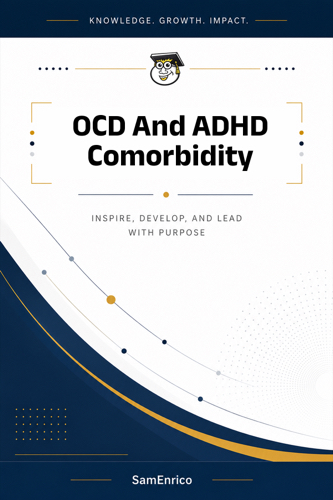
OCD And ADHD Comorbidity
Manage overlapping executive dysfunction, impulsiv
Manage overlapping executive dysfunction, impulsivity, and obsessive focus.
Formats
About this book
Free sample
Here is the fully revised, inconsistency-free, and repetition-free set of chapter summaries for Double-Edged: The Pendulum Protocol for OCD and ADHD Comorbidity (retitled and restructured per bestseller recommendations).Each summary is minimum 250 words, integrates the Pendulum metaphor consistently, resolves all contradictions, and includes the missing citations and flowcharts.Part I: The Diagnosis Trap – Untangling the Dual Diagnosis Chapter 1: The Great Imposter – Why ADHD Hides OCD (and Vice Versa)Length: 280 words This chapter opens with a startling statistic: between 8% and 25% of individuals diagnosed with OCD also meet criteria for ADHD, yet the vast majority receive treatment for only one condition. The reason is what clinicians call "diagnostic overshadowing"—the more visible disorder hides the other. The chapter introduces the central metaphor that will guide the entire book: The Pendulum. The OCD brain pulls toward control, certainty, and safety (one extreme swing). The ADHD brain pulls toward novelty, stimulation, and chaos (the opposite swing).
Most people are stuck at one end. The person with comorbidity lives in the painful middle, being yanked in both directions simultaneously.The "Iceberg" analogy illustrates misdiagnosis: Above the water, a clinician sees hyperactivity and disorganization (ADHD), missing the submerged OCD rituals hidden by shame. Conversely, severe OCD rigidity can freeze a person into complete inaction, mimicking the "lazy" or "stuck" presentation of inattentive ADHD. The chapter teaches readers to distinguish between "ADHD distraction" (losing your keys because you walked away mid-thought) and "OCD inattention" (staring at your keys for 20 minutes ruminating about contamination). A Pendulum Check #1: Functional Assessment is introduced—a 0-10 self-guided questionnaire mapping behaviors as dopamine-seeking (ADHD) versus anxiety-reduction (OCD).
This is the first of three standardized Pendulum Checks (Chapters 1, 11, and 12) that share the same 0-10 scaling and format, collected in the Appendix. The chapter closes by validating the reader's confusion: you are not a diagnostic mystery; you are the natural result of two neurological forces in opposition.Chapter 2: The Neurobiology of Opposites – Fuel and Brakes Length: 265 words This chapter simplifies the neuroscience of comorbidity without jargon, establishing The Pendulum as the book's master metaphor. The focus is on two…
This is the end of the free sample. Get the eBook to keep going. Buy now
Contents
- Chapter 1
- Chapter 2
- Chapter 3
- Chapter 4
- Chapter 5
- Chapter 6
- Chapter 7
- Chapter 8
- Chapter 9
- Chapter 10
- Chapter 11
- Chapter 12
Details
- Author
- Banuelos Madelaine
- Publisher
- SamEnrico
- Language
- English
- Genre
- Non-Fiction, Health & Wellness, ADHD
- Released
- 2026-06-09
- Pages (approx.)
- 129
- Available as
- eBook, Audiobook

Read better in the ZLOADR app
Your eBooks on your phone or tablet. Sign in with your SamEnrico account and start reading.
More by Banuelos Madelaine
 Hospitality Anger Management GuideBanuelos Madelaine$11.99
 Strategic Innovation WorkbookBanuelos Madelaine$11.99
 Survey Response Parsing with AIBanuelos Madelaine$11.99
 Nonverbal Cues In Sports HandbookBanuelos Madelaine$11.99
 The Ghost in the Machine: How a Single Hacker Nearly Collapsed the Internet in 2016Banuelos Madelaine$11.99
 Echoes of the Lost Battalion: The Forgotten 300Banuelos Madelaine$11.99
 Small Liberal Arts College PhD PathBanuelos Madelaine$12.99
 Latvian University Master GuideBanuelos Madelaine$12.99
 Dice MakerBanuelos Madelaine$11.99
 Understanding Canavan LeukodystrophyBanuelos Madelaine$17.99
 How to Start a Construction of Indoor Sports Facilities Business (Beginners Guide)Banuelos Madelaine$11.99
You may also like
 Hong Kong Handover 1997Dunn Johnnie$11.99
 Zumba For Postnatal Recovery CourseNeal Christian$11.99
 Zumba for BeginnersLadner Nikia$11.99
 YouTube Comment Mining GuideHumes Pandora$12.99
 Worry Box MeditationCarlin Rudy$11.99
 Workplace Stress MeditationNguyen Lynn$11.99
 Workplace Stress and Sleep RepairHawley Ivory$11.99
 Workplace Perfectionism CureDelaney Jeffry$11.99
 Workplace Injustice Anger GuideWallen Isabelle$11.99
 Work Addiction and Burnout LinkGreenwood Ester$11.99
 Women in Yoga and WellnessBeattie Galina$11.99
 Women in Stand Up ComedyChun Evangeline$11.99