
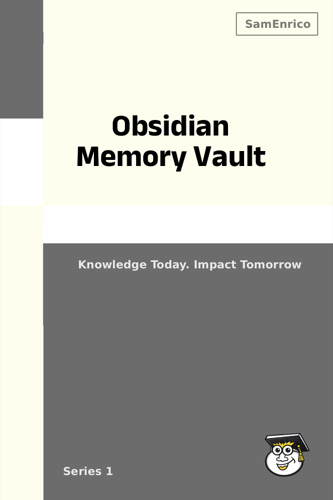
Obsidian Memory Vault eBook
Build a personal knowledge base with linked notes
Build a personal knowledge base with linked notes using this guide.
Formats
Free sample
Chapter 1: The Hoarding Illusion...--–- You have probably never lost a file.Think about that for a moment. Your computer’s search function works. Your cloud storage syncs reliably. You can find that PDF from three years ago, that spreadsheet from last quarter, that email about the meeting agenda. The files are all there.
Every single one of them.And yet, you cannot find what matters.You know you read something about behavioral economics six months ago. You remember thinking, “This will be useful for my project.” You might even recall that it was a blog post by a specific author. But when you search your bookmarks, your downloads folder, your notes app, and your email, you find nothing. Or worse, you find the file but cannot remember why you saved it. The insight that once struck you as brilliant now sits buried under a generic filename, surrounded by hundreds of other orphaned highlights, none of which speak to each other.This is the hoarding illusion.
You have accumulated vast quantities of information, but you have not built a system that can retrieve, connect, or activate that knowledge when you need it most. You are not suffering from a lack of storage. You are suffering from a lack of architecture.Every day, the average knowledge worker encounters enough information to fill a newspaper. We bookmark articles, highlight passages, screenshot charts, and save PDFs. We tell ourselves we are building a library.
But what we are really building is an attic—a dark, dusty space where valuable things go to be forgotten. And the tragedy is not that we lose the information. The tragedy is that we lose the connections that information might have sparked.This book exists because that tragedy is avoidable.The Three Lies We Tell Ourselves About Notes Before we can build a Memory Vault, we must first dismantle the false beliefs that keep us trapped in ineffective systems. These three lies are so deeply embedded in our work habits that we rarely question them. But each one silently sabotages our ability to think clearly and create meaningfully.Lie #1: “If I save it, I will remember it.”This is the most seductive lie because it feels true in the moment.
When you bookmark an article or highlight a passage, you experience a small surge of satisfaction. That satisfaction tricks your brain into believing that you have learned something. In reality, you have only performed the mechanical act of marking text. The psychological research on this is clear: the mere act of saving information creates an illusion of competence. You feel smarter because you have captured something smart, but the capture itself does not transfer understanding.The problem is structural.
Your brain did not evolve to retrieve information from external systems. It evolved to recognize patterns and make associations. When you save a file to a folder, your brain treats that action as “completed” and promptly forgets the content. This is why you can have a dozen articles about a topic in your “Read Later” folder and still feel completely unprepared to discuss that topic. The folder gave you a sense of security, but it gave you no comprehension.Lie #2: “Folders are the natural way to organize.”Walk into any office supply store, and you will see shelves of file folders, binders, and label makers.
The folder metaphor is so deeply ingrained in our culture that we assume it must be correct. Folders are neat. Folders are hierarchical. Folders give us a place to put things. But folders have a fatal flaw: a note can only exist in one folder at a time.Think about a project that spans multiple disciplines.
A product launch might involve marketing notes, engineering specifications, customer research, and budget spreadsheets. In a folder system, you have to choose where to put each piece of information. Do you file the customer interview notes under “Research” or under “Product Launch Q3”? Whatever you choose, you are actively hiding that information from the other context. The folder system forces you to sever connections before you even make them.This is not a minor inconvenience.
It is a fundamental limitation that shapes what you can think. When information is siloed, you cannot see how ideas from different domains might combine into something new. The folder system is not just a tool for storage; it is an invisible cage for your imagination.Lie #3: “My memory is good enough.”We tell ourselves this lie most quietly. We acknowledge that we forget things occasionally, but we assume that the important things will stick. This is statistically false.
The forgetting curve, first described by psychologist Hermann Ebbinghaus in 1885, shows that humans forget approximately 50% of new information within one hour and 70% within one day. Within a week, you retain less than 10% of what you initially learned—unless you actively review and reinforce that information.The problem is not that your memory is defective. The problem is that your memory was never designed for the volume and complexity of information you now encounter daily. Your ancestors needed to remember which berries were poisonous and which trails led to water. You need to remember the nuances of seventeen different software tools, the preferences of eight different stakeholders, and the findings from thirty research papers—all while responding to an endless stream of email.
The mismatch between your biological memory and your cognitive workload is not a personal failing. It is a design problem. And design problems require systematic solutions.The Anatomy of a Memory Vault If the three lies describe what is broken, the Memory Vault describes what is possible. A Memory Vault is not simply a collection of notes. It is a dynamic, interconnected system for capturing, developing, and expressing your ideas over a lifetime.
Unlike a folder-based system that isolates information, a Memory Vault connects it. Unlike a linear notebook that buries insights, a Memory Vault surfaces them. Unlike a scattered collection of bookmarks and highlights that decays into irrelevance, a Memory Vault grows more valuable with every note you add.The Memory Vault rests on four core principles, drawn from the work of productivity expert Tiago Forte and adapted specifically for the Obsidian application. Together, these principles form the acronym CODE: Capture, Organize, Distill, Express.Capture: Keep Only What Resonates Most people capture too much. They save entire articles when only one paragraph matters.
They bookmark entire websites when only one statistic is relevant. The instinct to hoard is understandable—you do not want to miss something valuable. But hoarding creates noise, and noise drowns signal.The Capture principle inverts this instinct. Instead of asking “What might I need someday?”, ask “What resonates with me right now?” When you read something that surprises you, challenges you, or excites you, capture that specific passage. When you hear an idea that connects two things you had not connected before, write down that connection in your own words.
Capture is not about completeness. Capture is about resonance.In practice, this means being ruthless about what enters your Memory Vault. A single sentence that sparks a new line of thinking is more valuable than an entire textbook that you never revisit. Your vault is not a…
This is the end of the free sample. Get the eBook to keep going. Buy now
About this book
Details
- Author
- Jeffrey Gayla
- Publisher
- SamEnrico
- Language
- English
- Genre
- Non-Fiction, Self-Help, Obsidian
- Released
- 2026-06-07
- Pages (approx.)
- 134
- Available as
- eBook, Audiobook

Read better in the ZLOADR app
Your eBooks on your phone or tablet. Sign in with your SamEnrico account and start reading.
More by Jeffrey Gayla
 Validating In Eating DisordersJeffrey Gayla$11.99
 Mayor of a Casino CityJeffrey Gayla$11.99
 Single Parent Self Care WorkbookJeffrey Gayla$11.99
 Dribbble Shot Envy GuideJeffrey Gayla$11.99
 The Scarcity Mindset Reset GuideJeffrey Gayla$11.99
 Bilevel PAP Therapy GuideJeffrey Gayla$11.99
 Sleep Deprivation Memory LossJeffrey Gayla$11.99
 Pomodoro For Note TakingJeffrey Gayla$11.99
 The Visionaries of Stone: The Architectural Genius of the Swahili CoastJeffrey Gayla$11.99
 The Medici Dynasty: Blood, Art, and the Birth of the Modern Family EmpireJeffrey Gayla$11.99
 The Last Voyage of the DemeterJeffrey Gayla$11.99
 Growing Ficus PumilaJeffrey Gayla$11.99
You may also like
 Hong Kong Handover 1997Dunn Johnnie$11.99
 Zumba For Postnatal Recovery CourseNeal Christian$11.99
 Zumba for BeginnersLadner Nikia$11.99
 YouTube Comment Mining GuideHumes Pandora$12.99
 Worry Box MeditationCarlin Rudy$11.99
 Workplace Stress MeditationNguyen Lynn$11.99
 Workplace Stress and Sleep RepairHawley Ivory$11.99
 Workplace Perfectionism CureDelaney Jeffry$11.99
 Workplace Injustice Anger GuideWallen Isabelle$11.99
 Work Addiction and Burnout LinkGreenwood Ester$11.99
 Women in Yoga and WellnessBeattie Galina$11.99
 Women in Stand Up ComedyChun Evangeline$11.99