
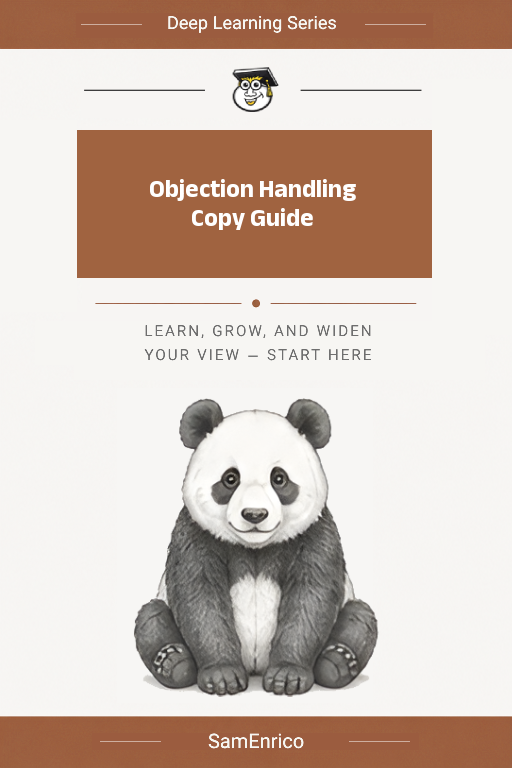
Non-FictionAI OperatorObjection Handling
Objection Handling Copy Guide eBook
Generate copy that addresses common customer objec
Generate copy that addresses common customer objections using AI prompt engineering.
Formats
Free sample
Chapter 1: The Prediction Machine--–- Every word you write is a trigger. Before your prospect reads the second sentence, their brain has already decided whether to trust you or dismiss you. This chapter reveals why most copy fails before it reaches the eyes—and how to write sentences that pre-answer the hidden objections your customer doesn’t even know they’re forming.The 300-Millisecond Problem Close your eyes for a moment. (Okay, don’t actually close them—you’re reading. But imagine.)You click on a landing page.
Before you’ve finished reading the headline, something happens inside your skull. A flash of judgment. A feeling. “This is legit.” Or: “This is garbage.”That judgment doesn’t take seconds. It takes 300 milliseconds.Neuroscientists have measured this.
In less than the time it takes to blink, the human brain evaluates a new stimulus—a face, a sound, a sentence—and makes a primitive call: friend or foe? safe or threat? relevant or noise?Your copy doesn’t get the benefit of the doubt. It gets 300 milliseconds before the amygdala (the brain’s smoke alarm) decides whether to let the rest of the cortex pay attention.Here’s the part that most copywriters—and almost all AI prompts—get catastrophically wrong.That 300-millisecond judgment isn’t random. It’s predictive.
Your prospect’s brain is not a blank slate waiting to be persuaded. It is a prediction engine, constantly forecasting what comes next and comparing it to what actually appears.When you write: “This course will double your revenue…”The brain doesn’t wait for the rest of the sentence. It predicts: “That’s a scam.”When you write: “Our software is used by 10,000 companies…”The brain predicts: “This is going to be expensive.”When you write: “I struggled for years until I discovered…”The brain predicts: “Another guru selling a funnel.”Every sentence you write triggers a prediction. Most of those predictions are objections. And if your copy doesn’t address the prediction before it fully forms, you’ve lost.
Not because your product is bad. Not because your offer is weak. But because your words arrived one millisecond too late.This chapter introduces predictive processing—the neuroscientific model that explains why objections exist before conscious thought—and gives you the framework for writing copy that doesn’t persuade, but pre-answers.What Is Predictive Processing? (And Why It Matters for Copy)Predictive processing is not a marketing gimmick. It is one of the most well-supported theories in contemporary neuroscience, originating from the work of Karl Friston at University College London and expanded by researchers like Andy Clark and Lisa Feldman Barrett.Here’s the theory in plain language:Your brain is not a passive receiver of information.
It does not wait for sensory data to arrive and then react. Instead, your brain is constantly generating predictions about what it expects to experience next—and then checking those predictions against actual input.Think of it like this: your brain is a gambler. It places bets on every moment. “In the next 0.5 seconds, I will hear the sound of my fingers tapping the keyboard.” “In the next second, I will see the edge of my coffee mug.” When the prediction matches reality, you experience cognitive ease—a feeling of fluency, safety, and correctness.When the prediction fails—when you expected the keyboard sound and heard a crash instead—you experience cognitive friction. Surprise.
Alertness. Danger.Now apply this to copy.When a prospect reads your headline, their brain has already placed a bet on what comes next. That bet is shaped by every piece of copy they’ve ever read, every scam they’ve encountered, every disappointed purchase. Their brain predicts: “This is going to promise me something unrealistic.” Or: “This is going to waste my time.” Or: “This person doesn’t understand me.”If your next sentence confirms that prediction—if you do, in fact, promise something unrealistic—the brain experiences a moment of prediction fulfillment. But not the good kind.
The brain says: “See? I was right. This is a scam.” And the prospect clicks away, feeling smart for having avoided a trap.If your next sentence violates that prediction in a positive way—if the prospect expected hype and got honesty—the brain experiences a jolt of surprise. Not the fearful kind. The curious kind.
“Huh. That’s not what I expected.”That curiosity is the gateway to attention.Great copy doesn’t persuade. It violates predictions in ways that create curiosity, then fulfills new predictions with evidence.The Three Types of Predictions (And the Objections They Create)Not all predictions are created equal. Based on the Objection Hierarchy introduced in Chapter 2 (which we’ll reference throughout this book), the brain makes predictions at three depths. Understanding these depths is the difference between copy that converts and copy that collects digital dust.Surface Predictions (Tier 1)These are the fastest, most automatic predictions.
They happen in the first 100 milliseconds and are usually about logistics, features, and basic credibility.Examples:“This will take too long to read.”“This is going to cost more than I want to spend.”“This doesn’t apply to my industry.”“This is just another listicle.”Surface predictions are easy to address—but addressing them is rarely enough. You can say “It’s free” or “It takes two minutes” and satisfy the surface prediction. But the deeper predictions are still running in the background.Emotional Predictions (Tier 2)These predictions take slightly longer to form (200-400 milliseconds) and are about emotional outcomes: fear, shame, regret, hope.Examples:“If I buy this and it doesn’t work, I’ll feel stupid.”“My colleagues will laugh at me for trying this.”“I’ll regret this purchase tomorrow.”“I’m not smart enough to use this.”Emotional predictions are harder to address because they require empathy, not just facts. You can’t say “You won’t feel stupid” and expect that to work. The brain’s prediction is based on past experience—and past experience has taught the prospect that most purchases end in disappointment.
You need to acknowledge the fear, not dismiss it.Identity Predictions (Tier 3)These are the slowest to form (500+ milliseconds) and the most powerful. They are predictions about the self.Examples:“I’m not the kind of person who buys courses like this.”“I’m not a salesperson, so this won’t work for me.”“I don’t need help. I should be able to figure this out myself.”“If I buy this, I’m admitting I failed on my own.”Identity predictions are rarely spoken aloud. The prospect won’t say, “I’m not the kind of person who buys this.” They’ll say, “I need to think about it” or “Let me check my budget.” But the identity prediction is the real barrier. And most copy—especially AI-generated copy—completely misses it because the prospect never stated it directly.The key insight that will appear throughout this book: Your prompts must be written to address predictions in reverse order of speed.
Start with the slowest (identity), then emotional, then surface. Because if you address surface predictions first, you’ll never get the chance to address the deeper…
This is the end of the free sample. Get the eBook to keep going. Buy now
About this book
Details
- Author
- Woods Phillip
- Publisher
- SamEnrico
- Language
- English
- Genre
- Non-Fiction, AI Operator, Objection Handling
- Released
- 2026-06-01
- Pages (approx.)
- 153
- Available as
- eBook, Audiobook

Read better in the ZLOADR app
Your eBooks on your phone or tablet. Sign in with your SamEnrico account and start reading.
More by Woods Phillip
 Toxic Boss Anger ManagementWoods Phillip$11.99
 Non Traditional Career ConfidenceWoods Phillip$11.99
 Transition to Crib GuideWoods Phillip$11.99
 Fear of Flying HypnosisWoods Phillip$11.99
 Signal Privacy Anxiety AddictionWoods Phillip$11.99
 The Poisoned Prescription: Canada's Deadly Healthcare FraudWoods Phillip$11.99
 AgronomistWoods Phillip$11.99
 Understanding Microphthalmia Diaphragmatic Hernia FallotWoods Phillip$17.99
 Sustainability Trends Long Term GuideWoods Phillip$12.99
 Ultimate Handbook Guide to Yicheng : (China) Travel GuideWoods Phillip$11.99
You may also like
 Hong Kong Handover 1997Dunn Johnnie$11.99
 Zumba For Postnatal Recovery CourseNeal Christian$11.99
 Zumba for BeginnersLadner Nikia$11.99
 YouTube Comment Mining GuideHumes Pandora$12.99
 Worry Box MeditationCarlin Rudy$11.99
 Workplace Stress MeditationNguyen Lynn$11.99
 Workplace Stress and Sleep RepairHawley Ivory$11.99
 Workplace Perfectionism CureDelaney Jeffry$11.99
 Workplace Injustice Anger GuideWallen Isabelle$11.99
 Work Addiction and Burnout LinkGreenwood Ester$11.99
 Women in Yoga and WellnessBeattie Galina$11.99
 Women in Stand Up ComedyChun Evangeline$11.99