
Non-FictionStrategic AtlasSemiconductor
Nvidia SWOT Analysis Library Guide Audiobook
Analyze GPU leadership, AI accelerator dominance,
by Stern Cythia
Analyze GPU leadership, AI accelerator dominance, cyclical gaming demand, and competitive threats from AMD.
Formats
Free sample
Chapter 1: The Paranoia Engine...–- Jensen Huang does not sleep like a normal CEO. At least, that is the legend that circulates through Nvidia’s Santa Clara headquarters, repeated by new hires during orientation and whispered by competitors in dark bar conversations. The story goes that Huang wakes at 3:00 AM every morning, not to meditate or exercise, but to worry. He worries about competitors he has not yet heard of. He worries about technologies that do not exist.
He worries about customers who are perfectly happy today but will leave tomorrow. And most of all, he worries about success itself.This is not a story about a paranoid man. It is a story about a company that institutionalized paranoia so effectively that it became the most valuable semiconductor firm on Earth, worth more than $3 trillion in 2026, while its former rivals—Intel, AMD in previous eras, dozens of defunct graphics startups—faded into irrelevance or learned to survive on Nvidia’s leftovers. The thesis of this chapter, and indeed a central argument of this entire book, is that Nvidia’s greatest strength is not its technology, not its patents, not even its legendary CUDA ecosystem (which we will dissect in Chapter 2). Nvidia’s greatest strength is organizational psychology.
Specifically, it is a culture of what I call “paranoid optimism”—the relentless belief that tomorrow could be terrible, so today must be extraordinary.This chapter traces the origins of that psychology from Nvidia’s near-death experience in the late 1990s, through its systematic cultivation of failure as a management tool, and into the boardrooms of 2026 where the same paranoia that saved the company from bankruptcy now drives its trillion-dollar dominance. We will examine the “30-Day Failure” email system, the flat hierarchy that terrifies middle managers, the whiteboard ethic that banishes Power Point from strategy meetings, and most importantly, the way these mechanisms prevent what strategists call the “success trap”—the slow suffocation that killed Intel after it dominated the PC era.By the end of this chapter, you will understand why Nvidia can pivot from mobile chips (a spectacular failure) to AI accelerators (a spectacular success) without the internal friction that would paralyze almost any other organization. You will see why competitors copying Nvidia’s technology inevitably fail to copy Nvidia’s psychology. And you will grasp the central paradox of the company: the same culture that makes Nvidia nearly invincible also makes it deeply fragile, because that…
This is the end of the free sample. Get the Audiobook to keep going. Buy now
About this book
Details
- Author
- Stern Cythia
- Publisher
- SamEnrico
- Language
- English
- Genre
- Non-Fiction, Strategic Atlas, Semiconductor
- Released
- 2026-05-29
- Pages (approx.)
- 151
- Available as
- eBook, Audiobook

Listen in the VoxFlicks app
Audiobooks and audio dramas wherever you go. Sign in with your SamEnrico account and press play.
More by Stern Cythia
 The Ten Minute Mindfulness Habit GuideStern Cythia$11.99The Ten Minute Mindfulness Habit GuideStern Cythia$11.99
 Dental Neglect StoryStern Cythia$11.99
 The Joy of Letting GoStern Cythia$11.99
 Senior Comparison Esteem GuideStern Cythia$11.99
 Aggressive to Assertive WorkbookStern Cythia$11.99
 The Last Song of the DodoStern Cythia$11.99
 Becoming a Child AdvocateStern Cythia$11.99
 Gross Profit Formula PrimerStern Cythia$12.99
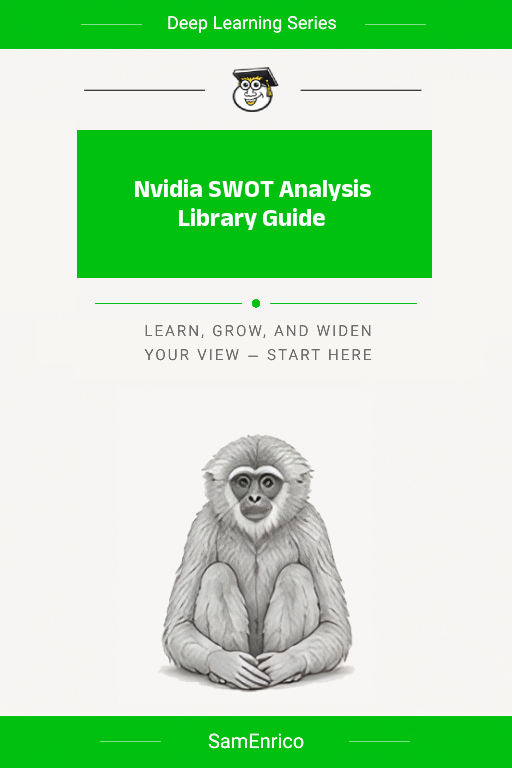 Nvidia SWOT Analysis Library GuideStern Cythia$12.99Nvidia SWOT Analysis Library GuideStern Cythia$12.99Nvidia SWOT Analysis Library GuideStern Cythia$12.99
You may also like
 Hong Kong Handover 1997Dunn Johnnie$11.99
 Zumba For Postnatal Recovery CourseNeal Christian$11.99
 Zumba for BeginnersLadner Nikia$11.99
 YouTube Comment Mining GuideHumes Pandora$12.99
 Worry Box MeditationCarlin Rudy$11.99
 Workplace Stress MeditationNguyen Lynn$11.99
 Workplace Stress and Sleep RepairHawley Ivory$11.99
 Workplace Perfectionism CureDelaney Jeffry$11.99
 Workplace Injustice Anger GuideWallen Isabelle$11.99
 Work Addiction and Burnout LinkGreenwood Ester$11.99
 Women in Yoga and WellnessBeattie Galina$11.99
 Women in Stand Up ComedyChun Evangeline$11.99