
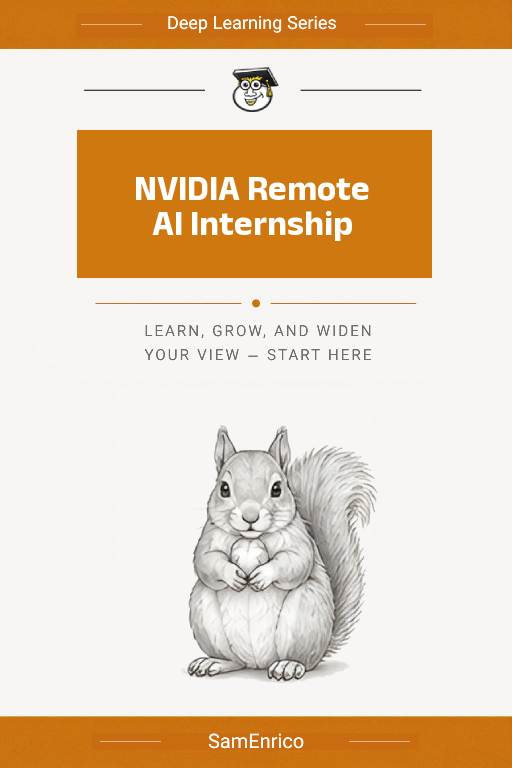
Non-FictionStudent's ShortcutAI InternshipNVIDIA Careers
NVIDIA Remote AI Internship eBook
Land a virtual internship at NVIDIA in deep learni
by Hale Elsa
Land a virtual internship at NVIDIA in deep learning GPU programming or autonomous vehicle simulation from home.
Formats
Free sample
Chapter 1: The Hidden Playbook--–- The moment you stop believing that internships go only to geniuses with perfect GPAs, you become dangerous. Not in an aggressive way. In a quiet, relentless, prepared way. You start noticing patterns that others miss. You realize that the student who lands the remote NVIDIA internship is rarely the smartest person in the room.
They are simply the one who refused to guess what NVIDIA wanted and instead went out to find the actual blueprint.This book is that blueprint.I wrote it because I spent six months studying every NVIDIA remote internship posting I could find, every technical screen transcript shared anonymously on forums, every Git Hub repository of engineers who made it through. I analyzed the gaps in existing books, which are either too academic (four hundred pages on CUDA theory without a single line about interviewing) or too generic (sixty pages of motivational advice with no code at all). What you hold in your hands is the synthesis of those two worlds. It is technical enough to pass the coding screen. And it is strategic enough to make sure you get that screen in the first place.But before we write a single kernel, before we install a single driver, you need to understand something more important than any line of code.
You need to understand the game you are playing.The Forgotten Rule: NVIDIA Does Not Hire Generic Let me share a number that should scare you. In 2024, NVIDIA received over forty-seven thousand applications for its summer internship cohort. The number of remote AI internship slots across deep learning GPU programming and autonomous vehicle simulation? Fewer than two hundred. That is a acceptance rate of 0.4 percent.
Lower than Harvard. Lower than Stanford. Lower than any metric that feels fair.But here is what the statistic does not tell you. The overwhelming majority of those forty-seven thousand applications looked almost identical. A degree in computer science or electrical engineering.
A few machine learning courses. A Kaggle competition or two. A generic cover letter that said “I am passionate about AI” without ever defining what that passion actually produced.The applications that got offers looked nothing like that. They were specific. They were technical.
They contained links to Git Hub repositories where someone had implemented a custom CUDA kernel for matrix multiplication. They referenced NVIDIA’s own open-source projects by name: Thrust, CUB, CCCL. They demonstrated that the applicant had already done the work before asking for the job.This is the forgotten rule, the one that no career center will tell you. NVIDIA does not hire generic. They hire people who have already built something that looks like what their interns build.
They hire people who have already struggled with shared memory bank conflicts and warp divergence. They hire people who have already spent a frustrated Tuesday night trying to figure out why their simulation crashed at hour three.Your resume is not a promise. It is evidence. And the evidence needs to be undeniable.The Three Doors: Which Internship Track Is Yours?Before you can build that evidence, you need to pick a door. NVIDIA offers many internship titles, but they collapse into three remote-viable tracks.
Each track has its own technical stack, its own interview questions, and its own portfolio expectations. Trying to prepare for all three at once is a recipe for burnout. Pick one and go deep.Door One: The CUDA Performance Engineer Job titles you will search for: Deep Learning Performance Intern, CUDA Libraries Intern, GPU Acceleration Intern, High-Performance Computing Intern.What you actually do: You take existing neural networks and make them run faster. You are not training models from scratch. You are profiling them with NVIDIA Nsight Systems, identifying bottlenecks in memory access or kernel launch overhead, and rewriting kernels in C++ CUDA to eliminate those bottlenecks.
You work with libraries like cu BLAS, cu DNN, and NCCL. You think in terms of latency reduction measured in microseconds.The technical bar: You need to write CUDA kernels that are not just correct but fast. You need to understand why coalesced memory access matters. You need to explain the difference between global, shared, and local memory. You need to have used Nsight Compute to identify warp divergence or bank conflicts.The portfolio project that gets you hired: A Git Hub repository where you take a standard operation (matrix multiplication, convolution, or softmax) and optimize it through three or four progressively faster implementations, each with benchmark graphs showing the speedup.
You do not need a novel research contribution. You need to demonstrate that you understand the optimization process.Who this track is for: You enjoy staring at flame graphs. You get a small thrill when you see your kernel go from twelve milliseconds to three. You are comfortable with C++ or willing to become comfortable quickly. You care more about making things fast than about what those things actually compute.Door Two: The Simulation Engineer Job titles you will search for: Autonomous Vehicle Simulation Intern, Robotics Simulation Intern, Omniverse Developer Intern, DRIVE Sim Intern.What you actually do: You build virtual worlds where autonomous systems can fail safely.
You spawn cars, drones, or robots in NVIDIA Isaac Sim (which runs on Omniverse). You attach sensors: cameras, Li DAR, radar, GPS. You write control policies in Python or ROS 2. You measure performance: how often does the lane-keeping agent drift? How many collisions per thousand miles?
How realistic are the sensor outputs compared to real-world data?The technical bar: You need to be comfortable with Isaac Sim or a similar robotics simulator (Gazebo, CARLA). You need to understand ROS 2 topics, services, and actions. You need to have written code that controls a simulated agent based on sensor inputs. You do not need to be a CUDA expert, but you need to understand enough about GPU memory to keep your simulation from crashing.The portfolio project that gets you hired: A video of a simulated car (or drone, or robot) performing a task, along with a publicly accessible repository containing the simulation configuration and control code. The video is not optional.
Hiring managers want to see your agent in motion.Who this track is for: You like watching things move, even if they only exist on a screen. You have patience for configuration files and physics parameters. You enjoy debugging emergent behavior: why did the car swerve left for no apparent reason? You care about the gap between simulation and reality.Door Three: The Synthetic Data Specialist Job titles you will search for: Synthetic Data Generation Intern, Generative AI Intern, World Models Intern, Simulation Data Intern.What you actually do: You generate training data for rare events that are expensive or dangerous to collect in the real world. Car crashes.
Snowstorms. Nighttime pedestrians. Flooded roads. Medical images of rare diseases. You use diffusion models (Stable Diffusion, Control Net) and world models (Dreamer, Day Dreamer) to create millions of synthetic examples.
You then measure the quality of your generated data using metrics like FID score, precision, recall, and diversity.The technical bar: You need to be fluent in Python and Py Torch or Tensor Flow. You need to understand how diffusion models…
This is the end of the free sample. Get the eBook to keep going. Buy now
About this book
Details
- Author
- Hale Elsa
- Publisher
- SamEnrico
- Language
- English
- Genre
- Non-Fiction, Student's Shortcut, AI Internship, NVIDIA Careers
- Released
- 2026-06-01
- Pages (approx.)
- 141
- Available as
- eBook, Audiobook

Read better in the ZLOADR app
Your eBooks on your phone or tablet. Sign in with your SamEnrico account and start reading.
More by Hale Elsa
 Mastery and Accomplishment GuideHale Elsa$11.99
 Bank Robbery HostageHale Elsa$11.99
 Medical Conference Presentation NervesHale Elsa$11.99
 The Exhausted Parent Recovery GuideHale Elsa$11.99
 Deepfake Lip Sync for DubbingHale Elsa$11.99
 The Hollow Crown: The Secret War of the Mayan KingsHale Elsa$11.99
 The Sound of a Revolution: How a Teenager Changed Music ForeverHale Elsa$11.99
 Executive Summary Examples ReferenceHale Elsa$12.99
 Ultimate Handbook Guide to Qinhuangdao : (China) Travel GuideHale Elsa$11.99
 Understanding Bowen's DiseaseHale Elsa$17.99
 Clinical Supply Chain ManagerHale Elsa$11.99
You may also like
 Hong Kong Handover 1997Dunn Johnnie$11.99
 Zumba For Postnatal Recovery CourseNeal Christian$11.99
 Zumba for BeginnersLadner Nikia$11.99
 YouTube Comment Mining GuideHumes Pandora$12.99
 Worry Box MeditationCarlin Rudy$11.99
 Workplace Stress MeditationNguyen Lynn$11.99
 Workplace Stress and Sleep RepairHawley Ivory$11.99
 Workplace Perfectionism CureDelaney Jeffry$11.99
 Workplace Injustice Anger GuideWallen Isabelle$11.99
 Work Addiction and Burnout LinkGreenwood Ester$11.99
 Women in Yoga and WellnessBeattie Galina$11.99
 Women in Stand Up ComedyChun Evangeline$11.99