
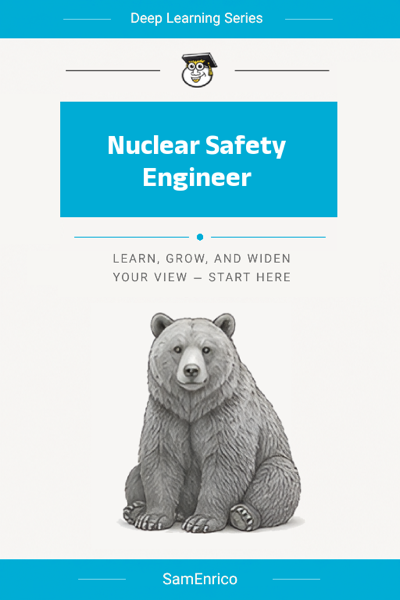
Non-FictionInformativeEducational
Nuclear Safety Engineer eBook
A Coursebook on Nuclear Safety Engineer
by Faison Lino
A Coursebook on Nuclear Safety Engineer
Formats
Free sample
Chapter 1: The Impossible Mission...--The nuclear safety engineer walks into a room that does not yet exist, carrying the weight of a promise made to people who will never know their name. This is not hyperbole. It is the most literal description of the profession ever written. Every day, somewhere in the world, a nuclear safety engineer makes a decision about a weld, a valve, a procedure, or a calculation that will determine whether, thirty years from now, a family living downwind of a reactor will breathe normally or die slowly. The engineer will never meet that family.
The family will never hear the engineer's name. And if the engineer does their job perfectly—absolutely, exhaustively, relentlessly perfectly—nothing whatsoever will happen. No explosion. No evacuation. No news coverage.
Just electricity, flowing quietly into a grid, powering a hospital or a school or a factory, utterly indistinguishable from electricity generated by coal, gas, or wind.This is the impossible mission: to prevent disasters that have not yet occurred, using tools that are incomplete, for stakeholders who are absent, under constraints that are unforgiving, with consequences that are irreversible. The nuclear safety engineer is not a hero in the Hollywood sense. There are no car chases, no last-second wire-cutting, no dramatic speeches. The heroism is entirely invisible. It consists of showing up, every day, to a job where the only reward for success is that nothing bad happens, and the penalty for failure is measured in square kilometers of contaminated land and decades of shortened lives.The Weight of a Single Micron Consider a single fuel pellet.
It is about the size of a pencil eraser, weighing roughly seven grams. Inside that tiny cylinder of ceramic uranium dioxide, packed into a zirconium alloy tube along with two hundred of its identical siblings, is the energy equivalent of one ton of coal. That energy, when released through controlled fission, produces heat that boils water, spins turbines, and generates electricity. But the fission process also produces something else: an inventory of radioactive isotopes so complex and so dangerous that a complete list would fill this entire chapter. Iodine-131, which concentrates in the thyroid.
Cesium-137, which mimics potassium and spreads through muscles and soft tissues. Strontium-90, which settles in bone. Each of these isotopes has a half-life ranging from days to decades, and each, if released, can cause cancer, birth defects, and acute radiation sickness.The nuclear safety engineer's first job is to understand, at an almost cellular level, exactly what stands between those isotopes and the outside world. That defensive line is not one barrier but four, arranged like Russian nesting dolls around the radioactive core. The first barrier is the fuel matrix itself—the ceramic uranium dioxide crystal structure that retains the vast majority of fission products within its lattice.
The second barrier is the fuel cladding, a tube of zirconium alloy roughly four millimeters in diameter and four meters long, which contains the fuel pellets and the volatile fission gases that escape the ceramic matrix. The third barrier is the reactor coolant system—thick-walled pipes and vessels made of stainless steel or low-alloy steel, designed to hold the high-pressure water or gas that carries heat away from the core. The fourth barrier is the containment building, a structure of reinforced concrete and steel liner designed to withstand pressures equivalent to a commercial airliner crash or a small earthquake.These four barriers are not theoretical. They are physical objects, manufactured by humans, inspected by humans, maintained by humans, and subject to all the imperfections, fatigue, corrosion, and error that humans introduce. A scratch in the cladding, a pinhole in a weld, a crack in a containment wall—any of these can become a pathway for radioactive release.
The nuclear safety engineer's mission is to ensure that these pathways do not exist, and if they do exist, that they are found and repaired before they matter.The Unforgiving Mathematics of Decay Heat Here is the fact that keeps nuclear safety engineers awake at night: when a reactor shuts down, the fission chain reaction stops almost instantly, but the reactor does not become safe. It becomes, in some ways, more dangerous. The reason is decay heat. During normal operation, roughly seven percent of the reactor's thermal power comes not from ongoing fission but from the radioactive decay of fission products already produced. After shutdown, that seven percent remains, decaying exponentially but stubbornly.
One second after shutdown, decay heat is approximately seven percent of full power. One hour later, it is about one and a half percent. One day later, it is about half of one percent. One month later, it is still measurable—still requiring active cooling to prevent the fuel from overheating, melting, and releasing its radioactive inventory.This decay heat is the fundamental threat that all nuclear safety systems are designed to address. The reactor can be shut down.
The control rods can be fully inserted. The neutron chain reaction can be halted entirely. But the decay heat remains, and if cooling is lost, the temperature of the fuel will begin to rise. At around 800 degrees Celsius, the zirconium cladding begins to creep and deform. At around 1200 degrees Celsius, a chemical reaction begins that makes everything worse: the zirconium combines with steam to produce hydrogen gas and additional heat, accelerating the temperature rise.
At around 2000 degrees Celsius, the fuel pellets begin to melt, releasing volatile fission products from the ceramic matrix. At around 2800 degrees Celsius, the molten fuel and cladding form a lava-like substance called corium, which can melt through the reactor vessel and into the containment building's concrete foundation.The nuclear safety engineer does not just memorize these numbers. They internalize them. They know that the difference between 1199 degrees and 1201 degrees is not an academic distinction—it is the difference between a manageable accident and a severe accident involving hydrogen explosions. They know that the time available to restore cooling after a loss of coolant accident is measured not in hours but in minutes, sometimes seconds.
They know that every safety system, every procedure, every backup, every redundant train exists because decay heat does not negotiate.The Spectrum of Bad Things That Can Happen Nuclear safety engineering categorizes potential failures not by their likelihood but by their consequences. The lowest tier is the anticipated operational occurrence—events expected to happen several times during the plant's lifetime, such as a loss of off-site power or a minor equipment malfunction. These events should cause no significant fuel damage and no off-site radiological release. Next are design basis accidents—postulated events that are unlikely but possible, such as a pipe break or a control rod ejection. The plant must be designed to withstand these events with no off-site release requiring long-term evacuation.
Beyond that are beyond-design-basis accidents—events more severe than the plant was originally designed for, such as a station blackout lasting longer than assumed or an external flood exceeding the design height. And at the far end of the spectrum are severe accidents—core damage events that involve melting of fuel and potential containment failure.Each of these categories has its own analytical methods, its own acceptance criteria, and its own set of engineered protections.…
This is the end of the free sample. Get the eBook to keep going. Buy now
About this book
Details
- Author
- Faison Lino
- Publisher
- SamEnrico
- Language
- English
- Genre
- Non-Fiction, Informative, Educational
- Released
- 2026-06-02
- Pages (approx.)
- 129
- Available as
- eBook, Audiobook

Read better in the ZLOADR app
Your eBooks on your phone or tablet. Sign in with your SamEnrico account and start reading.
More by Faison Lino
 The Listening Spouse GuideFaison Lino$11.99
 The Teacher Student CommunicationFaison Lino$11.99
 Musical Composition Dream Incubation CourseFaison Lino$11.99
 Transforming Parental Anger Into ConnectionFaison Lino$11.99
 The Email Copywriting GuideFaison Lino$11.99
 The Silent Codebreakers: The Women Who Cracked Nazi SecretsFaison Lino$11.99
 Green Credit for NonprofitsFaison Lino$12.99
 ARIPO Registration TimelineFaison Lino$12.99
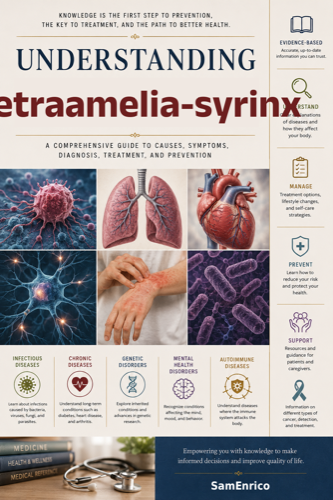 Understanding Tetraamelia-syrinxFaison Lino$17.99
 How to Start a Jewelry Store BusinessFaison Lino$11.99
You may also like
 Hong Kong Handover 1997Dunn Johnnie$11.99
 Zumba For Postnatal Recovery CourseNeal Christian$11.99
 Zumba for BeginnersLadner Nikia$11.99
 YouTube Comment Mining GuideHumes Pandora$12.99
 Worry Box MeditationCarlin Rudy$11.99
 Workplace Stress MeditationNguyen Lynn$11.99
 Workplace Stress and Sleep RepairHawley Ivory$11.99
 Workplace Perfectionism CureDelaney Jeffry$11.99
 Workplace Injustice Anger GuideWallen Isabelle$11.99
 Work Addiction and Burnout LinkGreenwood Ester$11.99
 Women in Yoga and WellnessBeattie Galina$11.99
 Women in Stand Up ComedyChun Evangeline$11.99