
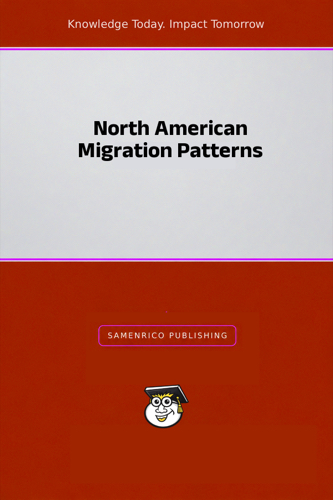
Non-FictionForecast & OutlookNAFTA
North American Migration Patterns eBook
Forecasts tech talent moves between US, Canada, an
Forecasts tech talent moves between US, Canada, and Mexico.
Formats
Free sample
Chapter 1: The Broken Pipeline...--The email arrived at 11:47 PM on a Tuesday. Rajesh had been refreshing his browser for fourteen hours straight, watching the H-1B lottery results trickle out in erratic bursts. His wife was asleep upstairs. His three-year-old daughter's crayon drawing of a family of four—missing him because he was always working—was taped to the monitor. When the status finally changed from "Submitted" to "Not Selected," he didn't shout or cry.
He closed the laptop, walked to the kitchen, and stood in the dark for twenty minutes. This was his third consecutive loss. He had a master's degree from Carnegie Mellon, seven years of experience at a Fortune 500 fintech company, and a perfect record on performance reviews. None of it mattered. The lottery did not care about his credentials, his mortgage, or the fact that his daughter had started calling him "the man on the phone." Three days later, a recruiter from a Canadian AI startup messaged him on Linked In.
The salary was 18 percent lower than his US compensation. The processing time for permanent residence under Canada's Global Skills Strategy was two weeks. He accepted the offer before the month ended. By June, he was living in Toronto, filing Canadian taxes, and watching from afar as his former team in the US was gradually replaced by engineers in Monterrey who cost half his old salary and shared the same time zone. His story is not an outlier.
It is the new normal. This chapter explains why the H-1B visa system—the primary pipeline for foreign tech talent into the United States for three decades—has become functionally broken, and how that breakdown is reshaping the entire continent's labor geography.The Origins of the Pipeline The H-1B visa was created by the Immigration Act of 1990, a piece of legislation signed by President George H.W. Bush at the tail end of the Cold War. The world looked very different then. The Soviet Union was collapsing.
Japan was seen as the primary economic threat to American technological supremacy. The commercial internet was still a Pentagon research project called ARPANET. The idea that a software engineer would need to cross borders to find work was still niche; most tech talent was born, educated, and employed within a few miles of its hometown. The H-1B program was designed as a narrow, temporary fix for genuine skill shortages. Employers could sponsor foreign professionals for up to six years, after which they had to return home unless they obtained permanent residence.
The annual cap was set at 65,000 visas—a number that seemed generous at the time. In 1990, the United States employed approximately 500,000 software developers. Adding 65,000 foreign workers per year would have increased the talent pool by 13 percent annually, an enormous influx. But the cap was not filled in those early years. In 1991, only 40,000 H-1B petitions were filed.
Employers were still learning how to use the system, and immigration lawyers were still interpreting the regulations.Fast forward thirty-five years. The US tech industry employs nearly 4.5 million software developers, data scientists, and AI specialists. The H-1B cap remains virtually unchanged at 85,000 per year (65,000 for the regular cap, plus 20,000 for master's degree holders). Demand has exploded. In 2024, US employers filed 758,000 H-1B registrations for those 85,000 slots.
That is a success rate of 11.2 percent. By 2026, the number of registrations had grown to 890,000. The lottery success rate fell below 10 percent for the first time in history. This is not a labor market. It is a casino.
And like any casino, the house always wins. The house in this case is not the US government or the tech industry but the law firms, the scammers, and the consultancies that have turned the H-1B system into a multi-billion-dollar shadow economy. The workers themselves are the chips being pushed across the table.The Anatomy of a Broken System To understand why the H-1B visa is irreparably broken, one must understand its three core failures: the lottery, the backlog, and the lack of portability.Failure One: The Lottery. The shift from a first-come, first-served system to a random lottery was implemented in 2020 under the Trump administration. The stated goal was to reduce fraud.
The actual effect was to eliminate any incentive for employers to be selective. Previously, companies had to prepare complete petitions, pay significant filing fees, and demonstrate a genuine need for each worker. The lottery allowed employers to register workers for a nominal fee—initially $10, later raised to $10 per registration, a trivial cost for any tech company. This created an explosion of "mock registrations." A single US employer might file 1,000 registrations for 200 actual positions, simply to game the odds. Worse, Indian consulting firms with names like "Tech Global Solutions" and "Innovative IT Services" began filing tens of thousands of registrations for workers they did not yet have, with the intention of finding bodies to fill the slots after the lottery was won.
The Department of Homeland Security estimated in 2025 that 35 percent of all H-1B registrations were fraudulent or duplicative. That means one out of every three lottery entries was a ghost. The legitimate workers—the Rajeshes of the world—were competing against phantoms.Failure Two: The Backlog. Even if a worker wins the lottery, the nightmare has only begun. The path from H-1B to green card (lawful permanent residence) is measured in years for most nationalities and decades for citizens of India and China.
The per-country cap on green cards—7 percent of the annual total for any single nation—creates a staggering disparity. A British software engineer might wait two years for a green card. An Indian software engineer who entered the lottery in 2015 is, as of 2026, still waiting. The backlog for Indian-born professionals in the EB-2 and EB-3 employment-based categories exceeds 1.2 million people. At current processing rates, someone born in India who applies today will receive a green card in the year 2075.
That is not a typo. The year 2075. A newborn child would be fifty years old. The worker who applied at age thirty would be eighty-five. This is not immigration policy.
It is a form of indentured servitude. Because H-1B holders cannot change employers without restarting the green card process (a process that takes three to five years in itself), they are effectively chained to their sponsoring employer. They cannot negotiate raises. They cannot quit without losing their legal status. They cannot start a company or work as a freelancer.
They are, in the most literal sense, economic prisoners.Failure Three: Lack of Portability. The American labor market is built on the principle of at-will employment. Workers can quit. Employers can fire. The dynamic tension between those two freedoms creates efficient labor markets.
The H-1B visa destroys that dynamic. A worker on an H-1B can transfer to a new employer, but the process is slow, expensive, and uncertain. The new employer must file a new petition, pay thousands of dollars in legal fees, and wait months for approval. During that waiting period, the worker cannot start the new job. They must remain with the old employer or risk falling out of status.
In practice, this means H-1B workers accept lower wages, worse working conditions, and fewer opportunities for advancement than their US…
This is the end of the free sample. Get the eBook to keep going. Buy now
About this book
Details
- Author
- Lorenz Margarette
- Publisher
- SamEnrico
- Language
- English
- Genre
- Non-Fiction, Forecast & Outlook, NAFTA
- Released
- 2026-06-09
- Pages (approx.)
- 142
- Available as
- eBook, Audiobook

Read better in the ZLOADR app
Your eBooks on your phone or tablet. Sign in with your SamEnrico account and start reading.
More by Lorenz Margarette
 The Two Year Old Sleep RegressionLorenz Margarette$11.99
 Polish Green Incentives ManualLorenz Margarette$11.99
 Innocence Project Nevada CasesLorenz Margarette$11.99
 Bodyweight Beginner Zero KitLorenz Margarette$11.99
 Rhythm & Rebellion: The Jazz Warriors of 1924Lorenz Margarette$11.99
 Dwarka's Lost Kingdom: Uncovering India's Sunken CivilizationLorenz Margarette$11.99
 How to Become a Tap-and-die-maker TechnicianLorenz Margarette$11.99
 Public Speaking Development PlanLorenz Margarette$12.99
 Nunavut PNP for GraduatesLorenz Margarette$12.99
 Understanding Chromosome 18, TrisomyLorenz Margarette$17.99
 Business Immigration ParalegalLorenz Margarette$11.99
You may also like
 Hong Kong Handover 1997Dunn Johnnie$11.99
 Zumba For Postnatal Recovery CourseNeal Christian$11.99
 Zumba for BeginnersLadner Nikia$11.99
 YouTube Comment Mining GuideHumes Pandora$12.99
 Worry Box MeditationCarlin Rudy$11.99
 Workplace Stress MeditationNguyen Lynn$11.99
 Workplace Stress and Sleep RepairHawley Ivory$11.99
 Workplace Perfectionism CureDelaney Jeffry$11.99
 Workplace Injustice Anger GuideWallen Isabelle$11.99
 Work Addiction and Burnout LinkGreenwood Ester$11.99
 Women in Yoga and WellnessBeattie Galina$11.99
 Women in Stand Up ComedyChun Evangeline$11.99