
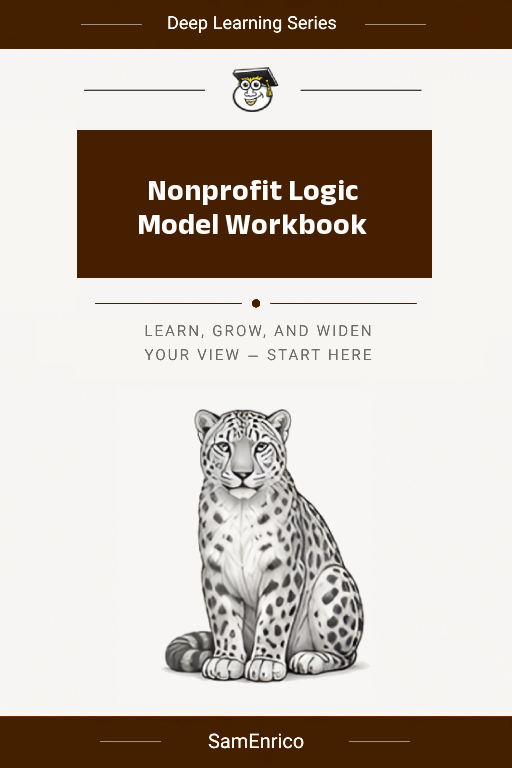
Non-FictionSide Hustle ArchitectFundraising WritingWorkbook
Nonprofit Logic Model Workbook
Create compelling logic models, problem statements
Create compelling logic models, problem statements, and outcome measurements for federal and foundation grants. Includes worksheet templates, M&E plan examples, and theory-of-change builders.
Formats
About this book
Free sample
Chapter 1: The Hidden Diagnosis--–- You have just spent eleven weeks writing a federal grant proposal. Your budget is balanced. Your narrative sings. Your letters of support are signed by four community leaders. You hit submit at 4:58 PM on the deadline day, exhale for the first time in days, and begin the long wait.Three months later, the rejection letter arrives.The feedback is painfully vague: "The proposal did not adequately demonstrate a clear connection between program activities and anticipated outcomes." Or worse: "The logic model was inconsistent with the narrative."You read it again.
Then again. You know your program backward. You know it works. But something in that logic model—that one-page diagram the funder required almost as an afterthought—broke the deal.This chapter is the diagnosis of that hidden fracture. It is called The Hidden Diagnosis because most nonprofit professionals never realize that their logic model is the single highest-leverage page in any grant application.
A great narrative with a weak logic model loses. A mediocre narrative with a strong logic model often wins. And the difference between winning and losing comes down to three specific failure patterns that this chapter will help you name, diagnose, and route to the correct solution elsewhere in this workbook.Before we build anything new, you must understand why your previous logic models failed. This chapter is not the construction chapter—that comes in Chapter 4, where you will build the Golden Thread from impact backward to inputs. This chapter is the emergency room triage.
It will give you a diagnostic checklist, a vocabulary for your pain, and a personalized reading plan for the rest of this book.Let us begin with a blunt truth: logic models are not optional accessories. They are not boxes to check before submitting a budget narrative. They are the skeleton upon which your entire grant proposal hangs. When the skeleton is misshapen, the narrative slumps. When the skeleton is fractured, the proposal collapses entirely.
And yet, most nonprofit professionals treat logic models as a last-minute exercise—something to sketch on a whiteboard twenty minutes before the…
This is the end of the free sample. Get the eBook to keep going. Buy now
Contents
- Chapter 1
- Chapter 2
- Chapter 3
- Chapter 4
- Chapter 5
- Chapter 6
- Chapter 7
- Chapter 8
- Chapter 9
- Chapter 10
- Chapter 11
- Chapter 12
Details
- Author
- Souza Charlyn
- Publisher
- SamEnrico
- Language
- English
- Genre
- Non-Fiction, Side Hustle Architect, Fundraising Writing, Workbook
- Released
- 2026-05-28
- Pages (approx.)
- 142
- Available as
- eBook, Audiobook

Read better in the ZLOADR app
Your eBooks on your phone or tablet. Sign in with your SamEnrico account and start reading.
More by Souza Charlyn
 SMART Goals Action Planning GuideSouza Charlyn$11.99
 I Statements MasterySouza Charlyn$11.99
 The Car Wash Ghost CompaniesSouza Charlyn$11.99
 Heights Virtual GuideSouza Charlyn$11.99
 Understanding Kindling in Alcohol WithdrawalSouza Charlyn$11.99
 The Phantom of the MediterraneanSouza Charlyn$11.99
 How to Become a Choke ReamerSouza Charlyn$11.99
 Celadonite MiningSouza Charlyn$11.99
 Understanding Infectious ArthritisSouza Charlyn$17.99
 Furniture Home Decor SpendingSouza Charlyn$12.99
You may also like
 Hong Kong Handover 1997Dunn Johnnie$11.99
 Zumba For Postnatal Recovery CourseNeal Christian$11.99
 Zumba for BeginnersLadner Nikia$11.99
 YouTube Comment Mining GuideHumes Pandora$12.99
 Worry Box MeditationCarlin Rudy$11.99
 Workplace Stress MeditationNguyen Lynn$11.99
 Workplace Stress and Sleep RepairHawley Ivory$11.99
 Workplace Perfectionism CureDelaney Jeffry$11.99
 Workplace Injustice Anger GuideWallen Isabelle$11.99
 Work Addiction and Burnout LinkGreenwood Ester$11.99
 Women in Yoga and WellnessBeattie Galina$11.99
 Women in Stand Up ComedyChun Evangeline$11.99