
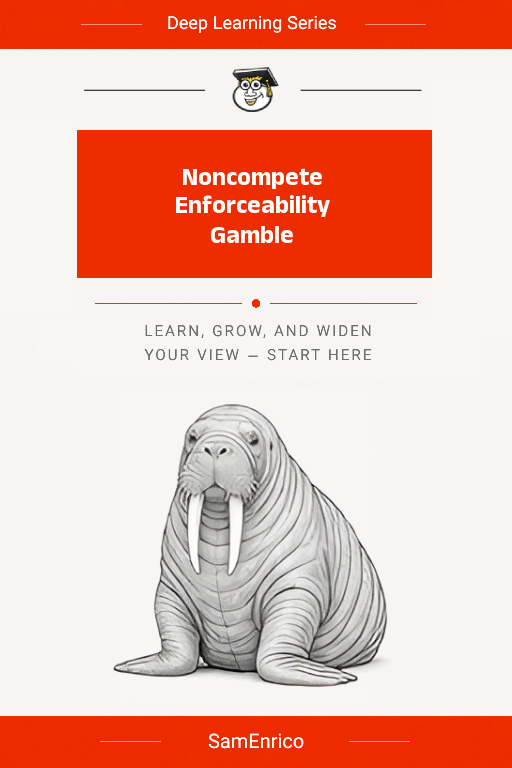
Non-FictionTrade SecretsRestrictive Covenants
Noncompete Enforceability Gamble eBook
Draft geographic and time-limited noncompete claus
by Spence Santo
Draft geographic and time-limited noncompete clauses that survive state judicial scrutiny, avoiding complete unenforceability that leaves trade secrets exposed.
Formats
Free sample
Chapter 1: The $47 Million Handshake--–- The email arrived at 11:47 PM on a Tuesday. Mark had just finished brushing his teeth when his phone buzzed with the subject line: “Resignation – Effective Immediately.” It was his Chief Technology Officer, a quiet engineer named Priya who had been with the company since the first seed round. She wasn't just leaving. She was joining their biggest competitor, a well-funded rival that had been trying to replicate Mark’s proprietary logistics algorithm for eighteen months. Mark wasn't panicked.
He was prepared. He had made every employee, including Priya, sign a noncompete agreement that prohibited working for any competitor within a fifty-mile radius of any company office for two years. His lawyer had charged him $3,500 for the template. It was ironclad. Or so he believed.Ninety days later, Mark sat across from his attorney in a conference room, staring at a preliminary injunction denial.
The judge had not only refused to stop Priya from starting her new role—she had already moved to Austin, well outside the fifty-mile radius—but had also issued an opinion that called Mark’s noncompete “unreasonable in geographic scope, duration, and activity.” The judge used the word “boilerplate” six times. Mark’s competitor, now armed with his algorithm, raised a Series B at a $47 million valuation. His own investors called a special board meeting. The question they asked was not about product-market fit. It was: “How did you let our biggest trade secret walk out the door with a piece of paper a judge threw in the trash?”This is the cost of the noncompete gamble.
It is not a theoretical risk buried in law review articles. It is a daily reality in courthouses across the country, where judges—many of whom spent decades as employment lawyers before ascending to the bench—routinely void restrictive covenants that employers assumed were bulletproof. The most dangerous words in employment law are not “trade secret” or “reasonable.” The most dangerous words are “we’ve always used this form.”The purpose of this chapter is to fundamentally reset your understanding of what noncompetes are, what they are not, and why the era of the copy-paste restrictive covenant is not just ending—it has already ended. By the time you finish reading, you will understand the precise legal landscape that determines whether your agreement will be enforced, modified, or laughed out of court. You will learn why the FTC’s proposed ban is only part of the story, why California is not the only state that hates noncompetes, and why Oklahoma—of all places—has become a cautionary tale for employers who assume that “choice of law” clauses are magic incantations.But first, a warning.
This book is written for employers, in-house counsel, HR professionals, and the attorneys who advise them. It assumes you are on the side of protecting legitimate business interests, not evading employee rights. If you are an employee seeking to void a noncompete, you will find valuable legal principles here, but you should consult your own attorney for strategy. What follows is not legal advice. It is a battlefield map.
The terrain is shifting. Let us begin.The Death of the Boilerplate Noncompete For decades, employers operated under a comfortable fiction: a noncompete was a noncompete. You could buy a template from a legal forms website, fill in the employee’s name and a radius, and rest assured that a court would enforce it if the employee later joined a competitor. That fiction has collapsed. It has collapsed for three converging reasons, each of which we will explore in depth.First, state legislatures have discovered that noncompetes are politically popular targets.
In the past five years, more than twenty states have enacted laws restricting or prohibiting noncompetes for low-wage workers, medical professionals, and even certain tech employees. Illinois, Maine, Maryland, Massachusetts, Nevada, New Hampshire, Oregon, Rhode Island, Virginia, Washington, and the District of Columbia have all passed significant restrictions. These laws are not uniform. They create a patchwork where an agreement that is perfectly enforceable in Texas might be a felony in Oklahoma. The days of a single “national” noncompete are over.Second, the FTC’s proposed rule to ban virtually all noncompetes has forced every employer to confront a future where the traditional noncompete may simply disappear.
The proposed rule, introduced in January 2023 and still working its way through legal challenges as of this writing, would make it an unfair method of competition to enter into or enforce a noncompete with any worker—regardless of seniority or access to trade secrets. While the rule’s ultimate fate is uncertain (challenges are pending in federal court), the mere possibility has prompted sophisticated employers to begin shifting away from noncompetes and toward the alternatives we will cover in later chapters: non-solicitation agreements, non-recruitment covenants, garden leave provisions, and robust trade secret protection.Third, courts have lost patience. Judges who once routinely granted preliminary injunctions based on boilerplate language now demand evidence. They require specificity. They punish overreach.
A 2022 study by the University of Pennsylvania Law Review found that courts are nearly twice as likely to void a noncompete today as they were a decade ago, even when the facts are otherwise identical. The reason is not a change in the underlying law. The reason is that judges have seen too many abusive agreements that sought to prevent a sandwich shop employee from working at another sandwich shop across the street. Those cases poisoned the well for everyone.The Cost of a Voided Clause Before we dive into the legal nuances, let us be brutally honest about what happens when your noncompete is found unreasonable. The consequences cascade in ways most employers do not anticipate.Loss of trade secrets.
This is the obvious one. When a court refuses to enforce your noncompete, the employee is free to work for the competitor immediately. If that employee possessed your pricing models, customer lists, or proprietary source code, those assets are now in the hands of your direct rival. There is no remedy for this. You cannot un-ring the bell.
Trade secret litigation can take years; a noncompete injunction is supposed to stop the bleeding in days. When the injunction is denied, the bleeding continues.Six- to seven-figure litigation fees. The average cost of litigating a noncompete dispute through a preliminary injunction hearing is between 150,000and150,000 and 150,000and400,000. If the case goes to trial, that number can exceed $1 million. And here is the cruel irony: if you lose, you pay your own fees, and in some states (like California and Oklahoma), you may also be ordered to pay the employee’s fees.
The noncompete you thought was protecting your business becomes a financial catastrophe.Talent wars and reputational damage. When a court voids your noncompete, it becomes public record. Your employees will read the opinion. Your competitors will read the opinion. Recruiters will call your best people and say, “Did you know their noncompete is worthless?” The decision not only frees the departing employee but signals to your entire workforce that your restrictive covenants are toothless.
The result is often a cascade of departures.The knowledge transfer problem. Perhaps the most overlooked consequence is this: even if you…
This is the end of the free sample. Get the eBook to keep going. Buy now
About this book
Details
- Author
- Spence Santo
- Publisher
- SamEnrico
- Language
- English
- Genre
- Non-Fiction, Trade Secrets, Restrictive Covenants
- Released
- 2026-06-01
- Pages (approx.)
- 149
- Available as
- eBook, Audiobook

Read better in the ZLOADR app
Your eBooks on your phone or tablet. Sign in with your SamEnrico account and start reading.
More by Spence Santo
 The Suicide Concern TalkSpence Santo$11.99
 Customer Loyalty MappingSpence Santo$11.99
 Bipolar Wellness Recovery PlanSpence Santo$11.99
 The Protein Intake MetabolismSpence Santo$11.99
 Medication For Parental IrritabilitySpence Santo$11.99
 Improv for Social WorkersSpence Santo$11.99
 Gratitude for LeadersSpence Santo$11.99
 Public Speaking for Audiobook NarratorsSpence Santo$11.99
 The Timbuktu Codex: Shadows of the Golden ScholarsSpence Santo$11.99
 The Nautical Odyssey of John Cabot: Charting the New WorldSpence Santo$11.99
 How to Produce Outdoor LightingSpence Santo$11.99
 How to Produce Computer System Cooling PartsSpence Santo$11.99
You may also like
 Hong Kong Handover 1997Dunn Johnnie$11.99
 Zumba For Postnatal Recovery CourseNeal Christian$11.99
 Zumba for BeginnersLadner Nikia$11.99
 YouTube Comment Mining GuideHumes Pandora$12.99
 Worry Box MeditationCarlin Rudy$11.99
 Workplace Stress MeditationNguyen Lynn$11.99
 Workplace Stress and Sleep RepairHawley Ivory$11.99
 Workplace Perfectionism CureDelaney Jeffry$11.99
 Workplace Injustice Anger GuideWallen Isabelle$11.99
 Work Addiction and Burnout LinkGreenwood Ester$11.99
 Women in Yoga and WellnessBeattie Galina$11.99
 Women in Stand Up ComedyChun Evangeline$11.99