
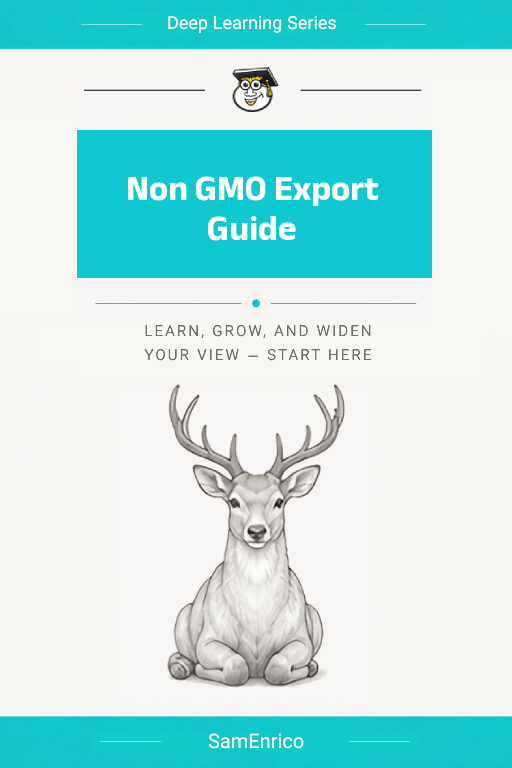
Non GMO Export Guide eBook
Get Non GMO Project certification for food exports
by Elrod Portia
Get Non GMO Project certification for food exports to North American natural products market.
Formats
Free sample
Chapter 1: The Butterfly’s Sting...--–- The email arrived at 9:47 AM on a Tuesday. Priya, the quality assurance director for a mid-sized spice export company in southern India, had been waiting for this moment for nearly four months. Her company had spent $18,000 on testing, consulting, and supply chain audits. They had switched suppliers for their organic turmeric powder twice. They had trained their logistics team in cleanout procedures no one fully understood.
And now, finally, the message from their Technical Administrator appeared in her inbox with the subject line: "Certificate of Verification – Decision."Her thumb hovered over the trackpad. She clicked."After review of the submitted documentation and laboratory results, we are unable to issue a Certificate of Verification at this time. The following non-conformities were identified..."The rest of the email blurred. Somewhere in the text, the words "cross-contact risk" and "insufficient segregation documentation" appeared. Priya closed her laptop and stared at the ceiling.
Her company had just lost a $1.2 million contract with a natural foods distributor in Chicago. The distributor had given them ninety days to deliver a valid Non-GMO Project Certificate of Verification. Day ninety was last Friday. The Butterfly had stung.This story is not hypothetical. It happens to exporters every month.
And it happens because most people misunderstand what the Non-GMO Project Butterfly actually represents. They think it is a test result. They think it is a stamp of approval on a final product. They think it is something you can buy, like organic certification, by paying a fee and filling out paperwork.All of these assumptions are wrong.The Non-GMO Project Butterfly is not a product claim. It is a supply chain confession.
When you display that logo on your packaging, you are not telling the customer, "We tested this and it came out clean." You are telling them, "We have documented every single step of how this ingredient moved from a seed to a shelf, and we can prove that at no point did it knowingly or accidentally mingle with genetically modified material beyond a tiny, regulated threshold." That is a much harder promise to keep. And that is why most exporters fail on their first attempt.This book exists to ensure you are not one of them.The $5 Billion Question: Why the Butterfly Matters Right Now Before we discuss how to achieve Non-GMO Project Verification, we must understand why it has become the single most valuable label for natural products entering the United States and Canadian markets. The numbers are not subtle.According to the Non-GMO Project's annual market report, verified products generate over $5 billion in annual retail sales across North America. That figure has grown every year for more than a decade, surviving economic recessions, supply chain disruptions, and shifting consumer trends. In 2023 alone, the Project reported over 300,000 verified products from more than 3,000 brands.
The Butterfly appears on everything from breakfast cereal to cooking oil to baby formula to pet food.But the raw size of the market is less important than the psychology driving it. Consumers do not simply prefer non-GMO products. They actively distrust products that lack third-party verification. A 2022 consumer survey conducted by the Hartman Group found that 67% of natural products shoppers said they would "definitely" or "probably" switch brands if they discovered a product they purchased regularly was not verified as non-GMO. Among households with children, that number rose to 74%.Why?
Because the Butterfly solves a specific trust problem that other labels do not.Consider the term "natural." It is essentially unregulated in the United States. The Food and Drug Administration has no formal definition for "natural" on food labels, though it has stated informally that nothing artificial or synthetic should be added. That leaves enormous room for interpretation. A product labeled "natural" may still contain genetically modified ingredients, because GMOs are derived from natural organisms through artificial selection techniques—or so the legal argument goes. The point is that "natural" means nothing specific, and consumers know it.Consider the term "non-GMO" used alone, without third-party verification.
Any company can print those words on a package. There is no federal law preventing it. However, the Federal Trade Commission has pursued enforcement actions against companies that make unsubstantiated "non-GMO" claims under its authority to prohibit deceptive advertising. In 2018, the FTC settled with a snack food company that claimed its products were "non-GMO" despite using corn syrup derived from genetically modified corn. The company paid a six-figure penalty and agreed to stop making the claim without verification.That settlement sent a clear message to the food industry: if you say it, you had better be able to prove it.
And the most widely accepted proof is the Butterfly.The retailers know this. Whole Foods Market has required Non-GMO Project Verification for any product labeled "non-GMO" in its US and Canadian stores since 2018. Costco Wholesale has a formal supplier questionnaire that asks specifically whether products are Non-GMO Project Verified and requires the Certificate of Verification as an attachment. Kroger, the largest supermarket chain in the United States by revenue, uses the Non-GMO Project Standard as its internal benchmark for evaluating non-GMO claims made by private label suppliers.These retailers are not being charitable. They are protecting themselves from liability.
If a supplier claims a product is non-GMO and that claim turns out to be false, the retailer can be named in a class action lawsuit alongside the manufacturer. By requiring third-party verification from the Non-GMO Project, retailers offload the verification risk to a recognized standard-setter. The Butterfly becomes their legal shield.But there is another layer to this story that most exporters miss entirely.The Bioengineered Disclosure Law You Cannot Ignore In 2016, the United States Congress passed the National Bioengineered Food Disclosure Standard (NBFDS), which went into full effect in 2022. This law requires food manufacturers, importers, and retailers to disclose the presence of bioengineered (BE) ingredients in their products. The disclosure can take several forms: a text label, a symbol, or a QR code linking to digital information.On its face, this law seems unrelated to non-GMO certification.
But the relationship is critical.The USDA's definition of "bioengineered" is narrower than the Non-GMO Project's definition of "GMO." The USDA excludes certain types of genetic modification from its disclosure requirements, including modifications created through conventional breeding, mutagenesis (a process that uses radiation or chemicals to create random mutations), and some newer techniques like CRISPR that do not introduce foreign DNA. The Non-GMO Project's Standard, by contrast, treats nearly all forms of modern genetic modification as disqualifying, including CRISPR-edited organisms.This difference creates a regulatory gap. A product could be legally sold in the United States without a bioengineered disclosure—because it falls outside the USDA's narrow definition—while still containing ingredients that the Non-GMO Project considers GMOs. For example, a CRISPR-edited soybean that has had a single gene turned off (rather than a foreign gene added) would not trigger the USDA disclosure requirement, but it would not qualify for Non-GMO Project Verification.Why does this matter for exporters? Because many companies assume that if they are complying with the bioengineered disclosure law, they are automatically qualified to make non-GMO claims.
That assumption is dangerously wrong. Compliance with federal law is the floor, not the ceiling. The Butterfly sits much higher.Exporters…
This is the end of the free sample. Get the eBook to keep going. Buy now
About this book
Details
- Author
- Elrod Portia
- Publisher
- SamEnrico
- Language
- English
- Genre
- Non-Fiction, Business Brief, Non GMO
- Released
- 2026-06-01
- Pages (approx.)
- 148
- Available as
- eBook, Audiobook

Read better in the ZLOADR app
Your eBooks on your phone or tablet. Sign in with your SamEnrico account and start reading.
More by Elrod Portia
 Loneliness in Empty NestElrod Portia$11.99
 English as a Second RevenueElrod Portia$11.99
 Cool Room Sleep MeditationElrod Portia$11.99
 Dolores Canady Prison ReformElrod Portia$11.99
 F 111 Aardvark PilotElrod Portia$11.99
 Opioid Induced Apathy GuideElrod Portia$11.99
 Multitasking Myth BusterElrod Portia$11.99
 Fear of Failure for CodersElrod Portia$11.99
 The Silk Road Pioneers: Byzantine Explorers and the Dawn of Global TradeElrod Portia$11.99
 The Collector’s Curse: The Obsession Behind the World’s Most Haunted ArtElrod Portia$11.99
 Service Providers Guide to Closet OrganizersElrod Portia$11.99
 How to Produce Vehicle Remote Keyless SystemsElrod Portia$11.99