
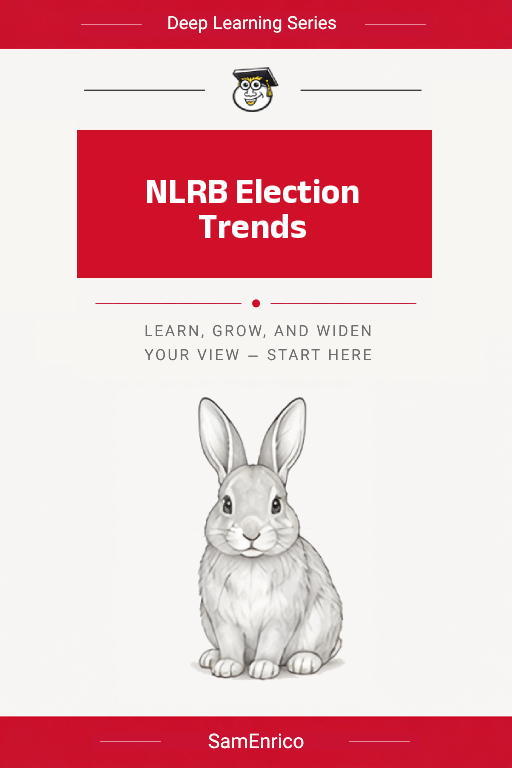
Non-FictionAnnual CheckupNLRBElection Trends
NLRB Election Trends
Analyze NLRB union election trends in tech and ret
by Weston Latia
Analyze NLRB union election trends in tech and retail including win rates and employer tactics.
Formats
About this book
Free sample
Chapter 1: The Great Inversion...--The statistic arrives like a victory bell. In 2024 and 2025, unions won 79 percent of all NLRB representation elections. Petitions surged by nearly a third in retail alone. The media runs headlines about a "union resurgence" and a "new labor movement." Organizers post celebratory graphics on social media. Workers at Starbucks, Trader Joe's, and Amazon warehouseseclaim small but real victories.
By any surface measure, labor appears to be winning.But the bell is cracked.Behind the 79 percent lies a story that most unions would rather not tell. The high win rates are real, but they are concentrated in places that do not change the fundamental balance of power between labor and capital. Unions are winning elections at single coffee shops, boutique retail outlets, small non-profit organizations, and niche digital media companies. They are losing elections at warehouses, distribution centers, manufacturing plants, and corporate campuses. They are winning the battles that matter least and losing the battles that matter most.This is the Great Inversion.The term describes a structural shift in union organizing over the past decade, accelerated dramatically between 2020 and 2026.
Traditional labor strongholds—manufacturing, construction, transportation, and heavy industry—have seen steady declines in organizing petitions, not because workers are satisfied but because unions have quietly retreated. In their place, organizing has surged in "customer-facing" industries: retail, food service, digital media, and personal services. These are workplaces where workers interact directly with the public, where brand reputation matters enormously, and where the emotional labor of constant customer interaction creates genuine grievances.On its face, this shift seems logical. Why not organize where workers are unhappy? Why not target industries with high turnover and low wages?
But the Great Inversion carries a hidden poison. The very features that make customer-facing workplaces accessible to organizing—small unit sizes, public visibility, and moderate employer resistance at the local level—also make them poor leverage points for changing industry-wide standards. Winning a single Starbucks is satisfying. Winning a thousand Starbucks would change the coffee industry. But unions are not winning a thousand Starbucks.
They are winning dozens while losing the battles that would force systemic change.This chapter lays the groundwork for everything that…
This is the end of the free sample. Get the eBook to keep going. Buy now
Contents
- Chapter 1
- Chapter 2
- Chapter 3
- Chapter 4
- Chapter 5
- Chapter 6
- Chapter 7
- Chapter 8
- Chapter 9
- Chapter 10
- Chapter 11
- Chapter 12
Details
- Author
- Weston Latia
- Publisher
- SamEnrico
- Language
- English
- Genre
- Non-Fiction, Annual Checkup, NLRB, Election Trends
- Released
- 2026-05-29
- Pages (approx.)
- 139
- Available as
- eBook, Audiobook

Read better in the ZLOADR app
Your eBooks on your phone or tablet. Sign in with your SamEnrico account and start reading.
More by Weston Latia
 Spin Class Music Sync TechniqueWeston Latia$11.99
 Emetophobia Vomit Fear GuideWeston Latia$11.99
 Return To Office Sanity GuideWeston Latia$11.99
 Harassment Death Threat Online CasesWeston Latia$11.99
 Antwerp Diamond Heist Suspect ProfilesWeston Latia$11.99
 Shadows Over the Sahara: The Secret War for Uranium in the 1970sWeston Latia$11.99
 Echoes of the Cosmic Pioneers: The Unsung Heroes of ApolloWeston Latia$11.99
 Understanding DiverticulosisWeston Latia$17.99
 Research Opportunities ArgentinaWeston Latia$12.99
 How to Start a Parking Meters Business (Beginners Guide)Weston Latia$11.99
 Building Maintenance TechnicianWeston Latia$11.99
You may also like
 Hong Kong Handover 1997Dunn Johnnie$11.99
 Zumba For Postnatal Recovery CourseNeal Christian$11.99
 Zumba for BeginnersLadner Nikia$11.99
 YouTube Comment Mining GuideHumes Pandora$12.99
 Worry Box MeditationCarlin Rudy$11.99
 Workplace Stress MeditationNguyen Lynn$11.99
 Workplace Stress and Sleep RepairHawley Ivory$11.99
 Workplace Perfectionism CureDelaney Jeffry$11.99
 Workplace Injustice Anger GuideWallen Isabelle$11.99
 Work Addiction and Burnout LinkGreenwood Ester$11.99
 Women in Yoga and WellnessBeattie Galina$11.99
 Women in Stand Up ComedyChun Evangeline$11.99