
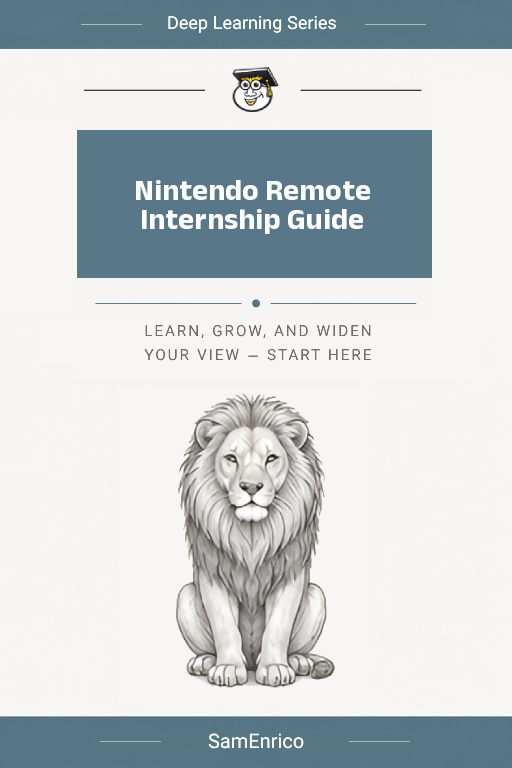
Non-FictionStudent's ShortcutGaming
Nintendo Remote Internship Guide eBook
Apply for remote internships at Nintendo in game d
Apply for remote internships at Nintendo in game design, development, or marketing.
Formats
Free sample
Chapter 1: The Silence Before the Offer--–- The email arrived at 11:47 PM on a Tuesday. No subject line. No name in the signature. Just a single sentence in plain text: “Your application has been received and will not be reviewed.” Not “thank you.” Not “we wish you the best.” Just a cold, algorithmic dismissal delivered with the precision of a machine that had processed ten thousand other applicants that same day.That email, or some version of it, is the first real interaction most aspiring Nintendo interns ever have with the company. It is not a rejection.
It is a ghosting disguised as a confirmation. And it is the single most important piece of feedback you will ever receive — because it contains the secret to everything that follows in this book.Most people read that email and feel defeated. They assume they weren’t good enough. They assume Nintendo is simply too competitive, too exclusive, too Japanese, too traditional, or too mysterious. They give up and apply to a different company.
But that is exactly what Nintendo expects you to do. The silence is a filter. And the people who pass through it are not necessarily the most talented or the most passionate. They are the ones who understand something that the other ninety-eight percent do not.This chapter dismantles the fantasy that working for Nintendo is about loving Mario, excelling at Zelda, or being the biggest fan in the room. It reveals why discipline trumps passion, why remote work is both harder and more accessible than you think, and why your application was probably deleted before a human ever saw it.
Most importantly, it introduces the single most important concept of this entire book: the Remote Bridge Strategy — a method for turning Nintendo’s traditional, secrecy-obsessed, in-person culture into an advantage for remote applicants.By the end of this chapter, you will understand exactly why Nintendo rejects ninety-eight percent of applicants without reading their resumes, what “partial remote” actually means for interns in 2025 and beyond, and how to position yourself as the kind of candidate who receives a different kind of email — the one that begins with “We would like to invite you…”The Hanafuda Paradox: Why a 135-Year-Old Card Company Holds the Key to Your Remote Future To understand how to work remotely for Nintendo, you must first understand why Nintendo has historically resisted remote work. The answer begins not with video games but with hand-painted playing cards.In 1889, Fusajiro Yamauchi founded Nintendo Koppai in Kyoto, Japan, producing Hanafuda cards — intricate, artisanal playing cards made from mulberry tree bark. Each card was painted by hand. Quality control was obsessive. The manufacturing process required craftsmen to work side by side, inspecting each other’s work, sharing techniques, and maintaining standards through physical proximity.
That model worked so well that Nintendo held a monopoly on playing cards in Japan for decades.Fast forward to 1983. The Famicom (Nintendo Entertainment System in the West) launches. The same philosophy applies: hardware and software developed by teams sitting in the same room, testing on the same machines, iterating in real time. Miyamoto Shigeru, the creator of Mario and Zelda, became famous for walking between desks, watching gameplay over developers’ shoulders, and offering adjustments on the spot. This was not casual management.
It was a deliberate creative process built on what the Japanese call “nemawashi” — consensus-building through constant, informal face-to-face communication.Here is what most people get wrong: Nintendo’s resistance to remote work is not about technology. It is not about trust. It is about a fundamental belief that great games are made by people who can see each other’s screens, share the same physical space, and absorb creative energy through proximity. This belief is so deeply embedded in Nintendo’s culture that it survived the 2020 pandemic. While companies like Twitter and Shopify announced permanent remote work, Nintendo of Japan required employees to return to the office as soon as legally possible.
In internal memos obtained by Japanese business press, executives cited “creative synergy” and “quality assurance” as non-negotiable benefits of in-person work.This is the Hanafuda Paradox: Nintendo’s greatest strength — its obsessive, hands-on, craft-first culture — is the same thing that makes it difficult to join from your living room in Ohio or Berlin or Melbourne.But here is the twist that changes everything. While Nintendo of Japan held firm, Nintendo of Europe quietly began experimenting with a “partial remote” model in 2022. By 2024, job postings for the Frankfurt office explicitly mentioned “remote work possible” for certain roles. By 2025, the phrase “partial remote” appeared in official internship descriptions. This was not a wholesale embrace of distributed work.
It was a crack in the wall. And through that crack, a small number of carefully prepared applicants began to slip.The Remote Bridge Strategy, which you will learn throughout this book, is the method for being one of those applicants. It does not require you to change Nintendo’s culture. It requires you to understand it so deeply that you can demonstrate the benefits of remote work without threatening the traditions that Nintendo holds sacred.The Myth of the Gamer: Why Your 200-Hour Zelda Playthrough Hurts Your Application Before we go any further, I need to say something that might upset you. If you are applying to Nintendo because you love Nintendo games, you are already at a disadvantage.
And the more you love them, the bigger the disadvantage becomes.Let me explain.I have reviewed hundreds of Nintendo internship applications — not as an employee, but as someone who has coached successful applicants and analyzed rejection patterns. The single most common mistake is what I call the “Gamer Resume.” It includes lines like:“Completed 100% of Breath of the Wild including all Korok seeds”“Ranked top 5% in Mario Kart 8 worldwide”“Have owned every Nintendo console since the N64”“Speedran Super Mario Odyssey in under an hour”To a fan, these are impressive achievements. To a Nintendo recruiter, they are red flags.Here is why. Nintendo receives over fifty thousand internship applications every year for fewer than two hundred positions. The recruiters reading those applications have a problem: nearly every applicant loves Nintendo games.
If they hired based on fandom, they would have to flip a coin. So they do the opposite. They filter out fans.Not because they dislike fans. Because fans are harder to manage.A fan shows up with opinions. A fan thinks they already understand the brand.
A fan wants to suggest new game mechanics, critique existing ones, or “fix” things they perceive as broken. That is the opposite of what Nintendo wants from an intern. Nintendo wants someone who can follow the “Nintendo Way” — a documented set of design principles, quality standards, and creative constraints that have been refined over four decades. They want discipline, not passion. They want execution, not ideas.
They want someone who will convert an asset exactly as specified, not someone who will suggest a better way to do it.This is uncomfortable to hear. It sounds anti-creative. But consider this: every successful Nintendo game ever made was created within strict constraints. The original Super Mario Bros. was limited by the Famicom’s 2KB of RAM.
The Legend of Zelda: Ocarina of Time was constrained by the Nintendo 64’s cartridge size. Modern Nintendo games are constrained…
This is the end of the free sample. Get the eBook to keep going. Buy now
About this book
Details
- Author
- Lindley Delicia
- Publisher
- SamEnrico
- Language
- English
- Genre
- Non-Fiction, Student's Shortcut, Gaming
- Released
- 2026-06-01
- Pages (approx.)
- 149
- Available as
- eBook, Audiobook

Read better in the ZLOADR app
Your eBooks on your phone or tablet. Sign in with your SamEnrico account and start reading.
More by Lindley Delicia
 Gary Player World WandererLindley Delicia$11.99
 South Korea Workcation VisaLindley Delicia$11.99
 Masked Hypertension GuideLindley Delicia$11.99
 Luxury Goods Precedent GuideLindley Delicia$11.99
 Ayurvedic Pulse DiagnosisLindley Delicia$11.99
 Postpartum Alcohol RecoveryLindley Delicia$11.99
 Therapy For PPDLindley Delicia$11.99
 OHS Master GuideLindley Delicia$11.99
 The Oracle of Delphi: Where Gods and Men Spoke in RiddlesLindley Delicia$11.99
 The Great BMX Hoax: How a British Stuntman Fooled the WorldLindley Delicia$11.99
 Service Providers Guide to Home StagingLindley Delicia$11.99
 How to Produce Thermal Imaging CamerasLindley Delicia$11.99
You may also like
 Hong Kong Handover 1997Dunn Johnnie$11.99
 Zumba For Postnatal Recovery CourseNeal Christian$11.99
 Zumba for BeginnersLadner Nikia$11.99
 YouTube Comment Mining GuideHumes Pandora$12.99
 Worry Box MeditationCarlin Rudy$11.99
 Workplace Stress MeditationNguyen Lynn$11.99
 Workplace Stress and Sleep RepairHawley Ivory$11.99
 Workplace Perfectionism CureDelaney Jeffry$11.99
 Workplace Injustice Anger GuideWallen Isabelle$11.99
 Work Addiction and Burnout LinkGreenwood Ester$11.99
 Women in Yoga and WellnessBeattie Galina$11.99
 Women in Stand Up ComedyChun Evangeline$11.99