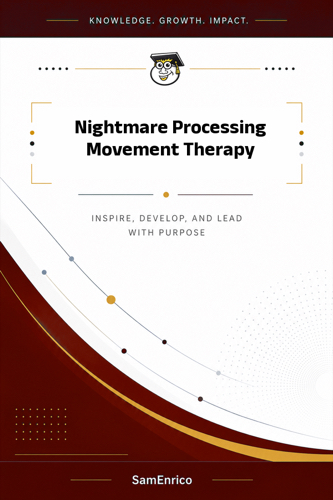
Nightmare Processing Movement Therapy eBook
Use dance and body awareness to process dream cont
by Larsen Ludie
Use dance and body awareness to process dream content.
Formats
Free sample
Chapter 1: The 3 AM Club...--You are not broken. You are not crazy. And you are not alone.If you are reading this book, chances are you know exactly what it feels like to jolt awake at 3:17 AM, heart hammering against your ribs, sheets soaked with sweat, the image of whatever was chasing you still burning behind your eyelids. You lie there in the dark, trying to convince your body that it was just a dream. But your body isn't listening.
Your hands are shaking. Your breath is shallow. Your jaw is clenched so tight your teeth ache. Somewhere in the house, a floorboard creaks, and you flinch.You wait for the panic to subside. Sometimes it does.
Sometimes it doesn't. And sometimes—the worst times—you drift back to sleep only to find yourself right back in the same nightmare, running down the same endless hallway, screaming the same silent scream.Morning comes. You're exhausted. Irritable. Haunted.So you do what everyone tells you to do.
You tell someone about it. You describe the dream in detail—the monster, the falling, the choking, the chase. You write it down in a dream journal. You analyze the symbols. You wonder what it "means." You might even bring it to a therapist, hoping that if you can just understand the nightmare, it will finally leave you alone.But it doesn't.
It comes back. Maybe not tonight, but soon. And when it does, it feels just as real, just as terrifying, just as inescapable as the first time.Here is the truth that no one has told you: talking about your nightmare is not helping you heal. In many cases, it is making the nightmare stronger.This is not your fault. You have been following the only advice our culture offers for dealing with psychological distress: name it, claim it, talk it through.
But nightmares do not operate by the rules of talk therapy. They operate by the rules of the body. And your body does not speak English.The Conversation That Never Ends Let me ask you something. Think of the nightmare that haunts you most. The one that shows up again and again, like an unwanted guest who knows where you hide the spare key.Now think about how many times you have told someone about it.
Your partner. Your best friend. Your therapist. Maybe you've typed it out in a forum or scribbled it into a journal by your bed. Each time, you described the same images, the same sequence, the same terrifying details.And each time, after the telling, did the nightmare feel smaller?
Or did it feel more real?For most people, the answer is the latter. And there is a neurological reason for this that has nothing to do with how smart you are or how hard you're trying.Every time you recite the narrative of your nightmare—"I was walking down a street, and then the sky turned black, and then something grabbed my ankle"—you are activating the same neural pathways that fire during the nightmare itself. The brain's language centers (Broca's area and Wernicke's area) are lighting up, yes. But so are the limbic structures that process fear: the amygdala, the hippocampus, the anterior cingulate cortex. You are quite literally rehearsing the terror.
You are telling your nervous system, This memory is important. Keep it. Rehearse it. Prepare for it to happen again.This is called reconsolidation, and it is one of the most counterintuitive discoveries in modern neuroscience. Every time you retrieve a memory, you have a brief window—a few hours—in which that memory becomes malleable.
It can be updated, rewritten, or even erased. But here's the catch: the way you retrieve the memory matters enormously. If you retrieve it as a story—a sequence of words and images—you are simply reinforcing the old pathway. The memory gets stronger, not weaker. The nightmare entrenches itself deeper into your neural architecture.But if you retrieve the memory through the body—through posture, sensation, and movement—you open a different door.
You access the memory not as a story to be told, but as an experience to be completed. And that changes everything.The Body's Secret Language Let me introduce you to a distinction that will become the foundation of everything in this book. It is the difference between declarative memory and procedural memory.Declarative memory is what most people think of when they think of memory. It is the "what" of experience. What happened.
Who was there. What color was the sky. What did the monster look like. This type of memory is stored in the neocortex, the wrinkled outer layer of your brain that handles language, logic, and conscious recall. Declarative memory is flexible, but it is also slow.
It requires effort to retrieve. And—here is the key—it is largely disconnected from your body's automatic responses.Procedural memory is different. Procedural memory is the "how" of experience. How your body responded. How your breath changed.
How your muscles tensed or froze. How your throat closed when you tried to scream. This type of memory is stored in the brainstem, the cerebellum, and the basal ganglia—ancient structures that evolved long before language. Procedural memory is automatic, fast, and deeply connected to survival. You do not have to "think" about how to pull your hand from a hot stove.
Your body just does it. That is procedural memory at work.Here is what most people—including most therapists—do not understand. Nightmares are primarily procedural memories, not declarative ones.When you wake up from a nightmare, the part of your brain that generates language is still coming online. The declarative memory of the dream—the story, the images, the sequence—is often fragmented, bizarre, or nonsensical. But the procedural memory is crystal clear.
Your body remembers exactly what it felt like to be chased. Your breath remembers the moment it got trapped in your chest. Your jaw remembers the clench of terror. Your legs remember the sensation of running in slow motion, of being unable to move fast enough.These are not metaphors. These are physiological events.
They are stored in your fascia, your muscles, your autonomic nervous system. And as long as that procedural memory remains incomplete—as long as your body believes it is still running, still fighting, still frozen—the nightmare will return.Because here is the brutal truth your nervous system operates on: an incomplete survival response is a nightmare that hasn't finished yet.Why Talking Makes It Worse (And Movement Makes It Better)Let me be very clear. I am not saying that talk therapy is useless. For many kinds of psychological distress—relationship issues, grief, identity questions, existential concerns—the ability to articulate and reflect on experience is profoundly healing. Language is one of humanity's greatest tools.But language is not the right tool for every job.
And it is demonstrably the wrong tool for completing a frozen survival response.When an animal in the wild is chased by a predator and escapes, it does not sit down afterward and tell the story of the chase. It does not analyze the symbolism of the…
This is the end of the free sample. Get the eBook to keep going. Buy now
About this book
Details
- Author
- Larsen Ludie
- Publisher
- SamEnrico
- Language
- English
- Genre
- Non-Fiction, Self-Help, Dance Therapy
- Released
- 2026-06-07
- Pages (approx.)
- 134
- Available as
- eBook, Audiobook

Read better in the ZLOADR app
Your eBooks on your phone or tablet. Sign in with your SamEnrico account and start reading.
More by Larsen Ludie
 Missionary Kid Identity RecoveryLarsen Ludie$11.99
 Anger De escalation for VeteransLarsen Ludie$11.99
 Medical Record RequestsLarsen Ludie$11.99
 Small Talk for Introverts WorkbookLarsen Ludie$11.99
 Math Study TechniquesLarsen Ludie$11.99
 Facial Composite SoftwareLarsen Ludie$11.99
 Control Loss TriggersLarsen Ludie$11.99
 The Rajah's Ransom: The 1892 Bombay Hostage Crisis and the Bollywood UnderworldLarsen Ludie$11.99
 Tipu's Last Stand: The Siege of Seringapatam (1799)Larsen Ludie$11.99
 How to Produce GPS MountsLarsen Ludie$11.99
 A Collector's Handbook to the Daimler LimousineLarsen Ludie$11.99
 Business Loan Prepayment Penalty GuideLarsen Ludie$12.99