
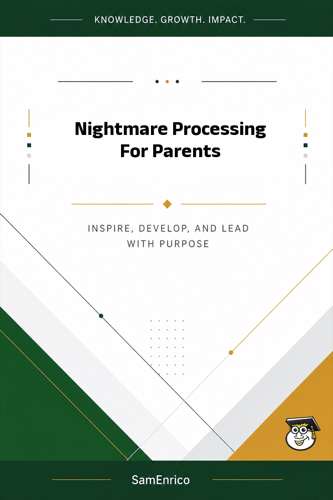
Nightmare Processing For Parents eBook
Help parents cope with dreams about harm to childr
Help parents cope with dreams about harm to children.
Formats
Free sample
Chapter 1: The 3 AM Spike...--I want you to imagine something specific. Not a memory, not a fear—an actual scene. It is 3:17 in the morning. You are not sure what woke you at first. Maybe a noise from down the hall, maybe nothing at all.
But then you feel it: your heart is slamming against your ribs like a trapped bird. Your T-shirt is damp with sweat even though the room is cool. You reach for your phone or the baby monitor or your partner's arm, and then the image hits you like a physical blow.Your child was falling. Off a balcony, down a staircase, into dark water. You watched it happen in slow motion.
You reached out but your arms turned to stone. You tried to scream but nothing came out. And then you woke up.Now you are lying in the dark, and your brain is doing what human brains evolved to do: it is asking whether this was a warning. Was that a premonition? Is something wrong with your child right now?
Should you get up and check? Should you wake them up just to see them breathe?You lie there for ten minutes. Twenty. An hour. The sun starts to lighten the edges of the curtains.
You have not gone back to sleep. You will go through tomorrow—today, now—on four hours of fractured rest, carrying the weight of an image that was never real but feels more real than anything.Here is what I need you to know before we go any further, before any techniques or explanations or worksheets: You are not broken. You are not secretly wishing harm on your child. You are not alone. And the dream you just had—the one that has your hands shaking as you read this—is not a prophecy.
It is a symptom. And symptoms can be treated.This book exists because no one wrote it for me when I needed it. I spent two years waking up at 3 AM convinced my daughter had stopped breathing, had fallen out a window, had been taken from a crowded room. I checked her monitor so many times I wore out the batteries. I stopped traveling for work because I was afraid to be in a hotel room without her.
I told no one, because what kind of mother dreams of her child being hurt?The kind who loves her child more than anything. That is the answer. That is the only answer.The Silent Epidemic Let me give you a number. In 2019, a research team at the University of Montreal surveyed over one thousand parents of children under the age of ten. They asked a simple question: have you ever had a dream in which your child was harmed, threatened, or in danger?
Sixty-eight percent said yes. Nearly seven out of ten.Here is the other number: among those parents, only three percent had ever mentioned these dreams to a doctor, a therapist, or even their partner.Think about that silence. Millions of parents are waking up in terror and never speaking a word of it. They are lying next to their sleeping partners, heart pounding, convinced they are monsters. They are sitting in pediatric waiting rooms, wanting to ask "Is my child safe?" but instead asking about fevers and rashes because the real question feels too shameful.I have spoken to parents who stopped co-sleeping because they were afraid they would hurt their child in their sleep—not because they ever had, but because their dreams were so violent they didn't trust themselves.
I have spoken to parents who developed rituals: checking the locks exactly seven times, reciting the same prayer every night, avoiding any news story about child safety because it might "feed" the dreams. I have spoken to parents who stopped sleeping altogether.This is the epidemic no one is naming. And it is not your fault.Why This Dream Feels Different You have had bad dreams before. Everyone has. The classic anxiety dream—showing up to a final exam you never studied for, realizing you are naked in public, being chased by something formless and terrifying.
Those dreams are unpleasant. They might leave you unsettled for an hour. But they do not leave you weeping in the bathroom at 3 AM, trying not to wake the baby.Here is why these dreams are different: they target the most biologically central purpose of your existence.From an evolutionary perspective, nothing matters more than keeping your offspring alive. A human child takes years to reach even basic self-sufficiency. For most of human history, a child left unattended for an hour was a dead child.
Your brain is not operating on modern logic. It is operating on savanna logic, where a rustle in the grass could be a predator and the cost of ignoring a false alarm is extinction.This is why your body reacts to a dream of your child falling the same way it would react to actually watching your child fall. Your ancient threat-detection system—a small, almond-shaped cluster of neurons called the amygdala—does not know the difference between a real event and a vividly imagined one. It receives the same sensory input from your brain's visual cortex, the same emotional signals from your hippocampus, and it sounds the same alarm.Cortisol floods your system. Adrenaline constricts your blood vessels.
Your heart rate spikes. You wake up in full fight-or-flight mode because your brain thinks you just lived through a trauma. The fact that the trauma happened entirely inside your own head is irrelevant to your nervous system. It felt real, so it is real, as far as your body is concerned.And then comes the second wave: shame.The Shame Factor"What kind of mother dreams of her child being hurt?"I have heard this question from hundreds of parents. Sometimes they whisper it.
Sometimes they sob it. Sometimes they say it with a hollow, exhausted flatness that is somehow worse than crying. But they always say it.Here is what you need to understand about that question: it confuses two completely different things. It confuses the content of your dreams with the content of your character.Your dreams are not chosen. You do not decide what to dream any more than you decide what to digest or what your hair color will be.
Dreams are the result of your brain's nightly process of memory consolidation, emotional regulation, and threat simulation. They are not secret wishes. They are not hidden desires. They are not messages from your unconscious about what you truly want.Let me say this as clearly as I can: dreaming that your child is hurt does not mean you want your child to be hurt. It does not mean you are a bad parent.
It does not mean you are dangerous. It means your brain is doing its job—poorly, painfully, but correctly according to its ancient programming.The shame you feel is real. It is heavy. But it is also misdirected. You are not ashamed of your dream because of what it says about you.
You are ashamed because you have internalized a cultural message that good parents never have scary thoughts about their children.…
This is the end of the free sample. Get the eBook to keep going. Buy now
About this book
Details
- Author
- Turpin Fransisca
- Publisher
- SamEnrico
- Language
- English
- Genre
- Non-Fiction, Self-Help, Parenting
- Released
- 2026-06-06
- Pages (approx.)
- 143
- Available as
- eBook, Audiobook

Read better in the ZLOADR app
Your eBooks on your phone or tablet. Sign in with your SamEnrico account and start reading.
More by Turpin Fransisca
 Membership Site GrowthTurpin Fransisca$11.99
 Prodigy Child Burnout RecoveryTurpin Fransisca$11.99
 GPS Device FailuresTurpin Fransisca$11.99
 The Three Question Rule ManualTurpin Fransisca$11.99
 Being Interrupted TriggerTurpin Fransisca$11.99
 Language Learning ShortcutsTurpin Fransisca$11.99
 Closing Argument StrategiesTurpin Fransisca$11.99
 Flying Fortresses: How Japan's Carrier Strike at Pearl Harbor Redefined Naval WarfareTurpin Fransisca$11.99
 John D. Rockefeller: The Titan of Industry and PhilanthropyTurpin Fransisca$11.99
 Understanding Williams SyndromeTurpin Fransisca$11.99
 How to Start a Amusement Guide Periodical Publishing Business (Beginners Guide)Turpin Fransisca$11.99
 How to Produce Sports Fan AccessoriesTurpin Fransisca$11.99
You may also like
 Hong Kong Handover 1997Dunn Johnnie$11.99
 Zumba For Postnatal Recovery CourseNeal Christian$11.99
 Zumba for BeginnersLadner Nikia$11.99
 YouTube Comment Mining GuideHumes Pandora$12.99
 Worry Box MeditationCarlin Rudy$11.99
 Workplace Stress MeditationNguyen Lynn$11.99
 Workplace Stress and Sleep RepairHawley Ivory$11.99
 Workplace Perfectionism CureDelaney Jeffry$11.99
 Workplace Injustice Anger GuideWallen Isabelle$11.99
 Work Addiction and Burnout LinkGreenwood Ester$11.99
 Women in Yoga and WellnessBeattie Galina$11.99
 Women in Stand Up ComedyChun Evangeline$11.99