
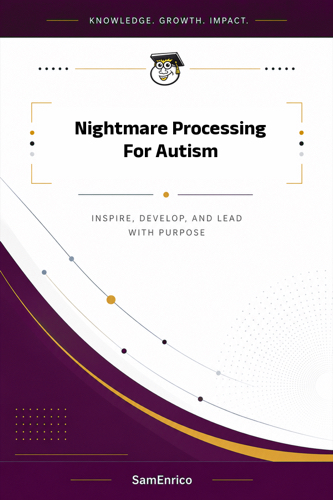
Nightmare Processing For Autism eBook
Adapt techniques for sensory and communication dif
Adapt techniques for sensory and communication differences.
Formats
Free sample
Chapter 1: The Silence After Screaming...--Every night, millions of autistic people wake up in terror, and every morning, they are asked a question they cannot answer: "What was your dream about?"The silence that follows is not stubbornness. It is not avoidance. It is not a failure of trust or a lack of vocabulary. It is the direct, predictable result of a neurological mismatch between how nightmares actually present in the autistic brain and how the world expects trauma to be processed. This chapter dismantles the single most damaging assumption in sleep medicine, trauma therapy, and parenting advice for autistic individuals: the belief that verbal recounting of nightmares is inherently therapeutic.
For a significant portion of the autistic population, being asked to "talk it out" after a nightmare does not bring relief. It brings shame, confusion, and a second wave of panic—not because the nightmare was too terrible to name, but because the act of naming requires neurological tools that may not be available in that moment.The standard protocols for nightmare treatment—Image Rehearsal Therapy (IRT), Cognitive Behavioral Therapy for Insomnia (CBT-I), and even simple "talk about it" parenting advice—all rest on a foundation of neurotypical assumptions about memory, emotion, and language. These assumptions are rarely stated aloud, which makes them invisible and therefore unassailable. But they are there, hiding in plain sight. The first assumption is that a nightmare has a narrative structure: a beginning, a middle, and an end.
The second assumption is that the dreamer can access that narrative and translate it into linear language. The third assumption is that the act of translation will reduce distress rather than amplify it. For many autistic individuals, all three assumptions are false.This chapter introduces the foundational concepts that will guide every intervention in this book. You will learn about alexithymia—the difficulty identifying and describing one's own emotions—and why it turns nightmares into physical "body flashbacks" rather than stories. You will encounter the "Sensory Storm" model, which reframes nightmares not as narratives to be decoded but as assaults on specific sensory channels.
And you will understand autistic inertia, the neurological phenomenon that explains why the "freeze" response in dreams mirrors waking shutdowns, making it nearly impossible to "fight back" even when lucid. By the end of this chapter, you will see nightmares—and the autistic response to them—in an entirely new light. And you will understand why the silence after screaming is not an emptiness waiting to be filled with words, but a different kind of language waiting to be learned.The Myth of the Tellable Nightmare Let us begin with a thought experiment. Imagine you are asked to describe the taste of salt water to someone who has never tasted it. You have the words: salty, briny, sharp, ocean-like.
But those words are not the experience. The experience is the sensation on your tongue, the slight sting in your throat, the memory of a wave hitting your face. Words are a translation, and translation loses data.Now imagine you are asked to describe the taste of salt water while also having a condition that makes it difficult to know what you are feeling in the first place. This is alexithymia. The word comes from Greek: *a* (without), lexis (words), thymos (emotion).
Without words for emotion. But that translation is slightly misleading. Alexithymia is not simply an inability to find the right words for feelings you clearly recognize. It is a difficulty knowing what you feel at all. People with alexithymia often cannot distinguish between fear and excitement, anger and hunger, sadness and exhaustion.
They feel something—a somatic disturbance, a change in heart rate, a pressure in the chest, a clenching of the jaw—but that something does not arrive with a label attached.Research estimates that approximately 50% of autistic individuals meet the diagnostic threshold for alexithymia, compared to about 10% of the general population. This is not a coincidence. The same neurological differences that shape autistic sensory processing and communication also shape interoception—the perception of internal body states. Interoception is what tells you that your stomach is growling (hunger), that your heart is racing (fear or excitement), that your muscles are tense (stress). When interoception is impaired, the body speaks in a language without a dictionary.Now apply this to nightmares.
A neurotypical person wakes from a nightmare and experiences a sequence: the memory of the dream (narrative), the emotion attached to that memory (fear), and the physical sensations that accompany that emotion (racing heart, sweating). For many autistic individuals with alexithymia, this sequence is scrambled or missing entirely. They wake with the physical sensations—racing heart, clenched jaw, sweating, nausea—but without the narrative. Or they wake with fragments: an image, a sound, a texture, a feeling of falling, but no story to contain these fragments. Or they wake with a clear memory of the dream's events but no ability to attach an emotion to those events, leaving them confused about why they feel so terrible.When a well-meaning partner, parent, or therapist asks "What was your dream about?" the autistic person faces an impossible task.
They must first determine if there is a narrative at all. Then they must translate that narrative (which may be sensory, not verbal) into linear language. Then they must attach emotion labels to experiences that arrived without labels. And they must do all of this while still in the physiological aftermath of a panic response, when the prefrontal cortex—the part of the brain responsible for language and sequencing—is partially offline.The result is silence. Or a single word: "Nothing." Or a meltdown triggered not by the nightmare but by the demand to explain it.
The silence is not resistance. It is neurological necessity.The Sensory Storm Model: Nightmares as Assault, Not Narrative If nightmares are not primarily narratives, what are they? This book proposes a new model: the Sensory Storm. Imagine a thunderstorm moving through your house. It does not have a plot.
It does not have a beginning, middle, and end that can be narrated. It has wind, rain, lightning, thunder, pressure changes, temperature drops. It assaults your senses simultaneously. Some storms are brief and intense. Others linger.
Some knock out power; others only rattle the windows.A nightmare, under this model, is a sensory storm that occurs during sleep. It attacks specific sensory channels:Tactile (Touch) Nightmares: Sensations of being grabbed, held down, falling, floating, pricked, burned, frozen, or crushed. The classic "falling" dream is tactile. So is the dream of being unable to move (sleep paralysis). So is the dream of something crawling on your skin.Auditory (Sound) Nightmares: Screaming, crashing, buzzing, ringing, whispering, footsteps, doors slamming, alarms, or the absence of expected sound (a silence that feels oppressive).
Many autistic people report that the sound of the nightmare is more distressing than the image.Visual (Sight) Nightmares: Flickering lights, looming shapes, faces that distort, patterns that crawl, darkness that feels solid, colors that are too bright or too muted, objects that grow or shrink.Proprioceptive (Body Position) Nightmares: Falling, floating, spinning, being pulled, being stretched, being crushed, the sensation of limbs not belonging to you, the feeling of moving in…
This is the end of the free sample. Get the eBook to keep going. Buy now
About this book
Details
- Author
- Carver Rosalind
- Publisher
- SamEnrico
- Language
- English
- Genre
- Non-Fiction, Self-Help, Autism
- Released
- 2026-06-07
- Pages (approx.)
- 155
- Available as
- eBook, Audiobook

Read better in the ZLOADR app
Your eBooks on your phone or tablet. Sign in with your SamEnrico account and start reading.
More by Carver Rosalind
 Real Estate PersuasionCarver Rosalind$11.99
 Alcoholic Parent RecoveryCarver Rosalind$11.99
 Online Learning Dubai GuideCarver Rosalind$11.99
 Low Carb Mindset RetrainingCarver Rosalind$11.99
 Swallowed by WildernessCarver Rosalind$11.99
 Trader Gambling AddictionCarver Rosalind$11.99
 Boundaries With FamilyCarver Rosalind$11.99
 The Iron Masters of Meroë: Forging an EmpireCarver Rosalind$11.99
 The Last Stand of the Righteous Fists: The Boxer Rebellion's Defiant UprisingCarver Rosalind$11.99
 How to Start a Engines for Forklift Trucks Business (Beginners Guide)Carver Rosalind$11.99
 How to Produce Golf Cart EnclosuresCarver Rosalind$11.99
 A Collector's Handbook to the Daimler Db18 Sports SpecialCarver Rosalind$11.99
You may also like
 Hong Kong Handover 1997Dunn Johnnie$11.99
 Zumba For Postnatal Recovery CourseNeal Christian$11.99
 Zumba for BeginnersLadner Nikia$11.99
 YouTube Comment Mining GuideHumes Pandora$12.99
 Worry Box MeditationCarlin Rudy$11.99
 Workplace Stress MeditationNguyen Lynn$11.99
 Workplace Stress and Sleep RepairHawley Ivory$11.99
 Workplace Perfectionism CureDelaney Jeffry$11.99
 Workplace Injustice Anger GuideWallen Isabelle$11.99
 Work Addiction and Burnout LinkGreenwood Ester$11.99
 Women in Yoga and WellnessBeattie Galina$11.99
 Women in Stand Up ComedyChun Evangeline$11.99