
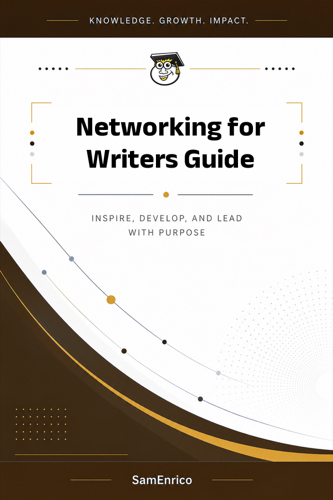
Networking for Writers Guide eBook
Connect with editors, publishers, and fellow autho
Connect with editors, publishers, and fellow authors for blurbs and reviews.
Formats
Free sample
Chapter 1: The Hidden Army--Most writers believe networking means handing out business cards at conferences, sending cold emails that get ignored, and feeling vaguely like a door-to-door salesperson in uncomfortable shoes. That belief is wrong. It is also the single biggest reason talented authors never get the blurbs, reviews, or professional connections their work deserves.Let me tell you about Sarah. She wrote a brilliant debut novel about three generations of Korean-American women. Her prose was stunning.
Her characters breathed. Her beta readers cried. Then she tried to get blurbs. She emailed twenty famous authors whose books she loved. She wrote passionate messages about how their work had changed her life.
She waited. Seventeen never replied. Two said they were too busy. One sent a polite "maybe next time." Sarah got zero blurbs. Her book launched quietly.
It sold fine. But it did not break out. And Sarah could not understand why.Here is what Sarah did not know: she was asking the wrong people, at the wrong time, in the wrong way. She did not understand the hidden army of publishing. She did not know that a commissioning editor and a copy editor are as different as a general and a cartographer.
She did not know that a professional blurb serves a completely different function than a reader review. She did not know that her beautiful, heartfelt emails were landing in the inboxes of people who could never say yes even if they wanted to.This chapter fixes that. By the time you finish reading, you will understand exactly how the publishing industry is structured, who does what, and why most networking failures happen before you ever type a single word. You will learn to distinguish the people who can actually grant your requests from the people who cannot. And you will leave with a simple but powerful framework called the Three Gates of Networking—a filter that will save you hundreds of hours of wasted effort.Let us begin by tearing down the most dangerous myth in publishing.The Myth of the Slush Pile Miracle Every writer has heard the story.
Some unknown genius submits a manuscript to a publisher. An editor plucks it from the slush pile at 3 AM. The book becomes a bestseller. The writer never had to talk to anyone. The work spoke for itself.That story is almost always fiction.In reality, the vast majority of traditionally published books—and nearly all successful self-published books—arrive at their audience through some form of networking.
An author met an editor at a conference. A critique partner introduced them to an agent. A blurb from a known writer caught a publisher's attention. A reviewer on Book Tok discovered the book because the author had built relationships in that community.This is not because publishing is corrupt or cliquish. It is because publishing professionals are drowning.
The average acquiring editor receives between fifty and two hundred queries per week. The average mid-list author receives ten to twenty blurb requests per month. The average publicist manages fifty books per season. These people are not gatekeepers guarding treasure. They are exhausted humans trying to do their jobs.
And they rely on signals—recommendations, social proof, familiar names—to separate what is worth their limited attention from what is not.Networking, properly understood, is not begging for favors. It is providing those signals. It is making yourself visible and trustworthy before you ask for anything. It is understanding the ecosystem well enough to approach the right person at the right time with the right request.But you cannot do any of that until you know who the right person is.Mapping the Hidden Army Let us walk through a publishing house. Imagine a medium-sized building with four floors.
Each floor contains different people doing different jobs. Most writers imagine that everyone in this building can help them. Most writers are wrong.On the top floor sit the commissioning editors and acquiring editors. These are the people who decide what books get published. They read proposals, attend meetings, and bet their budgets on manuscripts they believe in.
If you want a traditional publishing deal, these are the people you need to reach. But here is what most writers do not understand: commissioning editors rarely read unsolicited manuscripts. They rely on literary agents to filter submissions. And they rely on established authors to recommend new voices. A cold email from an unknown writer to a commissioning editor has approximately a 0.3 percent chance of being read.
A warm introduction from a published author has approximately a 40 percent chance of being read.One floor down sit the developmental editors. These are the people who work with authors after a book is acquired. They help shape structure, character arcs, pacing, and theme. They are incredibly valuable—once you have a deal. Before you have a deal, a developmental editor cannot help you.
They do not acquire books. They do not grant blurbs. They do not make introductions to acquiring editors. Emailing a developmental editor with a manuscript is like asking a race car driver to sell you tires. Wrong person.On the next floor sit the copy editors and proofreaders.
Copy editors fix grammar, consistency, and style. Proofreaders catch the final typos before a book goes to print. These are skilled professionals who do essential work. But they have absolutely no power to say yes to a manuscript, a blurb, or a review. Writers who send queries to copy editors are not networking.
They are wasting everyone's time.In the basement—figuratively and sometimes literally—sit the indexers, designers, and production staff. Indexers create the back-of-book index. Designers create the cover and interior layout. Production staff manage printing schedules. These people never, ever grant blurbs or acquire manuscripts.
They are not gatekeepers to anything a debut author needs. Yet writers constantly email them.Finally, scattered throughout the building are the publicists and marketing staff. These people promote books after they are published. They can be valuable allies once you have a book to promote. But they cannot get you a blurb.
They cannot get you a review before publication. They cannot introduce you to acquiring editors. Approaching a publicist with a manuscript is like asking a wedding planner to cater a funeral. Wrong event, wrong person.Here is the painful truth that transforms networking from random to strategic: you must know exactly what each person can and cannot do for you before you contact them. Most writers skip this step.
They fire off emails to anyone with a publishing-related job title. Then they wonder why no one replies.They do not reply because you asked the wrong person for the wrong thing.The Blurb Versus the Review: A Critical Distinction Before we go further, we need to clear up one of the most common and costly confusions in publishing. A blurb is not a review. A review is not a blurb. Using the wrong word with the wrong person can end a conversation before it starts.A blurb is a short endorsement from a recognized author or industry professional that appears on the back cover of your book.
It usually runs fifty to one hundred words. It says something like "A masterful debut—gripping, tender, and impossible to put…
This is the end of the free sample. Get the eBook to keep going. Buy now
About this book
Details
- Author
- Sargent Ardelia
- Publisher
- SamEnrico
- Language
- English
- Genre
- Non-Fiction, Self-Help, Writing
- Released
- 2026-06-09
- Pages (approx.)
- 127
- Available as
- eBook, Audiobook

Read better in the ZLOADR app
Your eBooks on your phone or tablet. Sign in with your SamEnrico account and start reading.
More by Sargent Ardelia
 Chiropractic vs Physical TherapySargent Ardelia$11.99
 MBSR Home Practice WorkbookSargent Ardelia$11.99
 The EQ for Lawyers GuideSargent Ardelia$11.99
 The Distressed Asset Capital GuideSargent Ardelia$11.99
 Shower Idea Ritual GuideSargent Ardelia$11.99
 NA Meetings DecodedSargent Ardelia$11.99
 Jackie KennedySargent Ardelia$11.99
 Whispers in the Rowan Tree: The Fairy Doctor's Last WarningSargent Ardelia$11.99Whispers in the Rowan Tree: The Fairy Doctor's Last WarningSargent Ardelia$11.99
 Sons of Odin: The Viking Storm That Shaped EuropeSargent Ardelia$11.99
 The Midnight Swap: The NBA's Most Shocking Trade Deadline DealSargent Ardelia$11.99
 GEPA Export LicenseSargent Ardelia$12.99
You may also like
 Hong Kong Handover 1997Dunn Johnnie$11.99
 Zumba For Postnatal Recovery CourseNeal Christian$11.99
 Zumba for BeginnersLadner Nikia$11.99
 YouTube Comment Mining GuideHumes Pandora$12.99
 Worry Box MeditationCarlin Rudy$11.99
 Workplace Stress MeditationNguyen Lynn$11.99
 Workplace Stress and Sleep RepairHawley Ivory$11.99
 Workplace Perfectionism CureDelaney Jeffry$11.99
 Workplace Injustice Anger GuideWallen Isabelle$11.99
 Work Addiction and Burnout LinkGreenwood Ester$11.99
 Women in Yoga and WellnessBeattie Galina$11.99
 Women in Stand Up ComedyChun Evangeline$11.99