
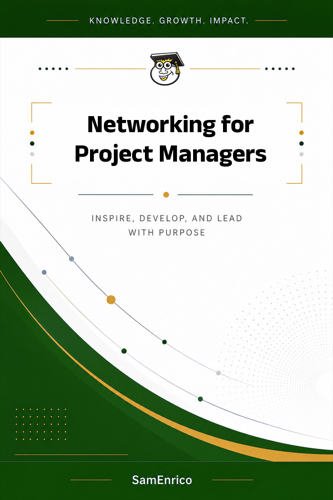
Networking for Project Managers eBook
Builds stakeholder and team relationships.
Builds stakeholder and team relationships.
Formats
Free sample
Chapter 1: The Authority Trap--The first time Maya realized her title meant nothing, she was standing in a conference room on the seventeenth floor of a glass tower in downtown Austin, holding a printed project charter that might as well have been written on tissue paper.She had spent two weeks building the perfect plan. Every dependency mapped. Every risk logged. Every milestone calibrated against the company’s quarterly OKRs. She had pulled three late nights refining the stakeholder register, cross-referencing every name against the org chart, color-coding each box by department, influence level, and required approval authority.
The document was fifty-seven pages of meticulous, defensible, flawless logic.The room held eleven people. Not one of them reported to her.“So here’s the timeline,” Maya said, clicking to the Gantt chart she had spent six hours formatting. “Development kicks off Monday. QA begins two weeks later. We need the data migration completed by end of month, which means the operations team will need to—”“We’re not doing that.”The voice came from the far end of the table.
Raj, head of operations. Fifty-two years old. Twenty-three years with the company. He had not opened the pre-read Maya had sent five days ago. He was not looking at her slide deck.
He was looking at his phone.Maya paused. “I’m sorry?”“The data migration.” Raj finally looked up. “We’re not doing it on your timeline. We have our own deliverables. Talk to my director.
Maybe we can fit you in sometime in Q3.”“But the charter clearly states—”“The charter,” Raj said, standing up, “is a document someone wrote in an office somewhere. I have a warehouse to run.”He walked out. Three other people followed him. The meeting lasted twelve more minutes, but it was over the moment Raj spoke. Maya packed her laptop, walked back to her cubicle, and sat in silence for a long time.
She had done everything right. Everything. And it had not mattered at all.That night, she called her mentor, a senior program manager named Diane who had survived fifteen years in the same matrixed hellscape.“You just learned something most PMs never figure out,” Diane said. “The title doesn’t work.”“Then what does?”“That’s the thing,” Diane said. “No one ever teaches you.”The Great Lie of Project Management Here is the secret that no certification exam will tell you, that no MBA program will admit, that no job description will ever print in fine print: project management, as it is taught, is a fiction.The textbooks describe a world where the project manager sits at the center of a tidy diagram.
Above, the sponsor provides air cover. Below, the team executes tasks. Beside, stakeholders offer input through orderly channels. Risk registers capture uncertainty. Communication plans specify exactly who gets which message on which day at which time.
It is clean. It is logical. It is a lie.The real world looks nothing like that diagram.In the real world, the project manager has responsibility for outcomes but authority over almost nothing. You cannot hire. You cannot fire.
You cannot give raises or promotions. You cannot reassign someone who is underperforming without negotiating with their functional manager, who has no incentive to help you. You cannot command. You cannot compel. You cannot demand.What you can do is ask.
And hope. And escalate. And wait.This is the Authority Trap. Every project manager falls into it eventually, usually around the third or fourth month of their first major assignment. They work harder.
They build better plans. They send more emails. They escalate to higher and higher levels of management, believing that if they just find the right person with the right title, someone will finally say “yes” and the machine will lurch back into motion.But the trap is this: the harder you lean on formal authority that does not exist, the less influence you actually have.Maya learned this the hard way. After the disaster with Raj, she escalated to her sponsor, a vice president named Henderson who had approved the project charter with great fanfare. Henderson sent a strongly worded email to Raj’s boss.
Raj’s boss had a conversation with Raj. Raj showed up to the next steering committee meeting, said all the right things, smiled at Maya, and then did exactly what he had planned to do all along—only now he did it quietly, without telling anyone, until the project was three weeks behind schedule and Maya had no idea why.That is the other thing about the Authority Trap. When you try to wield authority you do not have, people do not suddenly comply. They simply move underground. They stop telling you the truth.
They stop raising their hands when things go wrong. They smile at you in meetings and then go back to their desks and do what their real boss told them to do.And you never see the iceberg coming until you hit it.The Illusion of Control Let us be precise about what project managers actually control, because the gap between perception and reality is where careers go to die.You do not control budgets. You may have a line item in someone else’s cost center, but the actual spending authority belongs to a finance director who has never met your stakeholders and does not care about your timeline.You do not control headcount. Every person on your “team” reports to a functional manager who assigns them to your project as a favor, a loan, or a political obligation. That functional manager can pull them at any time, for any reason, with no notice, and you will discover it only when the daily standup report shows a missing name.You do not control promotions.
The people you depend on most will work for the ratings and raises their real boss controls. You are, at best, a secondary input—a box to check on a performance review form. “Seek feedback from project stakeholders.” That is all you are.You do not control priorities. Your project is one of twelve competing for the same people, the same budget cycles, the same executive attention. When something else catches fire—and something else will always catch fire—your project becomes invisible.
Not because anyone dislikes you. Because you do not have a title that commands visibility.Here is what you actually control: your calendar. Your email inbox. Your ability to ask questions. Your willingness to listen.
Your follow-through on small promises. The quality of your thank-yous. The accuracy of your documentation. The speed of your responses. Your reputation.That is it.Everything else is influence.
And influence is not granted by a title. Influence is earned, person by person, conversation by conversation, deposit by deposit.The $50 Million Mistake There is a case study that every PM eventually hears, passed around in Slack channels and Reddit threads like a ghost story. It is true, more or less, though the names have been changed to protect the catastrophically embarrassed.A global retailer decided to replace its entire inventory management system. The project was enormous—three years, fifty million dollars, a team of over two…
This is the end of the free sample. Get the eBook to keep going. Buy now
About this book
Details
- Author
- Deal Christene
- Publisher
- SamEnrico
- Language
- English
- Genre
- Non-Fiction, Self-Help, Project
- Released
- 2026-06-05
- Pages (approx.)
- 149
- Available as
- eBook, Audiobook

Read better in the ZLOADR app
Your eBooks on your phone or tablet. Sign in with your SamEnrico account and start reading.
More by Deal Christene
 Mindful Commute PracticeDeal Christene$11.99
 Vegan Nail Health GuideDeal Christene$11.99
 Active Listening for Sales ProfessionalsDeal Christene$11.99
 Winter Walking For SADDeal Christene$11.99
 Fear of Failure in SalesDeal Christene$11.99
 Anger De escalation for KidsDeal Christene$11.99
 Low Carb Diet Transformation WorkbookDeal Christene$11.99
 The Billion-Dollar Broadcast: How Soccer Rights Redefined Global MediaDeal Christene$11.99
 The Tsar's Golden Age: Peter the Great and the Birth of Modern RussiaDeal Christene$11.99
 Service Providers Guide to Grocery Shopping ServicesDeal Christene$11.99
 A Collector's Handbook to the Mercedes-benz 170vDeal Christene$11.99
 How to Start a Paper and Paperboard Coating, Covering and Impregnation Business (Beginners Guide)Deal Christene$11.99
You may also like
 Success Without Burnout for Project ManagersCowley Siobhan$11.99
 Creative Habits for Project ManagersAdcock Misha$11.99
 Growth Mindset for Project ManagersMears Sherrell$11.99
 Prioritization for Project ManagersGatewood Hortense$11.99
 SMART Goals for Project ManagementMccaskill Kathyrn$11.99
 Resilience for Project ManagersPate Layne$11.99
 Remote Work for Project ManagersMacias Farrah$11.99
 Personal Branding for Project ManagersWaters Betsy$11.99
 Morning Routine for Project ManagersPepper Adaline$11.99
 Improv for Project ManagersLarge Janessa$11.99
 Group Creativity for Project ManagersCruse Georgiann$11.99
 Fear of Failure for Project ManagersLacey Digna$11.99