
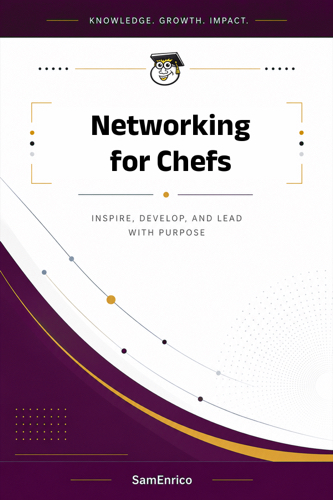
Networking for Chefs eBook
Builds supplier and farmer relationships.
Builds supplier and farmer relationships.
Formats
Free sample
Chapter 1: The Invoice Lie...--–- The first lie a young chef learns is written on an invoice. It arrives clipped to a cardboard box, usually on a Tuesday, usually just before the lunch rush. The paper says: Product: Roma Tomatoes, Case. Price: $24.99. Total Due: $24.99.
And the lie is this: that tomatoes cost $24.99. They do not. That is merely the price of the transaction. The true cost—the one that sinks restaurants, the one that turns six-day workweeks into seven, the one that leaves chefs screaming into walk-in freezers—is the cost of *not knowing anyone*. The young chef does not know that the farmer who grew those tomatoes woke up at 3:47 AM to irrigate before a heatwave.
She does not know that the distributor who trucked them across three state lines paid the driver $0.38 per mile and lost money on the route. She does not know that the tomatoes sitting in that box were picked green, gassed pink, and designed to survive a semi-trailer, not a palate. And because she does not know these things, she cannot do the one thing that separates profitable restaurants from dying ones: she cannot talk to anyone when something goes wrong.The tomato box arrives with twenty percent of its contents smashed. The distributor says, "File a claim in seven to ten business days." The farmer is a phone number she does not have. The invoice is paid anyway, because the salad station is already backed up.
This happens three hundred times a year. Each time, the restaurant bleeds a little more margin. Each time, the chef tells herself this is just how food works.It is not.This book exists to dismantle that assumption, brick by brick. It is not a sourcing guide, though you will learn where to find farmers. It is not a negotiation manual, though you will learn how to talk about money.
It is, instead, a radical reorientation: a proposal that a chef’s most valuable inventory is not the protein in the cooler or the produce in the walk-in, but the network that fills those spaces. The premise is simple. The execution is brutal. And it begins with unlearning everything you think you know about price.The Economics of Loneliness Restaurant procurement in the United States operates on a model of engineered isolation. The broadline distributor—Sysco, US Foods, PFG—exists to insert itself between the chef and the source.
This is not a conspiracy; it is logistics. A single distributor can consolidate orders from fifty farms, ten protein processors, and three dairy operations, then deliver them to two hundred restaurants on a single truck. The efficiency is astonishing. The cost, measured only in dollars, is low. But the cost, measured in relationships, is devastating.Consider the anatomy of a typical transaction.
A chef orders thirty cases of kale from a distributor’s online portal. The kale arrives. It is acceptable, but not great. The chef pays. The distributor’s algorithm registers the purchase and automatically reorders the same quantity for next week.
No human speaks to another human. The farmer who grew that kale—let us call her Maria—never learns that the chef would prefer smaller leaves. The chef never learns that Maria’s kale fields are located next to a pollinator habitat that gives the leaves a slightly peppery note worth marketing. Neither party learns anything that would make the other’s life easier or the product better.This is what we will call the Transaction Trap. It feels like efficiency.
It is actually atrophy. Every time a chef treats an ingredient as a commodity—something interchangeable, something whose only relevant feature is price—the chef loses a tiny piece of leverage. Not leverage to bargain down prices, but leverage to solve problems. When the truck breaks down, the chef with the distributor’s 1-800 number waits on hold. The chef with Maria’s cell phone gets kale from the farmer’s own pickup truck within the hour.
When a late frost wipes out Maria’s early tomato crop, the chef who has never called her receives nothing. The chef who called last month to say "I loved those tomatoes, please plant double next year" receives an apologetic text at 6:00 AM: "Crop lost. But my neighbor has extra. Want me to introduce you?"That is the difference. That is the invoice lie.
The tomatoes never cost $24.99. They cost $24.99 plus the cost of having no one to call during a crisis. And that second cost, unmeasured and unacknowledged, is usually higher than the first.The Case Study That Changed My Mind Before we go further, let me tell you about a chef named Elena. She ran a fifty-seat farm-to-table restaurant in the Hudson Valley, the kind of place where the menu changed weekly and the waitlist ran three weeks deep. Elena was a brilliant cook but a terrible purchaser.
She believed, with the fervor of a convert, in "the best ingredients." She paid $18 per pound for butter from a specific creamery. She flew in olive oil from Sicily. She bought heirloom beans from a purveyor in Oregon. Her food costs ran thirty-eight percent, which in fine dining is not insane, but her margins were razor-thin. She was working seventy hours a week and taking home less than her line cooks.Then, in July of her third year, a drought hit the Northeast.
Her distributor, the one she had used for years, sent an email: "Due to supply constraints, heirloom tomato orders will be reduced by 60%. No substitutions available." Elena panicked. Her signature salad—the one food critics had praised as "a summer on a plate"—depended on three varieties of heirloom tomatoes: Green Zebra, Cherokee Purple, and Brandywine. Without them, she would have to scrap the dish, reprint menus, and disappoint the reservations who had booked specifically for that salad.She spent a morning calling every distributor in her network. Nothing.
She spent an afternoon driving to farmers’ markets, arriving at closing time, begging for leftovers. She found a few cases, paid cash, felt like a hero.The next week, the same thing happened. And the week after that.What Elena discovered, through sheer exhaustion, was that one of the farmers at the market—a quiet woman named Darlene who sold mostly at a tiny roadside stand—had been growing heirloom tomatoes for twenty years. Darlene did not sell to distributors because they paid too slowly. She sold directly to restaurants, but only to chefs she knew personally.
Elena had never met her because Elena had never bothered to look past her distributor’s portal.Elena drove to Darlene’s farm. She brought pastries. She walked the fields. She asked Darlene about her irrigation system, her pest management, her harvest windows. She listened for two hours.
At the end, Darlene said, "I can give you twenty cases a week through September. But you have to take the ugly ones too. The squirrels got to some of them, but the flavor is fine."Elena agreed. She paid Darlene the same price she had paid her distributor—$32 per case, slightly above market rate. She ran the ugly tomatoes through her food processor and turned them into a passata…
This is the end of the free sample. Get the eBook to keep going. Buy now
About this book
Details
- Author
- Hanes Kristal
- Publisher
- SamEnrico
- Language
- English
- Genre
- Non-Fiction, Self-Help, Culinary
- Released
- 2026-06-06
- Pages (approx.)
- 135
- Available as
- eBook, Audiobook

Read better in the ZLOADR app
Your eBooks on your phone or tablet. Sign in with your SamEnrico account and start reading.
More by Hanes Kristal
 Gluten Free Vegan GuideHanes Kristal$11.99
 The Social Auto PurchaseHanes Kristal$11.99
 Two to One BreathHanes Kristal$11.99
 Anger De escalation in CourtHanes Kristal$11.99
 Mastering Active Listening Core SkillsHanes Kristal$11.99
 Morning Nature TimeHanes Kristal$11.99
 Remote Work Time Blocking GuideHanes Kristal$11.99
 The Siege of Hōjōjō: A Samurai's Last StandHanes Kristal$11.99
 The Iron Tide: How One Man Built a Shipping Empire from ScratchHanes Kristal$11.99
 Service Providers Guide to GiveawaysHanes Kristal$11.99
 A Collector's Handbook to the Mercedes-benz 230.6Hanes Kristal$11.99
 Collarbone Tap TechniqueHanes Kristal$12.99
You may also like
 Hong Kong Handover 1997Dunn Johnnie$11.99
 Zumba For Postnatal Recovery CourseNeal Christian$11.99
 Zumba for BeginnersLadner Nikia$11.99
 YouTube Comment Mining GuideHumes Pandora$12.99
 Worry Box MeditationCarlin Rudy$11.99
 Workplace Stress MeditationNguyen Lynn$11.99
 Workplace Stress and Sleep RepairHawley Ivory$11.99
 Workplace Perfectionism CureDelaney Jeffry$11.99
 Workplace Injustice Anger GuideWallen Isabelle$11.99
 Work Addiction and Burnout LinkGreenwood Ester$11.99
 Women in Yoga and WellnessBeattie Galina$11.99
 Women in Stand Up ComedyChun Evangeline$11.99