
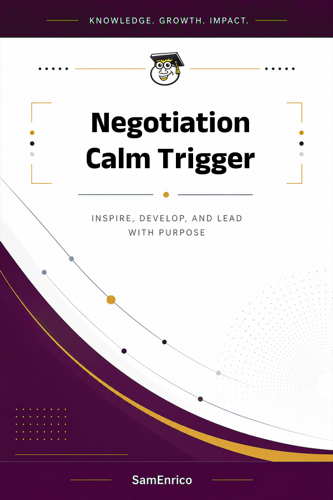
Negotiation Calm Trigger eBook
Post hypnotic anchor for remaining composed during
Post hypnotic anchor for remaining composed during negotiations.
Formats
Free sample
Chapter 1: The 0.3-Second War...--You are already losing before you know the battle has begun.Consider the last time a negotiation turned against you. Not the one where you were outsmarted or out-prepared—but the one where you felt perfectly ready, rehearsed your talking points, knew your BATNA, and still walked out wondering what happened. You said something you immediately regretted. You agreed to a term that made no sense in retrospect. You heard yourself making a concession and felt like a passenger in your own body.You did not lose because you lacked tactics.
You lost because, for 0.3 seconds, you were not home.This chapter reveals the hidden architecture of every negotiation failure: a neurological event so fast that you cannot feel it happening, yet so consequential that it determines every word that follows. Understanding this event is not optional. It is the foundation upon which the entire Negotiation Calm Trigger is built. Without this knowledge, the anchor is just a ritual. With it, the anchor becomes a weapon.The Moment Before the Flinch In 1974, a young Israeli psychologist named Daniel Kahneman was running a simple experiment that would eventually win him a Nobel Prize.
He asked participants to place one hand in painfully cold water—14 degrees Celsius, just above freezing—and the other hand in mildly uncomfortable water. Then he asked them to place one hand in the cold water for sixty seconds, followed by an additional thirty seconds during which the water was slowly warmed to a less painful temperature. When given the choice to repeat either the sixty-second trial or the ninety-second trial—the latter including thirty seconds of slightly reduced pain—participants overwhelmingly chose the longer trial.This made no logical sense. The ninety-second trial contained all the pain of the sixty-second trial plus thirty additional seconds of discomfort. Yet the human brain, Kahneman discovered, does not remember pain as a sum.
It remembers two moments: the peak of the pain and the end of the pain. The duration is nearly irrelevant. He called this the peak-end rule, and it revealed something profound about the architecture of human experience: we do not live in continuous time. We live in snapshots.Negotiation is no different.When you recall a negotiation that went wrong, you do not replay every sentence. You remember two things: the moment of maximum stress—often a specific word, an unexpected silence, or a sudden ultimatum—and how the negotiation ended.
Everything else dissolves. This is not a memory failure. It is a feature of how the brain processes threat. The amygdala, that small cluster of neurons deep in the temporal lobe, does not record experiences like a video camera. It records threat intensity.
And it records it fast.The Speed of Betrayal Here is the number that will change how you understand every high-stakes conversation you will ever have: 300 milliseconds.That is the upper bound of the amygdala hijack. In three-tenths of one second, your brain can detect a potential threat, activate the sympathetic nervous system, flood your bloodstream with cortisol and adrenaline, and begin shutting down access to the prefrontal cortex—the part of your brain responsible for logic, creativity, language, impulse control, and strategic thinking. Three hundred milliseconds is faster than a blink. It is faster than the time it takes to register surprise on your face. It is so fast that by the time you consciously notice that your heart is racing, the hijack has already completed its work.Let me repeat that for emphasis: by the time you feel the flinch, the damage is already done.Dr.
Joseph Le Doux, the neuroscientist who mapped the amygdala's threat-detection pathway at New York University, discovered something even more unsettling. There are two routes from sensory input to emotional output. The low road runs directly from the thalamus to the amygdala in approximately 100 milliseconds. This route is fast but stupid—it cannot distinguish between a gunshot and a car backfire. The high road runs from the thalamus to the cortex for processing, then to the amygdala, taking approximately 500 milliseconds.
This route is slow but smart—it can tell the difference between a genuine threat and a false alarm.Here is the problem: by the time the smart route has determined that the lowball offer is not actually a physical threat, the dumb route has already flooded your system with stress hormones. You are already compromised. Your voice has already changed. Your face has already revealed something. Your next sentence has already been shaped by a brain that thinks it is about to die.This is the 0.3-second war.
It is fought before you know you are fighting. And until now, you have been losing it every single time.The Hostage Negotiator's Secret In 1993, FBI negotiator Chris Voss was standing outside a bank in Brooklyn where two men had taken eleven employees hostage. The scene was chaos: SWAT teams, flashing lights, the low thrum of helicopters overhead. Voss's job was to establish a dialogue with the lead hostage-taker, a man named Luis who had already fired a weapon into the ceiling. Every instinct in Voss's body screamed for speed—get him talking, extract information, find leverage.
But Voss had learned something that most negotiators never understand: speed is not your friend. The amygdala hijack works both ways.Voss slowed down. He dropped his voice. He paused for long, uncomfortable silences. He repeated Luis's words back to him in a flat, calm monotone.
And over the course of fourteen hours, Luis went from screaming threats to whispering surrender. Voss did not out-argue him. He did not out-logic him. He simply refused to let Luis's amygdala hijack his own.What Voss understood implicitly—and what neuroscience has since confirmed—is that the amygdala hijack is contagious. When Luis yelled, Voss's brain wanted to yell back or retreat or freeze.
That is the three-part response to threat: fight, flight, or freeze. Every negotiation is, at its core, a threat-management exercise. The stakes may be money or custody or territory or respect, but the brain processes all of them through the same ancient circuitry. The hostage negotiator's secret is not special tactics. It is the ability to keep the prefrontal cortex online while the other person's is shutting down.You do not need to be an FBI negotiator to learn this skill.
You need to understand the timing.The Five-Second Window If the hijack takes 300 milliseconds, and the smart route takes 500 milliseconds, then the critical window—the moment when you can still intervene—is approximately 200 milliseconds wide. That is shorter than a single heartbeat. You cannot consciously decide to do anything in 200 milliseconds. Conscious thought requires the prefrontal cortex, which is precisely what the hijack is shutting down. This creates an apparent paradox: you need your prefrontal cortex to stop the hijack, but the hijack shuts down your prefrontal cortex.The solution to this paradox is the central insight of this book: you must bypass the prefrontal cortex entirely.The hijack operates on the body before the mind knows what is happening.
Therefore, the intervention must also operate on the body before the mind gets involved. You cannot think your way out of a hijack. You…
This is the end of the free sample. Get the eBook to keep going. Buy now
About this book
Details
- Author
- Martindale Keva
- Publisher
- SamEnrico
- Language
- English
- Genre
- Non-Fiction, Self-Help, Negotiation
- Released
- 2026-06-10
- Pages (approx.)
- 137
- Available as
- eBook, Audiobook

Read better in the ZLOADR app
Your eBooks on your phone or tablet. Sign in with your SamEnrico account and start reading.
More by Martindale Keva
 PCOS Lab Testing GuideMartindale Keva$11.99
 TM for Parents GuideMartindale Keva$11.99
 The Empathy for Suicidal Feelings GuideMartindale Keva$11.99
 Cloud Infrastructure Spending GuideMartindale Keva$11.99
 The Beast of Manchester: Britain's Forgotten Serial KillerMartindale Keva$11.99
 Understanding Penttinen–aula SyndromeMartindale Keva$17.99
 Stripe Webhook Configuration GuideMartindale Keva$12.99
 Oxford NanoporeMartindale Keva$12.99
 How to Start a Hobby in TerrariumsMartindale Keva$11.99
 Random Forest OperatorMartindale Keva$11.99
You may also like
 The Negotiation Table MapBest Leighann$11.99
 The Assertive Request FormulaFarrar Emogene$11.99
 NVC In Business NegotiationLink Shalonda$11.99
 Improv for NegotiationCantrell Elene$11.99
 Negotiation Nonverbal Strategy GuidePeralta Isabelle$11.99
 Negotiation Assertiveness GuideGarcia Jaime$11.99
 Imposter Syndrome and Salary NegotiationTovar Chassidy$11.99
 The No Blame Conversation MethodCantu Latosha$11.99
 The Door in Face Negotiation TacticBohn Sha$11.99
 The Contrast Persuasion GuideLouis Claude$11.99
 Persuasion for NegotiationsFinley Yajaira$11.99
 Personal Ing For Success Negotiation LeverageFogle Nakisha$11.99