
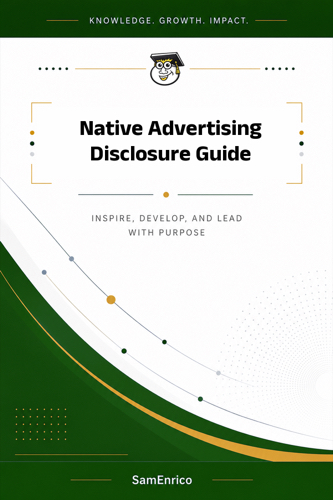
Non-FictionAnnual CheckupNative Advertising
Native Advertising Disclosure Guide
Label sponsored content that matches the look of o
Label sponsored content that matches the look of organic posts.
Formats
About this book
Free sample
Chapter 1: The Deception Paradox...--–- On a Tuesday morning in March 2024, a 34-year-old mother of two named Sarah scrolled through her Instagram feed while waiting for her coffee to brew. She stopped on a video of a lifestyle influencer she followed—a cheerful woman her own age, sitting in a kitchen remarkably similar to Sarah's own, holding up a green juice powder. The influencer said she drank it every morning, that it had cleared her skin, boosted her energy, and helped her lose the "last ten pounds of baby weight." The video felt authentic. It looked organic. There was no banner ad, no "sponsored" label flashing across the screen, no interruption to the natural flow of content.
Sarah clicked the link in the influencer's bio and bought three canisters for $89. What Sarah did not know—what she could not have known—was that the influencer had been paid $12,000 for that single video. The green juice company had also sent her an all-expenses-paid trip to a wellness retreat in Costa Rica. And the disclosure? It was there, technically.
Buried in the twenty-seventh line of the caption, behind the "more" button that 93% of viewers never tap. A single gray word: "#sp." Sarah never saw it. Neither did the other 847,000 people who watched that video. And that, in the simplest possible terms, is the deception paradox that this entire book exists to solve.This is not a hypothetical scenario. In October 2024, the Federal Trade Commission issued a warning letter to a supplement brand whose influencer campaign generated $2.4 million in sales from undisclosed native advertising.
The influencers used "#sp" or placed disclosure at the very end of long captions. The FTC argued that an ordinary consumer—someone scrolling quickly, watching without sound, or reading only the first two lines of a caption—would have no reasonable way to know the content was paid. The brand settled for $340,000. The influencers received individual fines ranging from $8,000 to $22,000. And every single one of them said the same thing in their defense: "I thought I was following the rules."The problem is not bad actors.
The problem is a fundamental misunderstanding of what native advertising actually is, how disclosure works, and why the FTC has…
This is the end of the free sample. Get the eBook to keep going. Buy now
Contents
- Chapter 1
- Chapter 2
- Chapter 3
- Chapter 4
- Chapter 5
- Chapter 6
- Chapter 7
- Chapter 8
- Chapter 9
- Chapter 10
- Chapter 11
- Chapter 12
Details
- Author
- Staggs Susannah
- Publisher
- SamEnrico
- Language
- English
- Genre
- Non-Fiction, Annual Checkup, Native Advertising
- Released
- 2026-06-11
- Pages (approx.)
- 155
- Available as
- eBook, Audiobook

Read better in the ZLOADR app
Your eBooks on your phone or tablet. Sign in with your SamEnrico account and start reading.
More by Staggs Susannah
 The Tiny House Retirement OptionStaggs Susannah$11.99
 Operation Car Wash Corruption OlympicsStaggs Susannah$11.99
 Governor's Prison ReformStaggs Susannah$11.99
 Journaling for Goal AchievementStaggs Susannah$11.99
 The Hollow Howl: When the Wolves SpokeStaggs Susannah$11.99
 Engineering ManagerStaggs Susannah$11.99
 A Beginners Guide to Blood Feud in New York (Volume 1)Staggs Susannah$11.99
 Money Shame Rewire WorkbookStaggs Susannah$12.99
 B2B Buying Committee EvolutionStaggs Susannah$12.99
 Understanding Intrinsic Factor, Congenital Deficiency OfStaggs Susannah$17.99
You may also like
 Hong Kong Handover 1997Dunn Johnnie$11.99
 Zumba For Postnatal Recovery CourseNeal Christian$11.99
 Zumba for BeginnersLadner Nikia$11.99
 YouTube Comment Mining GuideHumes Pandora$12.99
 Worry Box MeditationCarlin Rudy$11.99
 Workplace Stress MeditationNguyen Lynn$11.99
 Workplace Stress and Sleep RepairHawley Ivory$11.99
 Workplace Perfectionism CureDelaney Jeffry$11.99
 Workplace Injustice Anger GuideWallen Isabelle$11.99
 Work Addiction and Burnout LinkGreenwood Ester$11.99
 Women in Yoga and WellnessBeattie Galina$11.99
 Women in Stand Up ComedyChun Evangeline$11.99