
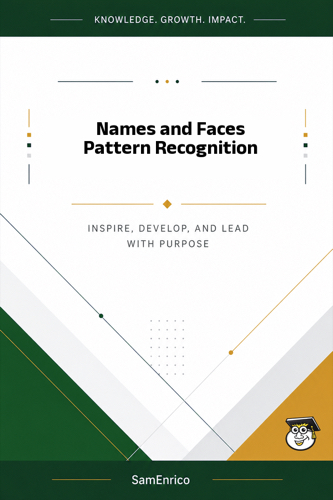
Names and Faces Pattern Recognition eBook
Spot visual patterns to remember names with this p
by Haney Tania
Spot visual patterns to remember names with this practical guide.
Formats
Free sample
Chapter 1: The 60-Second Thief--You have just met someone new. They extended a hand, smiled, and said, “Hi, I’m Sarah.” You said your name in return. You nodded. The conversation moved on. And within ten seconds—before the handshake was even complete—you had already begun to forget her name.This is not a failure of character.
It is not a sign of laziness, low intelligence, or social awkwardness. It is a predictable, well-documented feature of how the human brain processes information under social pressure. And once you understand why it happens, you can stop apologizing for it and start fixing it.Let us begin with an uncomfortable exercise. Think back to the last social event you attended—a party, a work meeting, a networking mixer, a wedding reception. Picture the room.
Now try to name, out loud or on paper, the last five people you were introduced to. Do not count people you already knew. Count only the strangers whose names you heard for the first time that night.If you are like the vast majority of human beings, you cannot do it. You remember faces, sure. You remember where they stood, what they wore, maybe even what you talked about.
But the names? They have vanished. Not faded. Not buried. Vanished—as if they were never there at all.Here is the truth that most memory books are afraid to tell you: forgetting a name within seconds of hearing it is not abnormal.
It is the default setting. Your brain is wired to forget. The question is not “Why am I so bad at this?” The question is “What am I supposed to do differently in the first minute?”The Sweetest Sound That Slips Away In his legendary book How to Win Friends and Influence People, Dale Carnegie made a simple but profound claim: “A person’s name is, to that person, the sweetest and most important sound in any language.” Carnegie was not a neuroscientist, but he was a brilliant observer of human nature. He understood that hearing your own name triggers a small burst of validation, a moment of being seen. When someone remembers your name, you feel respected.
When someone forgets it, you feel—if only for an instant—invisible.Yet here is the paradox that Carnegie himself never fully solved: the same brain that craves the sound of its own name is remarkably bad at remembering the names of others. Why? Because names are arbitrary. Unlike a face, which is rich with visual information (shape, color, texture, expression), a name is an abstract label. “Sarah” has no shape.
“Miller” has no color. “Takeshi” has no texture. Your brain evolved to remember faces because faces helped you identify friend from foe, tribe from outsider. Your brain did not evolve to remember arbitrary sound-labels attached to those faces. The two systems—visual recognition and verbal recall—are not well-connected inside your skull.
That disconnection is the source of nearly every embarrassing “I know your face but not your name” moment you have ever experienced.But there is more going on here than biology. There is also the specific social situation in which names are delivered. An introduction is not a calm, focused learning environment. It is a high-stakes, split-second performance.The Spotlight of Attention Imagine you are at a networking event. Someone approaches you.
You shake hands. And in that single moment, your brain is trying to do six things at once:First, you are monitoring your own appearance. Is my handshake too firm? Too weak? Am I smiling enough?
Too much? Second, you are listening to the other person’s name—but only with the part of your brain that processes sound passively, not actively. Third, you are already rehearsing your own name, because you know you are about to say it. Fourth, you are scanning the room over their shoulder, because humans are hardwired to be aware of their social environment. Fifth, you are thinking about what to say next to avoid an awkward silence.
Sixth, you are managing your own anxiety, which secretly worries that you will forget their name before the conversation ends.This divided attention is not a personal flaw. It is a universal condition of human social interaction. Cognitive psychologists call this phenomenon the Spotlight of Attention. The spotlight is not infinite. It can only illuminate one or two things at a time.
And during an introduction, that spotlight is pointed everywhere except where it needs to be: on the new name.Let us break down the three most common saboteurs that steal your attention during an introduction.Saboteur 1: Social Anxiety Social anxiety does not mean you are shy or introverted. It means your brain is running a background program that asks, “How am I being perceived?” This is not vanity; it is survival. Humans are social animals, and being accepted by the group once meant literal survival. So when you meet someone new, a small part of your brain shifts focus away from their name and onto your own performance. Am I standing correctly?
Is my smile natural? Did I just say something weird? This internal self-monitoring is so automatic that you do not even notice it happening. But it consumes precious attention that should have been used to encode “Sarah.”Saboteur 2: The Next-in-Line Effect Here is a cruel trick of the brain: when you know you are about to speak, your cognitive resources shift toward preparing your own output. In a group introduction, while others are saying their names, you are silently rehearsing yours.
“I’m John. I’m John. Don’t forget. I’m John.” This is called the next-in-line effect, and it has been documented in dozens of psychological studies. The person who speaks right before you?
You will forget their name almost instantly. Not because you are rude, but because your brain was busy being the next in line.Saboteur 3: Environmental Multitasking Finally, your brain is constantly scanning for threats, opportunities, and changes in the environment. During an introduction, you might notice someone else entering the room, a phone buzzing, a drink being spilled across the table, or any of a hundred irrelevant stimuli. Each micro-distraction steals a tiny slice of attention. And names, being fragile and abstract, are the first thing to drop out when attention fragments.The cumulative effect of these three saboteurs is devastating.
By the time the handshake ends, you have already lost the name. Not forgotten it hours later. Lost it immediately.The 60-Second Window Here is the single most important concept in this entire book, and the foundation upon which every subsequent chapter is built.Memory is not a single thing. It is a process with distinct stages. The first stage is immediate memory, sometimes called sensory memory.
This lasts for less than a second. It is the echo of a sound after it has stopped. The second stage is short-term memory, which lasts for about 15 to 30 seconds without active maintenance. This is where names first land. And the third stage is long-term memory, where information can be stored for hours, days, or years.Here is the catch: information does not automatically move from short-term to long-term memory.
It requires either deep processing (thinking about meaning, connections, or images) or active repetition. Without one of those two things…
This is the end of the free sample. Get the eBook to keep going. Buy now
About this book
Details
- Author
- Haney Tania
- Publisher
- SamEnrico
- Language
- English
- Genre
- Non-Fiction, Self-Help, Social Memory
- Released
- 2026-06-06
- Pages (approx.)
- 118
- Available as
- eBook, Audiobook

Read better in the ZLOADR app
Your eBooks on your phone or tablet. Sign in with your SamEnrico account and start reading.
More by Haney Tania
 Thunberg Global South JusticeHaney Tania$11.99
 Transcranial Magnetic StimulationHaney Tania$11.99
 The Food Scale GuideHaney Tania$11.99
 Improv for HR ProfessionalsHaney Tania$11.99
 Supplier Lead Time MLHaney Tania$11.99
 Self Esteem Identity Outside WorkHaney Tania$11.99
 Boundary Setting for EmpathsHaney Tania$11.99
 The Poisoned Vintage: The Deadly Deception of Victorian Wine FraudHaney Tania$11.99
 The Brush and the Battle: Healing Through Art in Colonial AustraliaHaney Tania$11.99
 How to Become a BarberHaney Tania$11.99
 Bull Terriers: The Egg-headed CompanionHaney Tania$11.99
 A Collector's Handbook to the Toyota 1000 (Publica)Haney Tania$11.99
You may also like
 Mnemonic Name Recall GuideMcgill Sena$11.99
 Name Recall For SeniorsPost Ivory$11.99
 Birthday Palace MethodStovall Wilfredo$11.99
 Name Recall Palace GuideMinton Thanh$11.99
 Birthday Memory PegsLoomis Gena$11.99
 Name to Face Memory GuideJanssen Collin$11.99
 Memory Palace for NamesDew Maud$11.99
 Names and Faces Memory SystemButterfield Kimbery$11.99
 Name Chunking Memory SystemMarks Deeanna$11.99
 Memory Palace For Names FacesRafferty Arnoldo$11.99
 Chunking Names And FacesDollar Dell$11.99
 Chunking for Names and FacesBrandt Georgette$11.99