
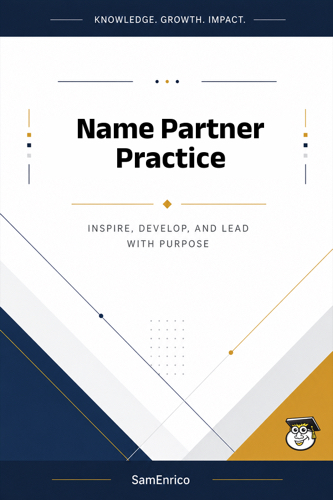
Non-FictionSelf-HelpAccountability
Name Partner Practice eBook
Quiz each other on names during social events.
Quiz each other on names during social events.
Formats
Free sample
Chapter 1: The Forgetting Curve...--–- The party was in full swing when I saw him. A senior vice president at the largest firm in my industry, a man I had met twice before, each time for over an hour. He was walking directly toward me, smiling, hand already extending. I had exactly four seconds to recall his name. My brain, which had effortlessly remembered the lyrics to a mediocre 1990s song from the car ride over, produced nothing.
Not a syllable. Not a hint. Just the hot, rising flush of panic and the quiet, devastating certainty that I was about to look like a fool.“Great to see you again,” he said.I shook his hand and said, “You too.”That was it. I didn’t use his name because I didn’t know it. I couldn’t introduce him to the colleague standing next to me, so I just let the silence hang.
He stayed for three more minutes, asked me two questions about my work, nodded politely, and left. Later that night, his name came back to me in a flash of useless, posthumous clarity: David. It had been David the whole time. David, who had introduced me to his wife at the last conference. David, who had offered to make an introduction to a hard-to-reach client.
David, whose name I had heard, repeated, and still lost.That was the moment I stopped telling myself the lie that most of us tell: “I’m just bad with names.”The Lie We All Tell Ourselves There is a strange comfort in saying “I’m bad with names.” It sounds like a confession, but it functions as an excuse. It says: This is not my fault. This is my nature. You cannot expect me to remember because my brain simply does not work that way.But here is the truth that no one tells you at those networking events, cocktail parties, and family reunions where you circle back to the same person three times hoping someone else will say their name first: You are not bad with names. You have never been bad with names.
You have simply never had a system.Let me prove it to you.Think about the last time you started a new job. Within two weeks, you probably knew the names of fifteen or twenty coworkers. You learned the name of the person in the cubicle next to you, the manager who schedules the Monday meetings, the quiet woman from accounting who always brings her dog to work. You did not use memory palaces or elaborate mnemonics. You learned those names because you heard them repeatedly, in context, with consequences attached.
Forgetting your manager’s name would be embarrassing. Forgetting the dog’s name? Less so.Now think about a party you attended last month. You met eight or ten new people. How many names do you remember today?
If you are like most people, the number is somewhere between zero and two. Not because you are lazy or unintelligent, but because the conditions for learning were completely different. At work, names are repeated, reinforced, and tied to roles. At a party, names are spoken once, drowned out by music, interrupted by a drink order, and then never heard again.The difference is not in your brain. The difference is in the environment and the process.This chapter is the foundation of everything that follows.
You cannot build a name partner system on a misunderstanding of how memory actually works. So we are going to start with the science, but not the kind of science that puts you to sleep. We are going to talk about why names slip, why your brain seems to betray you at the worst possible moments, and why almost every popular book on memory has missed the single most important factor: retrieval practice with accountability.By the end of this chapter, you will understand exactly why you forget names, and more importantly, you will never blame yourself for it again. Because forgetting is not a character flaw. It is a predictable, measurable, and fixable pattern.Cognitive Load: Why Your Brain Drops the Ball Imagine you are at a cocktail party.
You are holding a drink in one hand and a small plate of cheese in the other. The room is warm. The music is loud enough to be annoying but not loud enough to drown out conversation, which means your brain is working overtime to filter sound. You scan the room for familiar faces while also trying not to spill red wine on your shirt.Then someone approaches. You do not know them.
They say, “Hi, I’m Sarah.”In that single moment, your brain is juggling approximately seven different tasks simultaneously. You are monitoring your body language, processing ambient noise, keeping track of your drink, thinking about what to say next, noticing what Sarah is wearing, deciding whether to shake her hand, and somewhere in the background, attempting to store the name “Sarah” in memory.This is called cognitive load. It is the total amount of mental effort being used in your working memory at any given time. And here is the cruel reality: working memory is not infinite. In fact, it is famously small.
The psychologist George Miller proposed in 1956 that the average human can hold only about seven items in working memory at once. More recent research suggests the number is closer to four. Four items.At the moment of introduction, you are already holding at least five items: the environment, your physical state, social anxiety, the person’s face, and your upcoming response. The name does not have a dedicated slot. The name is fighting for space against the cheese plate.And the cheese plate usually wins.This is not a personal failing.
This is a fundamental limitation of human neurobiology. Your brain prioritizes survival and immediate physical navigation over arbitrary social data. A name is arbitrary social data. Unless you give it special treatment, it will be overwritten within seconds.I want you to run a small experiment right now. Do not skip this.
It will take thirty seconds.Think of the last person you met for the first time. It could have been a barista, a new neighbor, someone at a meeting. Now, without looking at your phone, try to recall their name. Do you have it?If yes, good. Now try to recall the color of their shirt.
The exact color. Not “blue” but “navy blue with white stripes.” Do you have that?Most people remember the name better than the shirt color, but neither is reliable. That is because your brain was busy with other things. It was not being lazy. It was being efficient.
Efficiency, unfortunately, is the enemy of name retention.The Baker/Baker Paradox: Why Meaning Matters Here is a famous experiment in memory research. Researchers gave two groups of people the same photograph of a man. The first group was told, “This is Mr. Baker.” The second group was told, “This is a baker.” Later, both groups were asked to recall the word associated with the photograph.The results were striking. The group that was told “This is a baker”…
This is the end of the free sample. Get the eBook to keep going. Buy now
About this book
Details
- Author
- Cambell Hillary
- Publisher
- SamEnrico
- Language
- English
- Genre
- Non-Fiction, Self-Help, Accountability
- Released
- 2026-06-09
- Pages (approx.)
- 147
- Available as
- eBook, Audiobook

Read better in the ZLOADR app
Your eBooks on your phone or tablet. Sign in with your SamEnrico account and start reading.
More by Cambell Hillary
 The Retirement Housing Cost CalculatorCambell Hillary$11.99
 Layoff Conversation GuideCambell Hillary$11.99
 Quality Time Stress ReconnectionCambell Hillary$11.99
 Event Based Pricing GuideCambell Hillary$11.99
 The Computer RefurbisherCambell Hillary$11.99
 OKRs for Product ManagersCambell Hillary$11.99
 Compulsive Spending And ADHDCambell Hillary$11.99
 The Healing Hands of the Nile: The Love and Legacy of Merit-PtahCambell Hillary$11.99
 The Ballarat Roadhouse Murders: Blood on the Victorian GoldfieldsCambell Hillary$11.99
 Service Providers Guide to Motorcycle ServiceCambell Hillary$11.99
 How to Produce Karaoke System AccessoriesCambell Hillary$11.99
 API Authentication Deep DiveCambell Hillary$12.99
You may also like
 Hong Kong Handover 1997Dunn Johnnie$11.99
 Zumba For Postnatal Recovery CourseNeal Christian$11.99
 Zumba for BeginnersLadner Nikia$11.99
 YouTube Comment Mining GuideHumes Pandora$12.99
 Worry Box MeditationCarlin Rudy$11.99
 Workplace Stress MeditationNguyen Lynn$11.99
 Workplace Stress and Sleep RepairHawley Ivory$11.99
 Workplace Perfectionism CureDelaney Jeffry$11.99
 Workplace Injustice Anger GuideWallen Isabelle$11.99
 Work Addiction and Burnout LinkGreenwood Ester$11.99
 Women in Yoga and WellnessBeattie Galina$11.99
 Women in Stand Up ComedyChun Evangeline$11.99