
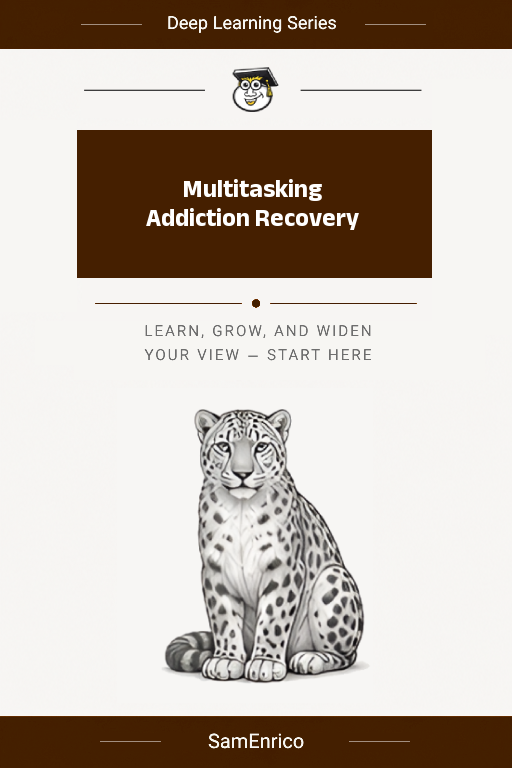
Non-FictionMental WealthAttention Training
Multitasking Addiction Recovery eBook
Break the habit of rapid app switching with single
Break the habit of rapid app switching with single window protocols that rebuild sustained attention.
Formats
Free sample
Chapter 1: The Dopamine Faucet--–- Emma, a 34-year-old project manager, sat down at her desk at 8:47 AM on a Tuesday. She had three hours before her first deadline. She opened her email. Then Slack. Then a spreadsheet.
Then a news tab. Then back to email. Then her calendar. Then Instagram. Then back to the spreadsheet.
By 9:15 AM—twenty-eight minutes later—she had switched windows forty-seven times. She had not written a single sentence of the report due at noon. At 5:00 PM, she packed up her laptop, drove home, and cried in her car because she had accomplished nothing. She was not lazy. She was not stupid.
She was addicted to the act of switching itself.This is not a book about willpower. It is not a book about meditation, digital detoxes, or moving to a cabin in the woods. It is a book about a faucet—a neurochemical faucet that lives inside your skull, and every time you switch from one window to another, you turn that faucet on. A tiny drip of dopamine lands on your brain’s reward center. It feels like progress.
It feels like productivity. It feels like you are doing something.But you are not doing anything. You are just switching.The Neuroscience of the Click Every human brain evolved on the savannahs of Africa, where novelty was rare and survival depended on noticing the unusual. A rustle in the grass might be a lion. A change in the wind might mean rain.
The brain developed a reward system—dopamine—that lit up whenever something new appeared. This system kept our ancestors alive.Modern technology has reverse-engineered that system.Dr. Anders Hansen, author of The Attention Fix, explains it bluntly: “Your brain is a Stone Age organ living in a space age world.” The dopamine pathway that once helped you spot a predator now fires when you see a notification badge. The novelty-seeking instinct that once led you to a new berry patch now drives you to refresh Twitter for the eleventh time in an hour.But here is the crucial distinction that most books get wrong. Not all switching is equal.
Not all dopamine is addictive. And understanding the difference between healthy novelty-seeking and compulsive window switching is the foundation of recovery.The Hierarchy of Switching Before we go any further, let me introduce a framework that will govern everything in this book. I call it the Hierarchy of Switching, and it will resolve every confusion you have ever had about whether you “should” be allowed to switch or not.Type A Switching: Addictive Switching (Forbidden)This is unconscious, reward-driven, task-avoidant behavior. You do not decide to switch. You simply find yourself on a different website, in a different app, with no memory of having made a choice.
The cue is boredom or difficulty. The craving is relief. The response is the click. The reward is a micro-dose of dopamine. Examples: checking news while writing a report, opening social media during a spreadsheet, refreshing email for the fifth time in ten minutes.Type B Switching: Necessary Switching (Allowed with Protocol)This is intentional, logged, and executed via a deliberate handoff.
You decide to switch. You write down where you are leaving off. You know exactly why you are switching and what you will do when you return. Examples: copying data from a PDF to an email, moving a figure from one document to another, checking a reference source that you specifically need.Type C Switching: Maintenance Switching (Batch Only)This is checking communication tools—Slack, email, Teams, text messages. You do not do this reactively.
You schedule specific windows (Chapter 7) and only switch during those windows. Outside of those windows, Type C switching is treated as Type A.Absolute Social Rule: No switching of any kind during face-to-face human interaction. There is no handoff that redeems looking at your phone while your partner is talking. (Chapter 10)For the rest of this chapter, we are focused entirely on Type A switching—the addictive kind. This is the faucet.
This is the enemy. This is what brought Emma to tears in her car.The Variable Reward Slot Machine Why does checking your email feel exactly like pulling a slot machine lever? Because it is structurally identical.In the 1940s, psychologist B.F. Skinner placed a hungry pigeon in a box with a button. Every time the pigeon pecked the button, a food pellet dropped.
The pigeon pecked consistently but showed no particular excitement. Then Skinner changed the mechanism. Instead of delivering a pellet every time, he delivered a pellet sometimes—randomly, unpredictably. The pigeon went insane. It pecked faster, harder, obsessively.
It developed superstitious rituals. It pecked, turned around, pecked again, bobbed its head. The variable reward schedule had hijacked the pigeon’s brain.Your inbox is a variable reward slot machine. Most of the time, you open it and find nothing urgent—just spam, newsletters, routine updates. But sometimes, unpredictably, there is something important.
An offer. A compliment. A crisis. Your brain cannot predict which time will be the jackpot, so it keeps pulling the lever. Every fifteen minutes.
Every five minutes. Every sixty seconds.Anna Lembke, author of Dopamine Nation, calls this the “dopamine overstimulation cycle.” Every time you get a reward—even a small one—your brain recalibrates. It raises the threshold for future pleasure. What used to feel satisfying becomes boring. So you need more switching.
More tabs. More novelty. More dopamine. The faucet turns from a drip to a stream.But here is the cruel irony: the dopamine you get from switching is not the dopamine of accomplishment. It is the dopamine of anticipation.
The pleasure is not in finishing the report. The pleasure is in the moment just before you click the next tab—the promise of something better on the other side.And that promise is almost always a lie.The Cost of the Click Let me tell you about a study that should terrify you.Researchers at the University of California, Irvine, led by Professor Gloria Mark, followed knowledge workers in their natural environments. They discovered that the average worker switches tasks every forty seconds. Forty seconds. That is not enough time to read a single paragraph carefully, let alone solve a complex problem.But the real shock came when they measured how long it took to return to a task after a distraction.
The answer: twenty-three minutes.Twenty-three minutes to fully re-engage with what you were doing before you checked that Slack message. Twenty-three minutes of cognitive friction, of mental gear-grinding, of your brain trying to remember where you left off and what you were thinking and what you planned to do next.That is the Switch Cost. And it is the single most expensive tax you pay every day.Worse, even when you switch back quickly, you never fully return. Mark’s research identified a phenomenon called Attention Residue. When you leave Task A to work on Task B, a portion of your cognitive capacity—about forty percent—remains stuck on Task A.
You are not fully present for Task B. You are not fully present for Task A when you return. You are split. Fragmented.…
This is the end of the free sample. Get the eBook to keep going. Buy now
About this book
Details
- Author
- Easterling Kathlyn
- Publisher
- SamEnrico
- Language
- English
- Genre
- Non-Fiction, Mental Wealth, Attention Training
- Released
- 2026-06-01
- Pages (approx.)
- 118
- Available as
- eBook, Audiobook

Read better in the ZLOADR app
Your eBooks on your phone or tablet. Sign in with your SamEnrico account and start reading.
More by Easterling Kathlyn
 The Rent Stress GuideEasterling Kathlyn$11.99
 Transcendental Meditation PrimerEasterling Kathlyn$11.99
 Outsourcing for Busy ParentsEasterling Kathlyn$11.99
 Fear of Failure in ActivismEasterling Kathlyn$11.99
 HGH Secretagogue IngredientsEasterling Kathlyn$11.99
 Micro Flow States GuideEasterling Kathlyn$11.99
 Prenup Stress ManagementEasterling Kathlyn$11.99
 Nicotine Master GuideEasterling Kathlyn$11.99
 The Maestros of the African Diaspora: Composers Who Shaped Classical MusicEasterling Kathlyn$11.99
 From Vines to Victory: The Pioneers of Australian WineEasterling Kathlyn$11.99
 The Essential Guide to SwingEasterling Kathlyn$11.99
 How to Start a Management Consultancy Business (Beginners Guide)Easterling Kathlyn$11.99
You may also like
 Hong Kong Handover 1997Dunn Johnnie$11.99
 Zumba For Postnatal Recovery CourseNeal Christian$11.99
 Zumba for BeginnersLadner Nikia$11.99
 YouTube Comment Mining GuideHumes Pandora$12.99
 Worry Box MeditationCarlin Rudy$11.99
 Workplace Stress MeditationNguyen Lynn$11.99
 Workplace Stress and Sleep RepairHawley Ivory$11.99
 Workplace Perfectionism CureDelaney Jeffry$11.99
 Workplace Injustice Anger GuideWallen Isabelle$11.99
 Work Addiction and Burnout LinkGreenwood Ester$11.99
 Women in Yoga and WellnessBeattie Galina$11.99
 Women in Stand Up ComedyChun Evangeline$11.99